Your car could soon warn you of danger ahead: India plans V2V safety mandate from 2028
India is preparing to mandate Vehicle-to-Vehicle (V2V) communication in new vehicles from 2028, a move aimed at improving road safety by enabling real-time communication between vehicles to prevent accidents.
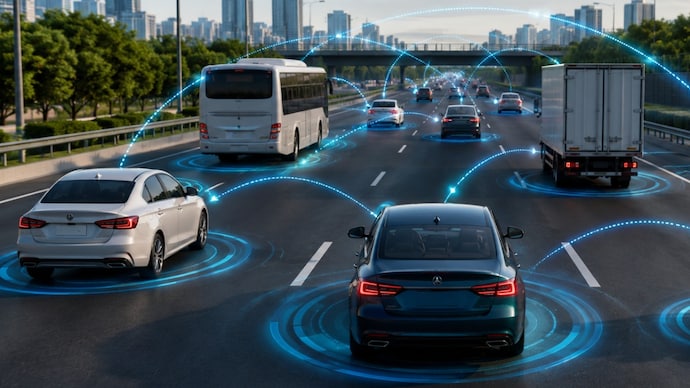
Cars in India could soon be able to talk to each other as the government moves to introduce Vehicle-to-Vehicle (V2V) communication technology. The Ministry of Road Transport and Highways (MoRTH) has proposed making the safety feature mandatory in new vehicles from October 1, 2028, through a phased rollout aimed at improving road safety and enabling connected mobility.
The proposal, issued through a draft amendment to the Central Motor Vehicles Rules (CMVR), 1989, outlines a roadmap under which passenger vehicles, commercial vehicles and two-wheelers will gradually adopt V2V technology. If implemented, the regulation could fundamentally change the way vehicles interact on Indian roads by enabling them to exchange safety-related information in real time.
What is V2V communication?
V2V, or Vehicle-to-Vehicle communication, allows nearby vehicles to wirelessly share information such as their speed, location, direction of travel and acceleration. By continuously exchanging this data, vehicles can detect potential hazards much earlier than conventional safety systems, allowing drivers or electronic safety systems to react before a dangerous situation develops.
Unlike camera- or radar-based systems that are limited by the driver's field of view, V2V technology can warn motorists about incidents occurring beyond visible traffic. For example, it can alert a driver about a vehicle braking suddenly several cars ahead, a wrong-way vehicle approaching, an emergency vehicle closing in or a neighbouring vehicle making an unsafe lane change, even when these are obscured by traffic or road geometry.
The technology is expected to complement Advanced Driver Assistance Systems (ADAS) and play a key role in the evolution of intelligent and connected transportation.
Two-stage implementation plan
The proposal outlines a phased two-step implementation plan.
- From October 1, 2027: All newly manufactured Category L, M and N vehicles equipped with Vehicle-to-Vehicle (V2V) communication systems must ensure those systems comply with the AIS-230 standard. However, fitting V2V technology itself will remain optional at this stage.
- From October 1, 2028: V2V communication systems meeting AIS-230 standards will become mandatory for all newly manufactured vehicles in Categories L, M and N.
The proposal covers the following vehicle classes:
- Category L: Two-wheelers and three-wheelers
- Category M: Passenger vehicles, including cars and buses
- Category N: Goods vehicles, trucks
The staggered implementation is intended to provide manufacturers, suppliers and other stakeholders adequate time to develop, validate and integrate the new technology into future products.
AIS-230: India's new V2V standard
At the centre of the proposal is AIS-230, India's dedicated technical standard governing Vehicle-to-Vehicle communication.
The standard lays down the minimum technical, functional, environmental, cybersecurity and performance requirements for V2V systems operating in India. It is based on factory-fitted On-Board Units (OBUs) using Cellular Vehicle-to-Everything (C-V2X) technology operating in the 5.875 GHz to 5.925 GHz spectrum.
The move follows the Department of Telecommunications' decision to exempt this spectrum band from licensing requirements through a notification issued on June 10, 2026, clearing the path for commercial deployment.
AIS-230 covers several technical parameters, including:
- Radio transmission performance
- Frequency stability
- Receiver sensitivity and selectivity
- GNSS-based positioning accuracy
- Electrical and power supply requirements
- Electromagnetic compatibility
- Cybersecurity and secure communication protocols
- Performance standards for road safety applications
Safety applications
The proposed standard is designed to support multiple connected safety functions that can be introduced in phases. Among the first applications planned are:
- Emergency Brake Alert
- Forward Collision Warning
- Wrong-way Driving Alert
- Emergency Vehicle Alert
These features aim to improve a driver's situational awareness by delivering advance warnings during critical driving scenarios, helping reduce the likelihood of collisions.
The proposal stems from recommendations made by the government's Task Force on Intelligent Transportation Systems (ITS), which advocated adopting the globally recognised 5.9 GHz V2X communication band to improve road safety and support future mobility technologies.
AIS-230 was subsequently reviewed by the Central Motor Vehicles Rules – Technical Standing Committee during its 56th meeting held on May 7, 2026, before being recommended as the technical framework for nationwide implementation.
The draft notification has now been released for public consultation. Stakeholders can submit comments and suggestions within 30 days, after which the ministry will review the feedback before issuing the final notification.
If notified in its current form, the regulation will represent one of India's most significant policy moves towards connected vehicles, paving the way for safer roads, smarter traffic management and the broader adoption of intelligent transportation systems.
Subscribe to Auto Today Magazine
Cars in India could soon be able to talk to each other as the government moves to introduce Vehicle-to-Vehicle (V2V) communication technology. The Ministry of Road Transport and Highways (MoRTH) has proposed making the safety feature mandatory in new vehicles from October 1, 2028, through a phased rollout aimed at improving road safety and enabling connected mobility.
The proposal, issued through a draft amendment to the Central Motor Vehicles Rules (CMVR), 1989, outlines a roadmap under which passenger vehicles, commercial vehicles and two-wheelers will gradually adopt V2V technology. If implemented, the regulation could fundamentally change the way vehicles interact on Indian roads by enabling them to exchange safety-related information in real time.
What is V2V communication?
V2V, or Vehicle-to-Vehicle communication, allows nearby vehicles to wirelessly share information such as their speed, location, direction of travel and acceleration. By continuously exchanging this data, vehicles can detect potential hazards much earlier than conventional safety systems, allowing drivers or electronic safety systems to react before a dangerous situation develops.
Unlike camera- or radar-based systems that are limited by the driver's field of view, V2V technology can warn motorists about incidents occurring beyond visible traffic. For example, it can alert a driver about a vehicle braking suddenly several cars ahead, a wrong-way vehicle approaching, an emergency vehicle closing in or a neighbouring vehicle making an unsafe lane change, even when these are obscured by traffic or road geometry.
The technology is expected to complement Advanced Driver Assistance Systems (ADAS) and play a key role in the evolution of intelligent and connected transportation.
Two-stage implementation plan
The proposal outlines a phased two-step implementation plan.
- From October 1, 2027: All newly manufactured Category L, M and N vehicles equipped with Vehicle-to-Vehicle (V2V) communication systems must ensure those systems comply with the AIS-230 standard. However, fitting V2V technology itself will remain optional at this stage.
- From October 1, 2028: V2V communication systems meeting AIS-230 standards will become mandatory for all newly manufactured vehicles in Categories L, M and N.
The proposal covers the following vehicle classes:
- Category L: Two-wheelers and three-wheelers
- Category M: Passenger vehicles, including cars and buses
- Category N: Goods vehicles, trucks
The staggered implementation is intended to provide manufacturers, suppliers and other stakeholders adequate time to develop, validate and integrate the new technology into future products.
AIS-230: India's new V2V standard
At the centre of the proposal is AIS-230, India's dedicated technical standard governing Vehicle-to-Vehicle communication.
The standard lays down the minimum technical, functional, environmental, cybersecurity and performance requirements for V2V systems operating in India. It is based on factory-fitted On-Board Units (OBUs) using Cellular Vehicle-to-Everything (C-V2X) technology operating in the 5.875 GHz to 5.925 GHz spectrum.
The move follows the Department of Telecommunications' decision to exempt this spectrum band from licensing requirements through a notification issued on June 10, 2026, clearing the path for commercial deployment.
AIS-230 covers several technical parameters, including:
- Radio transmission performance
- Frequency stability
- Receiver sensitivity and selectivity
- GNSS-based positioning accuracy
- Electrical and power supply requirements
- Electromagnetic compatibility
- Cybersecurity and secure communication protocols
- Performance standards for road safety applications
Safety applications
The proposed standard is designed to support multiple connected safety functions that can be introduced in phases. Among the first applications planned are:
- Emergency Brake Alert
- Forward Collision Warning
- Wrong-way Driving Alert
- Emergency Vehicle Alert
These features aim to improve a driver's situational awareness by delivering advance warnings during critical driving scenarios, helping reduce the likelihood of collisions.
The proposal stems from recommendations made by the government's Task Force on Intelligent Transportation Systems (ITS), which advocated adopting the globally recognised 5.9 GHz V2X communication band to improve road safety and support future mobility technologies.
AIS-230 was subsequently reviewed by the Central Motor Vehicles Rules – Technical Standing Committee during its 56th meeting held on May 7, 2026, before being recommended as the technical framework for nationwide implementation.
The draft notification has now been released for public consultation. Stakeholders can submit comments and suggestions within 30 days, after which the ministry will review the feedback before issuing the final notification.
If notified in its current form, the regulation will represent one of India's most significant policy moves towards connected vehicles, paving the way for safer roads, smarter traffic management and the broader adoption of intelligent transportation systems.
Subscribe to Auto Today Magazine
Cars in India could soon be able to talk to each other as the government moves to introduce Vehicle-to-Vehicle (V2V) communication technology. The Ministry of Road Transport and Highways (MoRTH) has proposed making the safety feature mandatory in new vehicles from October 1, 2028, through a phased rollout aimed at improving road safety and enabling connected mobility.
The proposal, issued through a draft amendment to the Central Motor Vehicles Rules (CMVR), 1989, outlines a roadmap under which passenger vehicles, commercial vehicles and two-wheelers will gradually adopt V2V technology. If implemented, the regulation could fundamentally change the way vehicles interact on Indian roads by enabling them to exchange safety-related information in real time.
What is V2V communication?
V2V, or Vehicle-to-Vehicle communication, allows nearby vehicles to wirelessly share information such as their speed, location, direction of travel and acceleration. By continuously exchanging this data, vehicles can detect potential hazards much earlier than conventional safety systems, allowing drivers or electronic safety systems to react before a dangerous situation develops.
Unlike camera- or radar-based systems that are limited by the driver's field of view, V2V technology can warn motorists about incidents occurring beyond visible traffic. For example, it can alert a driver about a vehicle braking suddenly several cars ahead, a wrong-way vehicle approaching, an emergency vehicle closing in or a neighbouring vehicle making an unsafe lane change, even when these are obscured by traffic or road geometry.
The technology is expected to complement Advanced Driver Assistance Systems (ADAS) and play a key role in the evolution of intelligent and connected transportation.
Two-stage implementation plan
The proposal outlines a phased two-step implementation plan.
- From October 1, 2027: All newly manufactured Category L, M and N vehicles equipped with Vehicle-to-Vehicle (V2V) communication systems must ensure those systems comply with the AIS-230 standard. However, fitting V2V technology itself will remain optional at this stage.
- From October 1, 2028: V2V communication systems meeting AIS-230 standards will become mandatory for all newly manufactured vehicles in Categories L, M and N.
The proposal covers the following vehicle classes:
- Category L: Two-wheelers and three-wheelers
- Category M: Passenger vehicles, including cars and buses
- Category N: Goods vehicles, trucks
The staggered implementation is intended to provide manufacturers, suppliers and other stakeholders adequate time to develop, validate and integrate the new technology into future products.
AIS-230: India's new V2V standard
At the centre of the proposal is AIS-230, India's dedicated technical standard governing Vehicle-to-Vehicle communication.
The standard lays down the minimum technical, functional, environmental, cybersecurity and performance requirements for V2V systems operating in India. It is based on factory-fitted On-Board Units (OBUs) using Cellular Vehicle-to-Everything (C-V2X) technology operating in the 5.875 GHz to 5.925 GHz spectrum.
The move follows the Department of Telecommunications' decision to exempt this spectrum band from licensing requirements through a notification issued on June 10, 2026, clearing the path for commercial deployment.
AIS-230 covers several technical parameters, including:
- Radio transmission performance
- Frequency stability
- Receiver sensitivity and selectivity
- GNSS-based positioning accuracy
- Electrical and power supply requirements
- Electromagnetic compatibility
- Cybersecurity and secure communication protocols
- Performance standards for road safety applications
Safety applications
The proposed standard is designed to support multiple connected safety functions that can be introduced in phases. Among the first applications planned are:
- Emergency Brake Alert
- Forward Collision Warning
- Wrong-way Driving Alert
- Emergency Vehicle Alert
These features aim to improve a driver's situational awareness by delivering advance warnings during critical driving scenarios, helping reduce the likelihood of collisions.
The proposal stems from recommendations made by the government's Task Force on Intelligent Transportation Systems (ITS), which advocated adopting the globally recognised 5.9 GHz V2X communication band to improve road safety and support future mobility technologies.
AIS-230 was subsequently reviewed by the Central Motor Vehicles Rules – Technical Standing Committee during its 56th meeting held on May 7, 2026, before being recommended as the technical framework for nationwide implementation.
The draft notification has now been released for public consultation. Stakeholders can submit comments and suggestions within 30 days, after which the ministry will review the feedback before issuing the final notification.
If notified in its current form, the regulation will represent one of India's most significant policy moves towards connected vehicles, paving the way for safer roads, smarter traffic management and the broader adoption of intelligent transportation systems.
Subscribe to Auto Today Magazine

