Amish Tripathi on History, AI and Raising Resilient Children: Why India's Master Storyteller Wants Us to Rethink the Future
In an interview on Booked, Amish Tripathi discussed Dhruv Tara, parenting, AI and storytelling. He said history should spark curiosity, failure should build resilience and technology must complement human creativity.
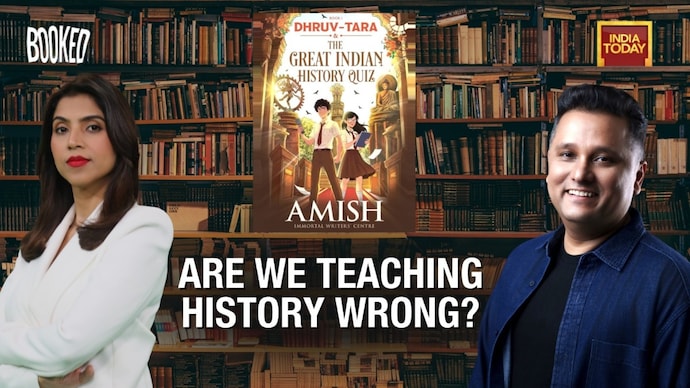
Bestselling author Amish Tripathi believes the biggest challenge facing India isn't just preserving its history—it's changing the way the next generation learns it.
In an exclusive conversation on Booked, the celebrated author of the Shiva Trilogy spoke candidly about his first foray into children's literature, the future of artificial intelligence, parenting, storytelling, and why he believes failure is one of life's greatest teachers.
Tripathi's latest book, Dhruv Tara, marks the beginning of a seven-book children's series. But according to the author, the project is about much more than introducing young readers to adventure. It is an attempt to make Indian history engaging while presenting what he describes as a more "decolonised" understanding of the country's past.
He argues that history in Indian classrooms has long been taught through narratives inherited from the colonial era and has become unnecessarily dull. "If you don't understand where you've come from, you won't know where you're going," he says, stressing that storytelling—not textbooks filled with dates—is the most effective way to make children curious about history.
Beyond history, the conversation also delves into parenting and the importance of preparing children for real life rather than shielding them from it. Rejecting the idea that competition itself is harmful, Tripathi says children should instead be taught how to compete with integrity and, more importantly, how to cope with failure.
Drawing from a poignant father-son moment in Dhruv Tara, he explains that setbacks are an inevitable part of life. Rather than placing relentless pressure on children to succeed, parents should help them develop resilience and the confidence to get back up after every fall.
The discussion then turns to one of the defining conversations of our time: artificial intelligence.
While acknowledging AI's extraordinary capabilities as a research tool, Tripathi remains convinced that human creativity still holds a unique advantage. According to him, AI excels at analysing and synthesising what already exists but lacks the ability to produce truly original insights driven by human intuition.
His advice is clear: don't fear AI—learn to use it. In his view, the future belongs not to AI alone but to people who know how to combine technology with human creativity.
The interview also offers exciting updates on several of Tripathi's ambitious projects. He confirms that work continues on a global AAA video game inspired by the world of the Ramayana, calling it one of India's most ambitious creative ventures. He also reiterates that any screen adaptation of the Shiva Trilogy will only move forward when it meets the creative standards the books deserve, preferring quality over speed.
Throughout the conversation, one philosophy remains constant. Whether writing mythology, historical fiction, children's books or exploring gaming and documentaries, Tripathi sees himself not merely as an author but as a storyteller committed to making Indian philosophy and culture accessible to modern audiences.
As India embraces new technologies while rediscovering its cultural roots, Tripathi's message is both timely and enduring: history should inspire curiosity, failure should build character, and stories remain one of the most powerful ways to shape the future.
Bestselling author Amish Tripathi believes the biggest challenge facing India isn't just preserving its history—it's changing the way the next generation learns it.
In an exclusive conversation on Booked, the celebrated author of the Shiva Trilogy spoke candidly about his first foray into children's literature, the future of artificial intelligence, parenting, storytelling, and why he believes failure is one of life's greatest teachers.
Tripathi's latest book, Dhruv Tara, marks the beginning of a seven-book children's series. But according to the author, the project is about much more than introducing young readers to adventure. It is an attempt to make Indian history engaging while presenting what he describes as a more "decolonised" understanding of the country's past.
He argues that history in Indian classrooms has long been taught through narratives inherited from the colonial era and has become unnecessarily dull. "If you don't understand where you've come from, you won't know where you're going," he says, stressing that storytelling—not textbooks filled with dates—is the most effective way to make children curious about history.
Beyond history, the conversation also delves into parenting and the importance of preparing children for real life rather than shielding them from it. Rejecting the idea that competition itself is harmful, Tripathi says children should instead be taught how to compete with integrity and, more importantly, how to cope with failure.
Drawing from a poignant father-son moment in Dhruv Tara, he explains that setbacks are an inevitable part of life. Rather than placing relentless pressure on children to succeed, parents should help them develop resilience and the confidence to get back up after every fall.
The discussion then turns to one of the defining conversations of our time: artificial intelligence.
While acknowledging AI's extraordinary capabilities as a research tool, Tripathi remains convinced that human creativity still holds a unique advantage. According to him, AI excels at analysing and synthesising what already exists but lacks the ability to produce truly original insights driven by human intuition.
His advice is clear: don't fear AI—learn to use it. In his view, the future belongs not to AI alone but to people who know how to combine technology with human creativity.
The interview also offers exciting updates on several of Tripathi's ambitious projects. He confirms that work continues on a global AAA video game inspired by the world of the Ramayana, calling it one of India's most ambitious creative ventures. He also reiterates that any screen adaptation of the Shiva Trilogy will only move forward when it meets the creative standards the books deserve, preferring quality over speed.
Throughout the conversation, one philosophy remains constant. Whether writing mythology, historical fiction, children's books or exploring gaming and documentaries, Tripathi sees himself not merely as an author but as a storyteller committed to making Indian philosophy and culture accessible to modern audiences.
As India embraces new technologies while rediscovering its cultural roots, Tripathi's message is both timely and enduring: history should inspire curiosity, failure should build character, and stories remain one of the most powerful ways to shape the future.

