As Parliament debates tougher anti-cheating law, exam papers keep leaking
MPs take up a new anti-cheating Bill today. In 22 years of recorded leaks, the law it strengthens has produced no reported convictions.
Rs 1.5 crore. That was the asking price for the Maharashtra teacher recruitment exam question paper. The police arrested three men carrying the paper from Delhi to Mumbai on the night of June 27. The exam was due the next morning at 1,028 centres across the state. It was called off instead.
Four weeks later, the education minister resigned. On Monday, Parliament was handed an amendment bill to make leaking a question paper harder to get away with. The Lok Sabha takes it up on Tuesday, with six hours set aside for the debate.
India keeps no official count of exam paper leaks. No ministry publishes one. No examination board keeps one. No agency is required to.
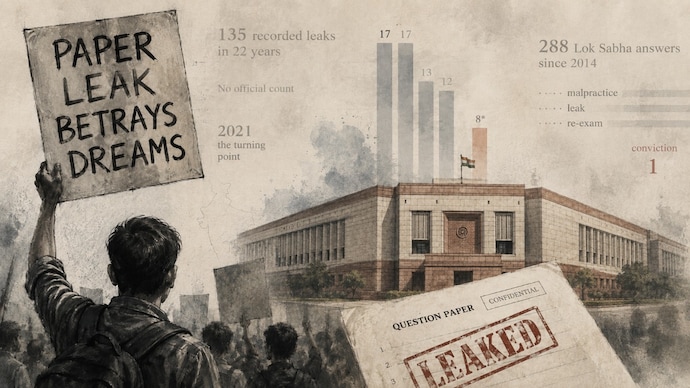
What exists instead are private lists, put together by volunteers, using old news reports. Merge the two biggest, and you get 135 leaks in 22 years, from April 2004 to July 2026. The figure is almost certainly too low. It is also the best anyone has.
WHAT 22 YEARS LOOK LIKE
For most of the 2000s, the record is close to empty. One incident in 2004, none in 2005, and one in 2006. That says more about how little news from those years survives online than about how clean the exams were.
The first cluster arrives in 2011 and 2012. Nine of those 16 incidents name Madhya Pradesh's Vyapam examination board, the recruitment scandal that would run through the courts for a decade. Then the record goes quiet again for most of the 2010s.
The break is 2021. The list records 17 leaks that year and 17 the year after, the two worst of the 22 years. In the four years from 2021, they record 59, almost as many as the 17 years before them put together. 2026 is not finished and already carries eight, as of July 27.
WHO IT HAPPENS TO
These are mostly not the exams that make national news. Four in five recorded incidents were run by a state body rather than a central one, and most are recruitment or eligibility tests to become teachers, police constables, or clerks in revenue offices.
Twenty-four states and Union Territories appear at least once. Madhya Pradesh records 18, Uttar Pradesh 14, Rajasthan 12, and Maharashtra eight. Those are raw counts and not a league table. A state that runs 40 recruitment exams a year has more chances of a leak one than a state that runs four.
WHAT PARLIAMENT HAS SAID
MPs have been asking about this for 12 years. Between July 9, 2014, and July 24, 2026, there have been 288 Lok Sabha questions and answers about examination malpractice across three Lok Sabhas and 32 ministries. Not only education: railways answers for its recruitment boards, health for NEET, personnel for staff selection.
Read those answers, and one word is missing. Malpractice appears in 54 of them. A leak appears in 36. A re-examination appears in 34. A conviction appears in just one.
Those are word matches, so they are a floor rather than a measurement. An answer saying that no conviction has been recorded still counts as a mention. The direction is not in doubt. Parliament has been told about this problem for more than a decade and has seldom been told about a punishment.
POLITICS MOVED FASTER THAN COURTS
Protest did what the questions did not. After the Maharashtra leak in June, the founder of the Cockroach Janta Party, Abhijeet Dipke, demanded that the education minister resign. On July 25, Dharmendra Pradhan did.
"Considering the situation that has arisen at Jantar Mantar and across the country, so that anti-national forces do not take advantage of this situation, I have sent my resignation letter to the Prime Minister," he said. The satirical youth movement called off its protests the same day, after the government accepted its demands, which included compensation for the families of students who died by suicide.
The pressure behind that is arithmetic. About 65 per cent of Indians are under 35, and almost a quarter of the young are in neither education, employment, nor training, according to The Economist. India has set itself a target of spending six per cent of the GDP on public education and spends closer to four per cent.
THE LAW AND THE LAW AFTER IT
The Public Examinations (Prevention of Unfair Means) Act came into force in June 2024. Two years on, no conviction under it has been reported.
The Bill before the Lok Sabha is aimed squarely at that, and it is not the education ministry's. It was introduced by Jitendra Singh, the Minister of State for Personnel, whose department runs the staff selection machinery.
The punishment for using unfair means rises from 3–5 years in prison to 5–10, and the maximum fine from Rs 10 lakh to Rs 50 lakh. A service provider caught helping can be fined Rs 5 crore instead of Rs 1 crore and barred from conducting exams for eight years instead of four. Organised crime carries a minimum of seven years and Rs 10 crore.
The clocks matter more than the numbers. Investigations must close within two months. Every state must designate a court of session as a special fast-track court, sitting day to day, finishing a trial within three months of the chargesheet. Appeals go to two High Court judges, must be filed within 30 days and disposed of within three months.
It is careful drafting, and it is an admission. None of it would be needed if the existing law had convicted anybody.
WHAT NUMBERS CAN’T SAY
Two things are worth knowing before anyone quotes that count of 135. The old years are thin because the internet is thin about them, not because the exams were safe. Any comparison that uses 2005 as a baseline is measuring the news archive.
And the lists run behind reality. On July 27, candidates in Pune said 90 of 100 questions in a state drug inspector exam had circulated on WhatsApp two days before the paper was held, back in March. The commission denies any breach. As of today, that case appears in no list of Indian exam leaks anywhere.
In Bhiwandi, the three men arrested that June night have been charged and held. The men who sent them have not. "The kingpins behind the racket remain absconding," Additional Commissioner of Police Ashok Dudhe reportedly said.
Rs 1.5 crore. That was the asking price for the Maharashtra teacher recruitment exam question paper. The police arrested three men carrying the paper from Delhi to Mumbai on the night of June 27. The exam was due the next morning at 1,028 centres across the state. It was called off instead.
Four weeks later, the education minister resigned. On Monday, Parliament was handed an amendment bill to make leaking a question paper harder to get away with. The Lok Sabha takes it up on Tuesday, with six hours set aside for the debate.
India keeps no official count of exam paper leaks. No ministry publishes one. No examination board keeps one. No agency is required to.
What exists instead are private lists, put together by volunteers, using old news reports. Merge the two biggest, and you get 135 leaks in 22 years, from April 2004 to July 2026. The figure is almost certainly too low. It is also the best anyone has.
WHAT 22 YEARS LOOK LIKE
For most of the 2000s, the record is close to empty. One incident in 2004, none in 2005, and one in 2006. That says more about how little news from those years survives online than about how clean the exams were.
The first cluster arrives in 2011 and 2012. Nine of those 16 incidents name Madhya Pradesh's Vyapam examination board, the recruitment scandal that would run through the courts for a decade. Then the record goes quiet again for most of the 2010s.
The break is 2021. The list records 17 leaks that year and 17 the year after, the two worst of the 22 years. In the four years from 2021, they record 59, almost as many as the 17 years before them put together. 2026 is not finished and already carries eight, as of July 27.
WHO IT HAPPENS TO
These are mostly not the exams that make national news. Four in five recorded incidents were run by a state body rather than a central one, and most are recruitment or eligibility tests to become teachers, police constables, or clerks in revenue offices.
Twenty-four states and Union Territories appear at least once. Madhya Pradesh records 18, Uttar Pradesh 14, Rajasthan 12, and Maharashtra eight. Those are raw counts and not a league table. A state that runs 40 recruitment exams a year has more chances of a leak one than a state that runs four.
WHAT PARLIAMENT HAS SAID
MPs have been asking about this for 12 years. Between July 9, 2014, and July 24, 2026, there have been 288 Lok Sabha questions and answers about examination malpractice across three Lok Sabhas and 32 ministries. Not only education: railways answers for its recruitment boards, health for NEET, personnel for staff selection.
Read those answers, and one word is missing. Malpractice appears in 54 of them. A leak appears in 36. A re-examination appears in 34. A conviction appears in just one.
Those are word matches, so they are a floor rather than a measurement. An answer saying that no conviction has been recorded still counts as a mention. The direction is not in doubt. Parliament has been told about this problem for more than a decade and has seldom been told about a punishment.
POLITICS MOVED FASTER THAN COURTS
Protest did what the questions did not. After the Maharashtra leak in June, the founder of the Cockroach Janta Party, Abhijeet Dipke, demanded that the education minister resign. On July 25, Dharmendra Pradhan did.
"Considering the situation that has arisen at Jantar Mantar and across the country, so that anti-national forces do not take advantage of this situation, I have sent my resignation letter to the Prime Minister," he said. The satirical youth movement called off its protests the same day, after the government accepted its demands, which included compensation for the families of students who died by suicide.
The pressure behind that is arithmetic. About 65 per cent of Indians are under 35, and almost a quarter of the young are in neither education, employment, nor training, according to The Economist. India has set itself a target of spending six per cent of the GDP on public education and spends closer to four per cent.
THE LAW AND THE LAW AFTER IT
The Public Examinations (Prevention of Unfair Means) Act came into force in June 2024. Two years on, no conviction under it has been reported.
The Bill before the Lok Sabha is aimed squarely at that, and it is not the education ministry's. It was introduced by Jitendra Singh, the Minister of State for Personnel, whose department runs the staff selection machinery.
The punishment for using unfair means rises from 3–5 years in prison to 5–10, and the maximum fine from Rs 10 lakh to Rs 50 lakh. A service provider caught helping can be fined Rs 5 crore instead of Rs 1 crore and barred from conducting exams for eight years instead of four. Organised crime carries a minimum of seven years and Rs 10 crore.
The clocks matter more than the numbers. Investigations must close within two months. Every state must designate a court of session as a special fast-track court, sitting day to day, finishing a trial within three months of the chargesheet. Appeals go to two High Court judges, must be filed within 30 days and disposed of within three months.
It is careful drafting, and it is an admission. None of it would be needed if the existing law had convicted anybody.
WHAT NUMBERS CAN’T SAY
Two things are worth knowing before anyone quotes that count of 135. The old years are thin because the internet is thin about them, not because the exams were safe. Any comparison that uses 2005 as a baseline is measuring the news archive.
And the lists run behind reality. On July 27, candidates in Pune said 90 of 100 questions in a state drug inspector exam had circulated on WhatsApp two days before the paper was held, back in March. The commission denies any breach. As of today, that case appears in no list of Indian exam leaks anywhere.
In Bhiwandi, the three men arrested that June night have been charged and held. The men who sent them have not. "The kingpins behind the racket remain absconding," Additional Commissioner of Police Ashok Dudhe reportedly said.
Rs 1.5 crore. That was the asking price for the Maharashtra teacher recruitment exam question paper. The police arrested three men carrying the paper from Delhi to Mumbai on the night of June 27. The exam was due the next morning at 1,028 centres across the state. It was called off instead.
Four weeks later, the education minister resigned. On Monday, Parliament was handed an amendment bill to make leaking a question paper harder to get away with. The Lok Sabha takes it up on Tuesday, with six hours set aside for the debate.
India keeps no official count of exam paper leaks. No ministry publishes one. No examination board keeps one. No agency is required to.
What exists instead are private lists, put together by volunteers, using old news reports. Merge the two biggest, and you get 135 leaks in 22 years, from April 2004 to July 2026. The figure is almost certainly too low. It is also the best anyone has.
WHAT 22 YEARS LOOK LIKE
For most of the 2000s, the record is close to empty. One incident in 2004, none in 2005, and one in 2006. That says more about how little news from those years survives online than about how clean the exams were.
The first cluster arrives in 2011 and 2012. Nine of those 16 incidents name Madhya Pradesh's Vyapam examination board, the recruitment scandal that would run through the courts for a decade. Then the record goes quiet again for most of the 2010s.
The break is 2021. The list records 17 leaks that year and 17 the year after, the two worst of the 22 years. In the four years from 2021, they record 59, almost as many as the 17 years before them put together. 2026 is not finished and already carries eight, as of July 27.
WHO IT HAPPENS TO
These are mostly not the exams that make national news. Four in five recorded incidents were run by a state body rather than a central one, and most are recruitment or eligibility tests to become teachers, police constables, or clerks in revenue offices.
Twenty-four states and Union Territories appear at least once. Madhya Pradesh records 18, Uttar Pradesh 14, Rajasthan 12, and Maharashtra eight. Those are raw counts and not a league table. A state that runs 40 recruitment exams a year has more chances of a leak one than a state that runs four.
WHAT PARLIAMENT HAS SAID
MPs have been asking about this for 12 years. Between July 9, 2014, and July 24, 2026, there have been 288 Lok Sabha questions and answers about examination malpractice across three Lok Sabhas and 32 ministries. Not only education: railways answers for its recruitment boards, health for NEET, personnel for staff selection.
Read those answers, and one word is missing. Malpractice appears in 54 of them. A leak appears in 36. A re-examination appears in 34. A conviction appears in just one.
Those are word matches, so they are a floor rather than a measurement. An answer saying that no conviction has been recorded still counts as a mention. The direction is not in doubt. Parliament has been told about this problem for more than a decade and has seldom been told about a punishment.
POLITICS MOVED FASTER THAN COURTS
Protest did what the questions did not. After the Maharashtra leak in June, the founder of the Cockroach Janta Party, Abhijeet Dipke, demanded that the education minister resign. On July 25, Dharmendra Pradhan did.
"Considering the situation that has arisen at Jantar Mantar and across the country, so that anti-national forces do not take advantage of this situation, I have sent my resignation letter to the Prime Minister," he said. The satirical youth movement called off its protests the same day, after the government accepted its demands, which included compensation for the families of students who died by suicide.
The pressure behind that is arithmetic. About 65 per cent of Indians are under 35, and almost a quarter of the young are in neither education, employment, nor training, according to The Economist. India has set itself a target of spending six per cent of the GDP on public education and spends closer to four per cent.
THE LAW AND THE LAW AFTER IT
The Public Examinations (Prevention of Unfair Means) Act came into force in June 2024. Two years on, no conviction under it has been reported.
The Bill before the Lok Sabha is aimed squarely at that, and it is not the education ministry's. It was introduced by Jitendra Singh, the Minister of State for Personnel, whose department runs the staff selection machinery.
The punishment for using unfair means rises from 3–5 years in prison to 5–10, and the maximum fine from Rs 10 lakh to Rs 50 lakh. A service provider caught helping can be fined Rs 5 crore instead of Rs 1 crore and barred from conducting exams for eight years instead of four. Organised crime carries a minimum of seven years and Rs 10 crore.
The clocks matter more than the numbers. Investigations must close within two months. Every state must designate a court of session as a special fast-track court, sitting day to day, finishing a trial within three months of the chargesheet. Appeals go to two High Court judges, must be filed within 30 days and disposed of within three months.
It is careful drafting, and it is an admission. None of it would be needed if the existing law had convicted anybody.
WHAT NUMBERS CAN’T SAY
Two things are worth knowing before anyone quotes that count of 135. The old years are thin because the internet is thin about them, not because the exams were safe. Any comparison that uses 2005 as a baseline is measuring the news archive.
And the lists run behind reality. On July 27, candidates in Pune said 90 of 100 questions in a state drug inspector exam had circulated on WhatsApp two days before the paper was held, back in March. The commission denies any breach. As of today, that case appears in no list of Indian exam leaks anywhere.
In Bhiwandi, the three men arrested that June night have been charged and held. The men who sent them have not. "The kingpins behind the racket remain absconding," Additional Commissioner of Police Ashok Dudhe reportedly said.

