India's fast-track courts: Fast hearings, slow convictions
The special courts clear rape and child-abuse trials nearly three times faster than ordinary courts. Turning that speed into convictions, however, is another matter.
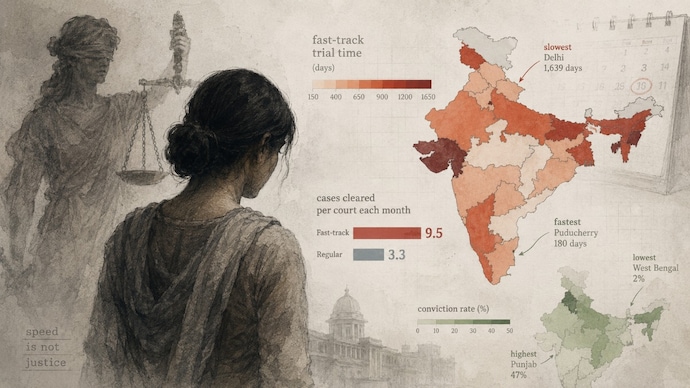


India's fast-track special courts were built for speed, and by that measure they are working. In 2024, the 774 courts dedicated to rape and child sexual abuse cases disposed of 85,595 of the 88,902 cases filed that year, a clearance rate of 96 per cent, according to the Ministry of Law and Justice’s Department of Justice. On average, each court cleared about 9.5 cases a month, nearly three times the 3.3 managed by a comparable regular court.
Yet speed alone is not justice. A Rajya Sabha response on December 18, 2025 shows that in most states, only a small share of these fast-tracked trials end in a conviction, and that how quickly a case is heard has almost nothing to do with whether the accused is found guilty.
Launched on October 2, 2019, after nationwide outrage over crimes against women, a centrally funded scheme now runs 774 fast-track special courts, including 398 dedicated solely to cases under the Protection of Children from Sexual Offences (POCSO) Act, across 29 states and Union Territories, as of January 31, 2026. Eight hundred and sixty-two fast-track courts handle heinous crimes, cases related to women/children, property disputes over five years, etc.
The gap between the fastest and slowest states is stark. In Puducherry, a fast-track case took an average of 180 days in 2024. In Delhi, the same trial dragged on for 1,639 days, roughly four and a half years, the longest in the country. Tripura and Manipur were not far behind, averaging more than 1,300 days each. The Bharatiya Nagrik Suraksha Sanhita suggests sexual-offence trials should finish within two months.
Conviction rates tell a bleaker story. In West Bengal, just two per cent of fast-track cases decided in 2024 ended in a conviction, the lowest in the country. Jammu and Kashmir recorded 4.5 per cent and Andhra Pradesh 5.2 per cent. Even Delhi fast-track special courts, for all the time they spend, have convicted in only 8.6 per cent of cases. Punjab, at 47 per cent, had the highest rate.
The two measures barely move together. Across the 30 states and Union Territories, there is virtually no relationship between how fast a court works and how often it convicts. Andhra Pradesh decides cases in about eight months but convicts barely one in 20; Meghalaya takes far longer yet convicts in nearly half. Some year-on-year swings are wild: Punjab's conviction rate jumped from 12 to 47 per cent in a single year, while Chandigarh's fell from 67 to 17 per cent, a reminder that small caseloads make these figures volatile.
The pattern matters because the country keeps turning to these courts at moments of public anger, most recently in calls to fast-track paper-leak cases. By the end of 2023, more than 2.4 lakh cases were still pending in fast-track courts, and even in 2024 the special courts took in more cases than they closed. The scheme, funded through the Rs 1,952 crore Nirbhaya Fund and extended to March 2026, expects each court to clear at least 165 cases a year, a target most still miss.
Fast-track courts have proved they can move a docket. Whether a faster trial delivers justice, or simply a quicker acquittal, is the harder question the numbers leave open.
Data note: Court counts and national disposal figures are from a Lok Sabha reply (unstarred Q. No. 5579, March 27, 2026) and the Department of Justice/PIB (March 20, 2025). State-wise conviction rates and average trial times are from a Rajya Sabha reply dated December 18, 2025, "as per details provided by the High Courts". The reply does not define how the conviction rate is calculated; the figures here are read as the share of cases decided, not of all cases pending. Small Union Territories and northeastern states have few cases, so their percentages swing sharply year to year. The 9.5-versus-3.3 monthly comparison is from media reports citing the Department of Justice.
India's fast-track special courts were built for speed, and by that measure they are working. In 2024, the 774 courts dedicated to rape and child sexual abuse cases disposed of 85,595 of the 88,902 cases filed that year, a clearance rate of 96 per cent, according to the Ministry of Law and Justice’s Department of Justice. On average, each court cleared about 9.5 cases a month, nearly three times the 3.3 managed by a comparable regular court.
Yet speed alone is not justice. A Rajya Sabha response on December 18, 2025 shows that in most states, only a small share of these fast-tracked trials end in a conviction, and that how quickly a case is heard has almost nothing to do with whether the accused is found guilty.
Launched on October 2, 2019, after nationwide outrage over crimes against women, a centrally funded scheme now runs 774 fast-track special courts, including 398 dedicated solely to cases under the Protection of Children from Sexual Offences (POCSO) Act, across 29 states and Union Territories, as of January 31, 2026. Eight hundred and sixty-two fast-track courts handle heinous crimes, cases related to women/children, property disputes over five years, etc.
The gap between the fastest and slowest states is stark. In Puducherry, a fast-track case took an average of 180 days in 2024. In Delhi, the same trial dragged on for 1,639 days, roughly four and a half years, the longest in the country. Tripura and Manipur were not far behind, averaging more than 1,300 days each. The Bharatiya Nagrik Suraksha Sanhita suggests sexual-offence trials should finish within two months.
Conviction rates tell a bleaker story. In West Bengal, just two per cent of fast-track cases decided in 2024 ended in a conviction, the lowest in the country. Jammu and Kashmir recorded 4.5 per cent and Andhra Pradesh 5.2 per cent. Even Delhi fast-track special courts, for all the time they spend, have convicted in only 8.6 per cent of cases. Punjab, at 47 per cent, had the highest rate.
The two measures barely move together. Across the 30 states and Union Territories, there is virtually no relationship between how fast a court works and how often it convicts. Andhra Pradesh decides cases in about eight months but convicts barely one in 20; Meghalaya takes far longer yet convicts in nearly half. Some year-on-year swings are wild: Punjab's conviction rate jumped from 12 to 47 per cent in a single year, while Chandigarh's fell from 67 to 17 per cent, a reminder that small caseloads make these figures volatile.
The pattern matters because the country keeps turning to these courts at moments of public anger, most recently in calls to fast-track paper-leak cases. By the end of 2023, more than 2.4 lakh cases were still pending in fast-track courts, and even in 2024 the special courts took in more cases than they closed. The scheme, funded through the Rs 1,952 crore Nirbhaya Fund and extended to March 2026, expects each court to clear at least 165 cases a year, a target most still miss.
Fast-track courts have proved they can move a docket. Whether a faster trial delivers justice, or simply a quicker acquittal, is the harder question the numbers leave open.
Data note: Court counts and national disposal figures are from a Lok Sabha reply (unstarred Q. No. 5579, March 27, 2026) and the Department of Justice/PIB (March 20, 2025). State-wise conviction rates and average trial times are from a Rajya Sabha reply dated December 18, 2025, "as per details provided by the High Courts". The reply does not define how the conviction rate is calculated; the figures here are read as the share of cases decided, not of all cases pending. Small Union Territories and northeastern states have few cases, so their percentages swing sharply year to year. The 9.5-versus-3.3 monthly comparison is from media reports citing the Department of Justice.
India's fast-track special courts were built for speed, and by that measure they are working. In 2024, the 774 courts dedicated to rape and child sexual abuse cases disposed of 85,595 of the 88,902 cases filed that year, a clearance rate of 96 per cent, according to the Ministry of Law and Justice’s Department of Justice. On average, each court cleared about 9.5 cases a month, nearly three times the 3.3 managed by a comparable regular court.
Yet speed alone is not justice. A Rajya Sabha response on December 18, 2025 shows that in most states, only a small share of these fast-tracked trials end in a conviction, and that how quickly a case is heard has almost nothing to do with whether the accused is found guilty.
Launched on October 2, 2019, after nationwide outrage over crimes against women, a centrally funded scheme now runs 774 fast-track special courts, including 398 dedicated solely to cases under the Protection of Children from Sexual Offences (POCSO) Act, across 29 states and Union Territories, as of January 31, 2026. Eight hundred and sixty-two fast-track courts handle heinous crimes, cases related to women/children, property disputes over five years, etc.
The gap between the fastest and slowest states is stark. In Puducherry, a fast-track case took an average of 180 days in 2024. In Delhi, the same trial dragged on for 1,639 days, roughly four and a half years, the longest in the country. Tripura and Manipur were not far behind, averaging more than 1,300 days each. The Bharatiya Nagrik Suraksha Sanhita suggests sexual-offence trials should finish within two months.
Conviction rates tell a bleaker story. In West Bengal, just two per cent of fast-track cases decided in 2024 ended in a conviction, the lowest in the country. Jammu and Kashmir recorded 4.5 per cent and Andhra Pradesh 5.2 per cent. Even Delhi fast-track special courts, for all the time they spend, have convicted in only 8.6 per cent of cases. Punjab, at 47 per cent, had the highest rate.
The two measures barely move together. Across the 30 states and Union Territories, there is virtually no relationship between how fast a court works and how often it convicts. Andhra Pradesh decides cases in about eight months but convicts barely one in 20; Meghalaya takes far longer yet convicts in nearly half. Some year-on-year swings are wild: Punjab's conviction rate jumped from 12 to 47 per cent in a single year, while Chandigarh's fell from 67 to 17 per cent, a reminder that small caseloads make these figures volatile.
The pattern matters because the country keeps turning to these courts at moments of public anger, most recently in calls to fast-track paper-leak cases. By the end of 2023, more than 2.4 lakh cases were still pending in fast-track courts, and even in 2024 the special courts took in more cases than they closed. The scheme, funded through the Rs 1,952 crore Nirbhaya Fund and extended to March 2026, expects each court to clear at least 165 cases a year, a target most still miss.
Fast-track courts have proved they can move a docket. Whether a faster trial delivers justice, or simply a quicker acquittal, is the harder question the numbers leave open.
Data note: Court counts and national disposal figures are from a Lok Sabha reply (unstarred Q. No. 5579, March 27, 2026) and the Department of Justice/PIB (March 20, 2025). State-wise conviction rates and average trial times are from a Rajya Sabha reply dated December 18, 2025, "as per details provided by the High Courts". The reply does not define how the conviction rate is calculated; the figures here are read as the share of cases decided, not of all cases pending. Small Union Territories and northeastern states have few cases, so their percentages swing sharply year to year. The 9.5-versus-3.3 monthly comparison is from media reports citing the Department of Justice.

