How Spain suffocated Argentina, minute by minute
Spain won the World Cup by refusing to let the holders play. The momentum data shows a final that was one-way for two hours, and a champion that scored on its 20th attempt.
Spain won its first World Cup in extra time in 2010. On Sunday at MetLife Stadium, it did so again. And the manner was almost identical: 120-odd minutes of patient suffocation, then one moment of release.
Ferran Torres, a substitute, shot past Argentina goalkeeper Emiliano Martinez in the 106th minute to make Spain world champions for a second time and end Argentina's defence of the title.
The scoreline was 1–0. Almost nothing else about the match was that close. Spain had 20 shots and 12 on target. Argentina, the holders, had two shots and none on target — and it did not manage either of them until the closing minutes of extra time. Between those two lines sits the whole final.
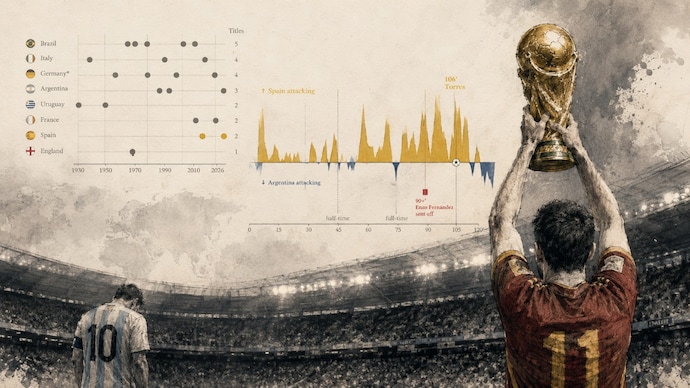
That gap between total territorial control and almost no reward is what makes this final worth charting rather than just recapping. Spain led in momentum for 67 per cent of the match, with Argentina at 19 per cent, according to FotMob's modelled minute-by-minute index. For most of the two hours, the chart was a single colour. What it measures is duration: how long Spain were this much better before the game finally broke.
THE SHAPE OF A STRANGLEHOLD
Spain's grip established itself early. Their strongest single spell came in the seventh minute, and the pattern held: probe, recycle, probe again. Rodri, named player of the tournament, set the tempo from the base of midfield.
The chart's blue patches are the tell. Argentina registered momentum in the opening five minutes, briefly after half-time, and in their deepest spell of normal time, a four-minute push from the 73rd to the 76th. But those passages produced nothing. Argentina's two shots both came in the closing minutes of extra time, so every one of those earlier spells was territory without an attempt. The ball moved, and it never arrived anywhere.
This is the distinction the graphic asks a reader to hold. A wave stretching from the centre line indicates a team was pressing rather than shooting. Argentina pressed for almost two hours without shooting, and when they finally did, neither attempt was on target.
Martinez finished with 11 saves, according to The Guardian, a number that belongs to a goalkeeper under siege rather than to a team level at 0–0 on merit.
THIS WAS A PLAN, NOT A COLLAPSE
It would be easy to read the chart as Argentina failing. The reporting suggests something more deliberate. Argentina manager Lionel Scaloni built a low block and then went lower, introducing Marcos Senesi for Julian Alvarez in the 101st minute and switching to 5–3–1, according to The Guardian. Argentina had reached the final on exactly this. It was not ahead in the 90th minute of its knockout ties.
The strategy was penalties, and it very nearly worked. What broke it was not a Spanish invention but an Argentine discipline. Enzo Fernandez, booked in the 83rd minute for dissent, was sent off in added time at the end of normal time for sending Pau Cubarsi flying, according to The Athletic. Argentina played the full 30 minutes of extra time a man short.
The red card sits on the chart at the 90-minute mark. Read what happens to the right of it. Spain's momentum touched its ceiling five times in the match, and three of those minutes fell within nine minutes of the sending-off. In extra time, the team’s pressure averaged 0.52 when it had the ball moving forward, against 0.32 in normal time. Spain still held 62 per cent of the extra-time minutes.
Spain's win puts it level with France and Uruguay on two, and leaves Brazil clear on five. The 16-year wait between the titles is not unusual for countries below the top three. Uruguay waited 20 years between 1930 and 1950, Argentina 36 years between 1986 and 2022. What is unusual is the company. Only eight nations have ever won this tournament, and the most recent name to join that list was Spain in 2010. Sixteen years on, it is the newest winner and a repeat winner.
WHAT IT COST
The goal, when it came, was Spain's tournament in miniature. Pedro Porro crossed deep; Nico Williams headed it back; Torres finished high. Three substitutes and a full-back, no superstar required. Spain conceded once in eight matches across the tournament.
For Argentina, it ends a run of three straight major titles, two Copa Americas either side of the 2022 World Cup, and in all likelihood, Lionel Messi's World Cup career. The 39-year-old touched the ball once in the opening 15 minutes, and that was from kick-off, according to The Athletic. His one shot of note came deep in extra time and was blocked.
Argentina's sharpest spell of the whole final, on the momentum data, came in the 126th minute, its best football of the night arriving a goal down, a man short, with seconds left. It found the urgency the moment it could no longer do anything.
Spain won its first World Cup in extra time in 2010. On Sunday at MetLife Stadium, it did so again. And the manner was almost identical: 120-odd minutes of patient suffocation, then one moment of release.
Ferran Torres, a substitute, shot past Argentina goalkeeper Emiliano Martinez in the 106th minute to make Spain world champions for a second time and end Argentina's defence of the title.
The scoreline was 1–0. Almost nothing else about the match was that close. Spain had 20 shots and 12 on target. Argentina, the holders, had two shots and none on target — and it did not manage either of them until the closing minutes of extra time. Between those two lines sits the whole final.
That gap between total territorial control and almost no reward is what makes this final worth charting rather than just recapping. Spain led in momentum for 67 per cent of the match, with Argentina at 19 per cent, according to FotMob's modelled minute-by-minute index. For most of the two hours, the chart was a single colour. What it measures is duration: how long Spain were this much better before the game finally broke.
THE SHAPE OF A STRANGLEHOLD
Spain's grip established itself early. Their strongest single spell came in the seventh minute, and the pattern held: probe, recycle, probe again. Rodri, named player of the tournament, set the tempo from the base of midfield.
The chart's blue patches are the tell. Argentina registered momentum in the opening five minutes, briefly after half-time, and in their deepest spell of normal time, a four-minute push from the 73rd to the 76th. But those passages produced nothing. Argentina's two shots both came in the closing minutes of extra time, so every one of those earlier spells was territory without an attempt. The ball moved, and it never arrived anywhere.
This is the distinction the graphic asks a reader to hold. A wave stretching from the centre line indicates a team was pressing rather than shooting. Argentina pressed for almost two hours without shooting, and when they finally did, neither attempt was on target.
Martinez finished with 11 saves, according to The Guardian, a number that belongs to a goalkeeper under siege rather than to a team level at 0–0 on merit.
THIS WAS A PLAN, NOT A COLLAPSE
It would be easy to read the chart as Argentina failing. The reporting suggests something more deliberate. Argentina manager Lionel Scaloni built a low block and then went lower, introducing Marcos Senesi for Julian Alvarez in the 101st minute and switching to 5–3–1, according to The Guardian. Argentina had reached the final on exactly this. It was not ahead in the 90th minute of its knockout ties.
The strategy was penalties, and it very nearly worked. What broke it was not a Spanish invention but an Argentine discipline. Enzo Fernandez, booked in the 83rd minute for dissent, was sent off in added time at the end of normal time for sending Pau Cubarsi flying, according to The Athletic. Argentina played the full 30 minutes of extra time a man short.
The red card sits on the chart at the 90-minute mark. Read what happens to the right of it. Spain's momentum touched its ceiling five times in the match, and three of those minutes fell within nine minutes of the sending-off. In extra time, the team’s pressure averaged 0.52 when it had the ball moving forward, against 0.32 in normal time. Spain still held 62 per cent of the extra-time minutes.
Spain's win puts it level with France and Uruguay on two, and leaves Brazil clear on five. The 16-year wait between the titles is not unusual for countries below the top three. Uruguay waited 20 years between 1930 and 1950, Argentina 36 years between 1986 and 2022. What is unusual is the company. Only eight nations have ever won this tournament, and the most recent name to join that list was Spain in 2010. Sixteen years on, it is the newest winner and a repeat winner.
WHAT IT COST
The goal, when it came, was Spain's tournament in miniature. Pedro Porro crossed deep; Nico Williams headed it back; Torres finished high. Three substitutes and a full-back, no superstar required. Spain conceded once in eight matches across the tournament.
For Argentina, it ends a run of three straight major titles, two Copa Americas either side of the 2022 World Cup, and in all likelihood, Lionel Messi's World Cup career. The 39-year-old touched the ball once in the opening 15 minutes, and that was from kick-off, according to The Athletic. His one shot of note came deep in extra time and was blocked.
Argentina's sharpest spell of the whole final, on the momentum data, came in the 126th minute, its best football of the night arriving a goal down, a man short, with seconds left. It found the urgency the moment it could no longer do anything.
Spain won its first World Cup in extra time in 2010. On Sunday at MetLife Stadium, it did so again. And the manner was almost identical: 120-odd minutes of patient suffocation, then one moment of release.
Ferran Torres, a substitute, shot past Argentina goalkeeper Emiliano Martinez in the 106th minute to make Spain world champions for a second time and end Argentina's defence of the title.
The scoreline was 1–0. Almost nothing else about the match was that close. Spain had 20 shots and 12 on target. Argentina, the holders, had two shots and none on target — and it did not manage either of them until the closing minutes of extra time. Between those two lines sits the whole final.
That gap between total territorial control and almost no reward is what makes this final worth charting rather than just recapping. Spain led in momentum for 67 per cent of the match, with Argentina at 19 per cent, according to FotMob's modelled minute-by-minute index. For most of the two hours, the chart was a single colour. What it measures is duration: how long Spain were this much better before the game finally broke.
THE SHAPE OF A STRANGLEHOLD
Spain's grip established itself early. Their strongest single spell came in the seventh minute, and the pattern held: probe, recycle, probe again. Rodri, named player of the tournament, set the tempo from the base of midfield.
The chart's blue patches are the tell. Argentina registered momentum in the opening five minutes, briefly after half-time, and in their deepest spell of normal time, a four-minute push from the 73rd to the 76th. But those passages produced nothing. Argentina's two shots both came in the closing minutes of extra time, so every one of those earlier spells was territory without an attempt. The ball moved, and it never arrived anywhere.
This is the distinction the graphic asks a reader to hold. A wave stretching from the centre line indicates a team was pressing rather than shooting. Argentina pressed for almost two hours without shooting, and when they finally did, neither attempt was on target.
Martinez finished with 11 saves, according to The Guardian, a number that belongs to a goalkeeper under siege rather than to a team level at 0–0 on merit.
THIS WAS A PLAN, NOT A COLLAPSE
It would be easy to read the chart as Argentina failing. The reporting suggests something more deliberate. Argentina manager Lionel Scaloni built a low block and then went lower, introducing Marcos Senesi for Julian Alvarez in the 101st minute and switching to 5–3–1, according to The Guardian. Argentina had reached the final on exactly this. It was not ahead in the 90th minute of its knockout ties.
The strategy was penalties, and it very nearly worked. What broke it was not a Spanish invention but an Argentine discipline. Enzo Fernandez, booked in the 83rd minute for dissent, was sent off in added time at the end of normal time for sending Pau Cubarsi flying, according to The Athletic. Argentina played the full 30 minutes of extra time a man short.
The red card sits on the chart at the 90-minute mark. Read what happens to the right of it. Spain's momentum touched its ceiling five times in the match, and three of those minutes fell within nine minutes of the sending-off. In extra time, the team’s pressure averaged 0.52 when it had the ball moving forward, against 0.32 in normal time. Spain still held 62 per cent of the extra-time minutes.
Spain's win puts it level with France and Uruguay on two, and leaves Brazil clear on five. The 16-year wait between the titles is not unusual for countries below the top three. Uruguay waited 20 years between 1930 and 1950, Argentina 36 years between 1986 and 2022. What is unusual is the company. Only eight nations have ever won this tournament, and the most recent name to join that list was Spain in 2010. Sixteen years on, it is the newest winner and a repeat winner.
WHAT IT COST
The goal, when it came, was Spain's tournament in miniature. Pedro Porro crossed deep; Nico Williams headed it back; Torres finished high. Three substitutes and a full-back, no superstar required. Spain conceded once in eight matches across the tournament.
For Argentina, it ends a run of three straight major titles, two Copa Americas either side of the 2022 World Cup, and in all likelihood, Lionel Messi's World Cup career. The 39-year-old touched the ball once in the opening 15 minutes, and that was from kick-off, according to The Athletic. His one shot of note came deep in extra time and was blocked.
Argentina's sharpest spell of the whole final, on the momentum data, came in the 126th minute, its best football of the night arriving a goal down, a man short, with seconds left. It found the urgency the moment it could no longer do anything.

