India's new skilling classroom is not a college. It's the workplace
On World Youth Skills Day, experts say employers are looking beyond degrees as AI reshapes work. They said continuous learning, workplace exposure and transferable skills now matter more in career readiness.
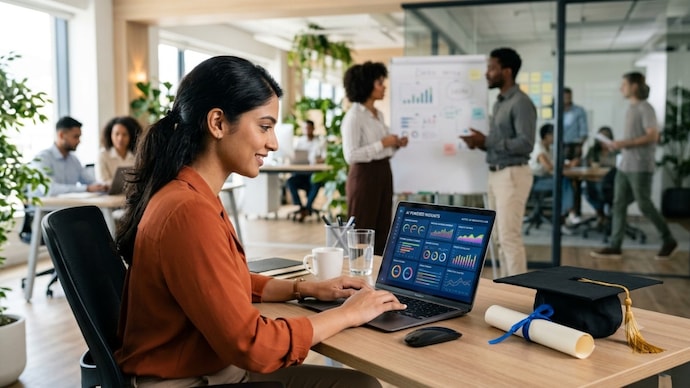
For generations, the path to a successful career seemed straightforward – study, earn a degree and enter the workforce. But on this World Youth Skills Day, education experts and recruiters say that model is being rewritten.
As artificial intelligence (AI), automation and digital technologies transform workplaces, employers are looking beyond academic qualifications. Increasingly, they want graduates who can communicate, solve problems, adapt quickly and continue learning long after they leave college.
The shift is changing not just how companies hire, but also how higher education prepares students for work.
EMPLOYABILITY IS NOW A SHARED RESPONSIBILITY
A decade ago, companies largely expected colleges to produce job-ready graduates. Today, that expectation has changed, says Shantanu Rooj, Founder and CEO of TeamLease EdTech.
"Employability has to be co-created by universities, employers and learning partners through internships, apprenticeships, live projects and work-integrated education," Rooj tells India Today.
"The degree still matters, but employers are increasingly asking a different question: Can this candidate communicate, solve problems, take ownership, learn quickly and apply knowledge in a real workplace?"
According to him, the education-to-employment bridge has become just as important as formal education itself.
THE SKILLS THAT MATTER AFTER GRADUATION
Many of the capabilities employers value most are not typically learnt inside classrooms.
According to Rooj, graduates often develop workplace communication, collaboration, accountability, problem framing and learning agility only after they begin working.
TeamLease EdTech's Career Outlook Report HY1 2026 also identifies communication, digital fluency, time management and learning agility among the top skills employers expect from fresh graduates.
"The real skills gap is often not that graduates don't know enough," Rooj says. "It's that they haven't had enough opportunities to apply what they know."
AI IS MAKING LIFELONG LEARNING ESSENTIAL
The rapid adoption of AI has further accelerated the need for continuous learning.
"AI has changed learning from a periodic activity into a continuous workplace habit," Rooj says.
He cites research showing that 92 per cent of Indian knowledge workers are already using AI at work, arguing that employees now need to experiment with new tools, verify outputs and combine AI with human judgement.
But as AI takes over routine tasks, employers say human skills are becoming even more valuable.
"Future readiness is shaped not only by technical skills but also by the ability to collaborate, lead through change, think strategically and deliver meaningful outcomes," says Amit Goyal, Managing Director, Project Management Institute (PMI) South Asia.
That changing balance between technical expertise and durable human skills is also prompting higher education institutions to rethink how they prepare students for work.
COLLEGES NEED TO PREPARE STUDENTS TO KEEP LEARNING
For higher education institutions, the challenge is no longer just teaching technical knowledge.
"A degree is no longer the finish line of learning; it is the starting point of a learning journey," says Dr Manujata Gupta, Assistant Professor of Business Communication at Birla Institute of Management Technology (BIMTECH), Greater Noida.
While universities are introducing courses on AI, data analytics and emerging technologies, Gupta says curricula alone cannot keep pace with the speed of workplace change.
Instead, colleges should focus on building transferable skills such as communication, critical thinking, creativity, adaptability and the ability to "learn, unlearn and relearn."
She also calls for stronger industry collaboration through internships, live projects and micro-certifications to help students transition more smoothly into employment.
As industries evolve and careers become less linear, experts believe skilling can no longer be viewed as something that ends with graduation.
For young people entering the workforce today, the most valuable qualification may not be a single degree or certification, but the ability to keep learning throughout their careers.
On World Youth Skills Day, that changing definition of skilling offers a reminder: in an AI-driven economy, education is no longer a one-time milestone. It is a lifelong process.
For generations, the path to a successful career seemed straightforward – study, earn a degree and enter the workforce. But on this World Youth Skills Day, education experts and recruiters say that model is being rewritten.
As artificial intelligence (AI), automation and digital technologies transform workplaces, employers are looking beyond academic qualifications. Increasingly, they want graduates who can communicate, solve problems, adapt quickly and continue learning long after they leave college.
The shift is changing not just how companies hire, but also how higher education prepares students for work.
EMPLOYABILITY IS NOW A SHARED RESPONSIBILITY
A decade ago, companies largely expected colleges to produce job-ready graduates. Today, that expectation has changed, says Shantanu Rooj, Founder and CEO of TeamLease EdTech.
"Employability has to be co-created by universities, employers and learning partners through internships, apprenticeships, live projects and work-integrated education," Rooj tells India Today.
"The degree still matters, but employers are increasingly asking a different question: Can this candidate communicate, solve problems, take ownership, learn quickly and apply knowledge in a real workplace?"
According to him, the education-to-employment bridge has become just as important as formal education itself.
THE SKILLS THAT MATTER AFTER GRADUATION
Many of the capabilities employers value most are not typically learnt inside classrooms.
According to Rooj, graduates often develop workplace communication, collaboration, accountability, problem framing and learning agility only after they begin working.
TeamLease EdTech's Career Outlook Report HY1 2026 also identifies communication, digital fluency, time management and learning agility among the top skills employers expect from fresh graduates.
"The real skills gap is often not that graduates don't know enough," Rooj says. "It's that they haven't had enough opportunities to apply what they know."
AI IS MAKING LIFELONG LEARNING ESSENTIAL
The rapid adoption of AI has further accelerated the need for continuous learning.
"AI has changed learning from a periodic activity into a continuous workplace habit," Rooj says.
He cites research showing that 92 per cent of Indian knowledge workers are already using AI at work, arguing that employees now need to experiment with new tools, verify outputs and combine AI with human judgement.
But as AI takes over routine tasks, employers say human skills are becoming even more valuable.
"Future readiness is shaped not only by technical skills but also by the ability to collaborate, lead through change, think strategically and deliver meaningful outcomes," says Amit Goyal, Managing Director, Project Management Institute (PMI) South Asia.
That changing balance between technical expertise and durable human skills is also prompting higher education institutions to rethink how they prepare students for work.
COLLEGES NEED TO PREPARE STUDENTS TO KEEP LEARNING
For higher education institutions, the challenge is no longer just teaching technical knowledge.
"A degree is no longer the finish line of learning; it is the starting point of a learning journey," says Dr Manujata Gupta, Assistant Professor of Business Communication at Birla Institute of Management Technology (BIMTECH), Greater Noida.
While universities are introducing courses on AI, data analytics and emerging technologies, Gupta says curricula alone cannot keep pace with the speed of workplace change.
Instead, colleges should focus on building transferable skills such as communication, critical thinking, creativity, adaptability and the ability to "learn, unlearn and relearn."
She also calls for stronger industry collaboration through internships, live projects and micro-certifications to help students transition more smoothly into employment.
As industries evolve and careers become less linear, experts believe skilling can no longer be viewed as something that ends with graduation.
For young people entering the workforce today, the most valuable qualification may not be a single degree or certification, but the ability to keep learning throughout their careers.
On World Youth Skills Day, that changing definition of skilling offers a reminder: in an AI-driven economy, education is no longer a one-time milestone. It is a lifelong process.

