Delhi University college students turn banana peels into eco-friendly leather
Students at Delhi University's Ramjas College have developed plant-based leather from banana peels. The project turns kitchen waste into a sustainable material for everyday accessories.
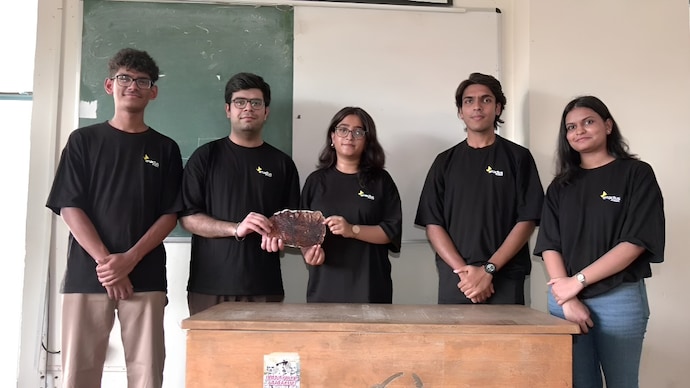
Leather has traditionally come from animal hides, but a group of students from Delhi University's Ramjas College is proving that an eco-friendly alternative may already be sitting in our kitchens. The team has developed a plant-based leather using discarded banana peels, turning fruit waste into a material that looks and feels similar to conventional leather.
The innovation aims to tackle two environmental concerns at once: reducing dependence on animal-derived leather while giving a second life to food waste that would otherwise end up in landfills.
FROM KITCHEN WASTE TO A NEW MATERIAL
The students spent nearly a year developing the material, which they have named 'Sahar'. Their biggest challenge was identifying which fruit waste could produce a durable, flexible and leather-like sheet.
Before settling on banana peels, the team experimented with several fruit wastes, including orange, mango, pineapple and coconut peels. While some materials turned out to be too soft, others were too brittle or stiff for practical use.
After several unsuccessful attempts and guidance from faculty members, the students found that banana peels offered the right combination of strength, flexibility and durability required to produce a leather-like material.
A YEAR OF TRIAL, ERROR AND PERSISTENCE
The students say the project demanded patience as each prototype behaved differently. They repeatedly refined the process until they created a material that could withstand regular use.
"Despite repeated failures, we never gave up. We wanted a fruit whose peel could be used to create a thick, leather-like layer that would last a long time. We spoke with various professors, who guided us, and finally, we were able to create the desired leather from banana peels," the team said.
The material is produced by processing discarded fruit peels and converting them into strong, flexible sheets using a natural binding technique. The finished product closely resembles leather in both texture and appearance.
SMALL PRODUCTS, BIG SUSTAINABILITY GOALS
At present, the team is focusing on products such as wallets, handbags, diary covers and fashion accessories. They say larger products like jackets and shoes may be explored in the future as the material is further refined.
It reflects a growing focus among young innovators on developing practical solutions that combine environmental responsibility with design and functionality.
Leather has traditionally come from animal hides, but a group of students from Delhi University's Ramjas College is proving that an eco-friendly alternative may already be sitting in our kitchens. The team has developed a plant-based leather using discarded banana peels, turning fruit waste into a material that looks and feels similar to conventional leather.
The innovation aims to tackle two environmental concerns at once: reducing dependence on animal-derived leather while giving a second life to food waste that would otherwise end up in landfills.
FROM KITCHEN WASTE TO A NEW MATERIAL
The students spent nearly a year developing the material, which they have named 'Sahar'. Their biggest challenge was identifying which fruit waste could produce a durable, flexible and leather-like sheet.
Before settling on banana peels, the team experimented with several fruit wastes, including orange, mango, pineapple and coconut peels. While some materials turned out to be too soft, others were too brittle or stiff for practical use.
After several unsuccessful attempts and guidance from faculty members, the students found that banana peels offered the right combination of strength, flexibility and durability required to produce a leather-like material.
A YEAR OF TRIAL, ERROR AND PERSISTENCE
The students say the project demanded patience as each prototype behaved differently. They repeatedly refined the process until they created a material that could withstand regular use.
"Despite repeated failures, we never gave up. We wanted a fruit whose peel could be used to create a thick, leather-like layer that would last a long time. We spoke with various professors, who guided us, and finally, we were able to create the desired leather from banana peels," the team said.
The material is produced by processing discarded fruit peels and converting them into strong, flexible sheets using a natural binding technique. The finished product closely resembles leather in both texture and appearance.
SMALL PRODUCTS, BIG SUSTAINABILITY GOALS
At present, the team is focusing on products such as wallets, handbags, diary covers and fashion accessories. They say larger products like jackets and shoes may be explored in the future as the material is further refined.
It reflects a growing focus among young innovators on developing practical solutions that combine environmental responsibility with design and functionality.
Leather has traditionally come from animal hides, but a group of students from Delhi University's Ramjas College is proving that an eco-friendly alternative may already be sitting in our kitchens. The team has developed a plant-based leather using discarded banana peels, turning fruit waste into a material that looks and feels similar to conventional leather.
The innovation aims to tackle two environmental concerns at once: reducing dependence on animal-derived leather while giving a second life to food waste that would otherwise end up in landfills.
FROM KITCHEN WASTE TO A NEW MATERIAL
The students spent nearly a year developing the material, which they have named 'Sahar'. Their biggest challenge was identifying which fruit waste could produce a durable, flexible and leather-like sheet.
Before settling on banana peels, the team experimented with several fruit wastes, including orange, mango, pineapple and coconut peels. While some materials turned out to be too soft, others were too brittle or stiff for practical use.
After several unsuccessful attempts and guidance from faculty members, the students found that banana peels offered the right combination of strength, flexibility and durability required to produce a leather-like material.
A YEAR OF TRIAL, ERROR AND PERSISTENCE
The students say the project demanded patience as each prototype behaved differently. They repeatedly refined the process until they created a material that could withstand regular use.
"Despite repeated failures, we never gave up. We wanted a fruit whose peel could be used to create a thick, leather-like layer that would last a long time. We spoke with various professors, who guided us, and finally, we were able to create the desired leather from banana peels," the team said.
The material is produced by processing discarded fruit peels and converting them into strong, flexible sheets using a natural binding technique. The finished product closely resembles leather in both texture and appearance.
SMALL PRODUCTS, BIG SUSTAINABILITY GOALS
At present, the team is focusing on products such as wallets, handbags, diary covers and fashion accessories. They say larger products like jackets and shoes may be explored in the future as the material is further refined.
It reflects a growing focus among young innovators on developing practical solutions that combine environmental responsibility with design and functionality.

