Jharkhand engineering students build water-cleaning robot to clean Shiv Ganga pond
What began as a final-year engineering project is now headed for real-world deployment. A team of five students from Dumka Engineering College has built an autonomous water-cleaning robot that will help clean the Shiv Ganga pond at Basukinath Dham during the Shravani Mela.
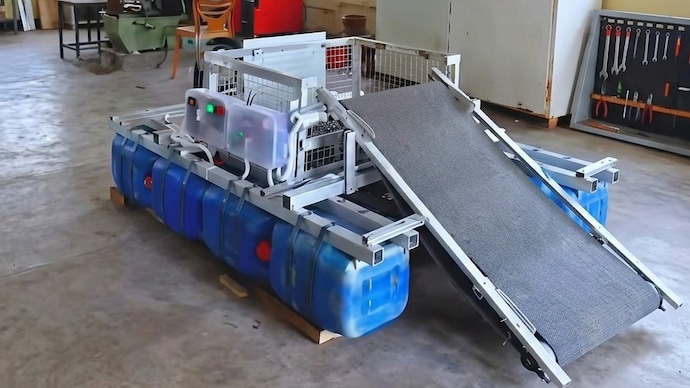
A final-year engineering project from Jharkhand is about to make a real difference on the ground. Five BTech students from Dumka Engineering College have developed an autonomous water-cleaning robot that will soon begin cleaning the Shiv Ganga pond at Basukinath Dham during the upcoming Shravani Mela, which starts on July 30.
Named 'Nature's Revival Bot – Autonomous Water Cleaning Robot', the device will be deployed for the first time at the sacred pond. According to officials, a live demonstration of the robot is scheduled for Monday before it begins regular operations during the annual pilgrimage.
FROM CLASSROOM PROJECT TO REAL-WORLD SOLUTION
The robot was developed over five months as the students' final-year project. Their aim was simple: find a better way to clean polluted waterbodies without depending entirely on manual labour.
Project team member Koushal Kumar, who has recently secured a job as an electrical engineer at a private company in Pune, said the robot was designed to tackle one of the biggest challenges faced by civic bodies, removing floating waste from ponds and lakes quickly and efficiently.
The project has now moved beyond the classroom, with the Dumka district administration deciding to deploy it at one of Jharkhand's busiest religious sites.
HOW THE ROBOT CLEANS THE POND
According to Professor Pankaj Sarkar, Head of the Department of Electrical Engineering at Dumka Engineering College, the robot uses a motor-driven track-belt conveyor system to collect floating waste from the water's surface and deposit it into a net-covered collection bucket.
It can remove plastic bottles, polythene bags, clothes, paper and other floating debris.
The robot is powered by three different motors. A Brushless Direct Current (BLDC) hub motor drives the propeller, a gear motor operates the conveyor belt, while a servo motor controls steering. It also features a photoelectric sensor that helps detect obstacles and prevents collisions.
Built on plastic drums fitted with an aluminium frame, the robot runs on a 48-volt hybrid battery combining lithium-ion and lead-acid batteries, allowing it to operate for up to 20 hours on a full charge.
BUILT FOR LONG HOURS OF CLEANING
The robot can clean around 8 square feet of water every minute and has an operating range of one kilometre. Its collection bucket can hold three to four quintals of waste, although the collected garbage must be removed manually once the bucket is full.
The device can also be monitored and controlled remotely, making it suitable for continuous operation during the busy pilgrimage season.
A BOOST FOR STUDENT INNOVATION
Dumka Deputy Commissioner Abijit Sinha said the robot impressed officials during a visit to the college's Centre for Electric Vehicle Technology in June, leading to the decision to deploy it at Shiv Ganga pond.
He expressed confidence that the innovation would help keep the pond cleaner during Shravani Mela while encouraging more students to develop practical solutions to real-life problems. Sinha also said the initiative strengthens the identity of 'Made in Jharkhand' and 'Made in Dumka'. Alongside the robot, a water filtration plant has also been installed at the pond to improve water quality and maintain water levels.
(With PTI inputs)
A final-year engineering project from Jharkhand is about to make a real difference on the ground. Five BTech students from Dumka Engineering College have developed an autonomous water-cleaning robot that will soon begin cleaning the Shiv Ganga pond at Basukinath Dham during the upcoming Shravani Mela, which starts on July 30.
Named 'Nature's Revival Bot – Autonomous Water Cleaning Robot', the device will be deployed for the first time at the sacred pond. According to officials, a live demonstration of the robot is scheduled for Monday before it begins regular operations during the annual pilgrimage.
FROM CLASSROOM PROJECT TO REAL-WORLD SOLUTION
The robot was developed over five months as the students' final-year project. Their aim was simple: find a better way to clean polluted waterbodies without depending entirely on manual labour.
Project team member Koushal Kumar, who has recently secured a job as an electrical engineer at a private company in Pune, said the robot was designed to tackle one of the biggest challenges faced by civic bodies, removing floating waste from ponds and lakes quickly and efficiently.
The project has now moved beyond the classroom, with the Dumka district administration deciding to deploy it at one of Jharkhand's busiest religious sites.
HOW THE ROBOT CLEANS THE POND
According to Professor Pankaj Sarkar, Head of the Department of Electrical Engineering at Dumka Engineering College, the robot uses a motor-driven track-belt conveyor system to collect floating waste from the water's surface and deposit it into a net-covered collection bucket.
It can remove plastic bottles, polythene bags, clothes, paper and other floating debris.
The robot is powered by three different motors. A Brushless Direct Current (BLDC) hub motor drives the propeller, a gear motor operates the conveyor belt, while a servo motor controls steering. It also features a photoelectric sensor that helps detect obstacles and prevents collisions.
Built on plastic drums fitted with an aluminium frame, the robot runs on a 48-volt hybrid battery combining lithium-ion and lead-acid batteries, allowing it to operate for up to 20 hours on a full charge.
BUILT FOR LONG HOURS OF CLEANING
The robot can clean around 8 square feet of water every minute and has an operating range of one kilometre. Its collection bucket can hold three to four quintals of waste, although the collected garbage must be removed manually once the bucket is full.
The device can also be monitored and controlled remotely, making it suitable for continuous operation during the busy pilgrimage season.
A BOOST FOR STUDENT INNOVATION
Dumka Deputy Commissioner Abijit Sinha said the robot impressed officials during a visit to the college's Centre for Electric Vehicle Technology in June, leading to the decision to deploy it at Shiv Ganga pond.
He expressed confidence that the innovation would help keep the pond cleaner during Shravani Mela while encouraging more students to develop practical solutions to real-life problems. Sinha also said the initiative strengthens the identity of 'Made in Jharkhand' and 'Made in Dumka'. Alongside the robot, a water filtration plant has also been installed at the pond to improve water quality and maintain water levels.
(With PTI inputs)
A final-year engineering project from Jharkhand is about to make a real difference on the ground. Five BTech students from Dumka Engineering College have developed an autonomous water-cleaning robot that will soon begin cleaning the Shiv Ganga pond at Basukinath Dham during the upcoming Shravani Mela, which starts on July 30.
Named 'Nature's Revival Bot – Autonomous Water Cleaning Robot', the device will be deployed for the first time at the sacred pond. According to officials, a live demonstration of the robot is scheduled for Monday before it begins regular operations during the annual pilgrimage.
FROM CLASSROOM PROJECT TO REAL-WORLD SOLUTION
The robot was developed over five months as the students' final-year project. Their aim was simple: find a better way to clean polluted waterbodies without depending entirely on manual labour.
Project team member Koushal Kumar, who has recently secured a job as an electrical engineer at a private company in Pune, said the robot was designed to tackle one of the biggest challenges faced by civic bodies, removing floating waste from ponds and lakes quickly and efficiently.
The project has now moved beyond the classroom, with the Dumka district administration deciding to deploy it at one of Jharkhand's busiest religious sites.
HOW THE ROBOT CLEANS THE POND
According to Professor Pankaj Sarkar, Head of the Department of Electrical Engineering at Dumka Engineering College, the robot uses a motor-driven track-belt conveyor system to collect floating waste from the water's surface and deposit it into a net-covered collection bucket.
It can remove plastic bottles, polythene bags, clothes, paper and other floating debris.
The robot is powered by three different motors. A Brushless Direct Current (BLDC) hub motor drives the propeller, a gear motor operates the conveyor belt, while a servo motor controls steering. It also features a photoelectric sensor that helps detect obstacles and prevents collisions.
Built on plastic drums fitted with an aluminium frame, the robot runs on a 48-volt hybrid battery combining lithium-ion and lead-acid batteries, allowing it to operate for up to 20 hours on a full charge.
BUILT FOR LONG HOURS OF CLEANING
The robot can clean around 8 square feet of water every minute and has an operating range of one kilometre. Its collection bucket can hold three to four quintals of waste, although the collected garbage must be removed manually once the bucket is full.
The device can also be monitored and controlled remotely, making it suitable for continuous operation during the busy pilgrimage season.
A BOOST FOR STUDENT INNOVATION
Dumka Deputy Commissioner Abijit Sinha said the robot impressed officials during a visit to the college's Centre for Electric Vehicle Technology in June, leading to the decision to deploy it at Shiv Ganga pond.
He expressed confidence that the innovation would help keep the pond cleaner during Shravani Mela while encouraging more students to develop practical solutions to real-life problems. Sinha also said the initiative strengthens the identity of 'Made in Jharkhand' and 'Made in Dumka'. Alongside the robot, a water filtration plant has also been installed at the pond to improve water quality and maintain water levels.
(With PTI inputs)

