From the India Today archives (1979) | Being Sunil Gavaskar
July 10 is Gavaskar's birthday. In this article, the reason he was Indian cricket's national obsession


Blinding, million-watt floodlights bathe the lush green stage in strobe-like brilliance. The audience is seated in plush tiers, the nine glasses and silver cutlery on the tables in front of them glittering in the artificial glare of the light. Suddenly, the rock band performing on a raised dais to one side of the huge stage breaks off in the middle of a song.
A catchy signature tune washes over the crowd from the gigantic speakers placed strategically around the oval-shaped hall. A pixie glass dome slides across the top of the hall, cutting out the night sounds of the world outside. The compere announces the start of the main entertainment feature on the programme - the show that most of the 75,000 spectators have come to see.
A roar of applause greets the stars of the show as they run out on to the Stage, led by bikini-clad cheer leaders, their purple, spangled outfits standing out starkly against the baize green stage floor. The performers scatter to various points of the stage, facing an arrow-straight fawn-coloured strip painted in the exact centre of the stage. Hidden microphones, strategically placed around the stage, amplify the action on the stage and the voices of the performers.
The crowd roars again as two more performers run out onto the stage carrying long aluminium objects. Their legs are covered in pink cowboy-like chaps; on their heads, garishly-coloured caps. The two men proceed to either end of the strip and stand facing each other. Directly behind each of them are three silver stokes, their tips buried in the stage floor. Seventy-five thousand pairs of eyes are rivet ted to the stage as the show begins accompanied by another roar of approval from the crowd.
The biggest nightclub in the world settles down to another stretch of uninterrupted entertainment. The gigantic neon lights outside the nightclub spell out the evening’s star turn - cricket. The performers - superstars flown in from the Caribbean to match their talents with the (ream of the British Isles.
Fiction? Maybe - now that the Kerry Packer cricket circus has wound up. But had the aggressive Australian TV tycoon not won his battle against the badly-shaken cricketing Establishment, the fiction would have become reality before anybody could say "Howzatt".
Packer’s original demand was exclusive rights for all cricket matches played in Australia for his private-owned channel Nine on Australia’s television network. It was only to put pressure on the international cricketing Establishment that Packer started "Pirating" the world’s top cricket talent for his World Cricket Series (WCS).
The ploy proved so effective that the Establishment eventually caved in to his demands rather than face the disastrous attendances at their test arenas. Now that Packer has got what he wanted, the WCS has been disbanded. An indication of the clout Packer wielded lies in the acknowledged fact that only three or four of the current Australian side in India will eventually find a place in the test team reinforced by the return of the Packerites.
That was Packer’s way of thumbing his nose at the international cricketing Establishment, and it proved a profitable one. It also proved a number of other equally significant points. In his own outlandish way, though most people refused or were unable to see it. Packer was a pioneer. He showed, with embarrassingly devastating success, that cricket could be made a glitter game. That there was more money and more excitement in buying up the game’s superstars, dolling them up in lavender outfits, and packaging them to an entertainment-starved public: at night, under floodlights, and with all the panache of an international circus king P. T. Barnum.
The crowds lapped it up and Packer lapped up the "filthy lucre". The purists curled up their stiff upper lips and stayed away. They branded Packer a pirate, a bloodthirsty, modern-day Captain Bluebeard brandishing a cheque book instead of a cutlass and looting the treasure that was rightfully theirs, but had never dared to exploit. Giving in to Packer’s demands was mere survival-reaction. By doing so, they were covertly admitting that he was doing a better job than they were - that the only way to save the game’s future, and theirs, was to give Packer what he wanted and thereby restore the status quo.
By then, Packer had proved his point. He had showed up the game for what it really was - the ultimate anachronism. a painful hangover from the British Raj. Certainly, in the age of the Concorde, instant food and automation, any game that takes six days to complete seems almost Victorian, totally out of step with the modern age.
That it is a Victorian legacy is evident from the fact that the only countries that indulge in it-Australia, the West Indies, New Zealand, India, Pakistan and South Africa-are all former colonies of the British Empire. In the rough, aggressive trend of modern sport, cricket has become the final refuge of the "Gentleman". Un-Emily post-like behaviour is considered "not quite cricket, old boy." Once Packer arrived on the scene, it was becoming rapidly evident that traditional cricket was passe; That the crowds at London’s hallowed Oval, in Melbourne and in Barbados were dwindling alarmingly.
But the message, like almost everything else, is yet to reach India. Here, it is carnival time once again. The entire nation has been afflicted with cricket fever. Last fortnight, Andhra Pradesh Government declared a state-wide holiday to allow its cricket-crazy public a glimpse of a second-string Australian Eleven take on South Zone. The cricket was uninspiring, dull, and a tedious affair.
But the jam-packed stands loved every minute of it. There were street urchins who couldn’t tell Rodney Hogg from Muhammad Ali. There were generously-endowed socialites in chiffons and silks who wouldn’t know a maiden over from a silly point. There were oily businessmen who were there because it was good for business - theirs. And there were the inevitable politicians to whom it was worth a fair number of votes to be seen there.
In fact, last month, shortly after the Australia-North Zone tie at Srinagar - the first cricket match played at the newly built stadium - Jammu and Kashmir Chief Minister Sheikh Abdullah announced that the state government would erect a test-class stadium so that Srinagar could become a cricket test venue. Abdullah was not doing so out of the goodness of his heart. It merely meant more votes come election time.
Cricket, in India, is perhaps the only event that can shoulder political events to the sidelines in the national media. There are more books written about cricket than any other game. Radio and television air cricket infinitely more than any other event, except political ones. When a test match is in session, entire offices empty out and the hapless city virtually comes to a standstill till the match is over. For the final half hour of the India-England cliff-hanger test at Oval early this month, almost the entire machinery ground to a halt as the nation held its collective breath.
Statistically, the wastage in terms of man-hours and money spent is mind-boggling. For the current Indo-Australian series, a total of 375,000 people will be viewing the six Tests and five zonal matches - spread across 46 days (31 for the Tests and 15 for the zonal matches). In other words, the number of man-days lost to the nation works out to an incredible 1.72 crore. In terms of money lost, at a conservative estimate of Rs 25 per day per person watching the series, would work out to a staggering Rs 43 crore.
Similarly, just for the Test matches, the total seat capacity at the six test centres, is around 275,000. Each person will be spending an average of Rs l00 per Test match - Rs 50 on the ticket and Rs 50 on items like food and cold drinks. By the time the current series is over, cricket fans will have spent Rs 2.75 crore in the tests alone. If the zonal matches are added, this will entail a further Rs 60 lakh a grand total of Rs 3.35 crore spent by Indians to watch more or less the same 22 men in action.
The figure is even more astonishing if one takes into account the people not seeing the match-the radio listeners. According to an estimate made for INDIA TODAY by media expert Dr N. Bhaskara Rao, the total cost of radio time on the national broadcasting hook-up for one five-day Test match is close to Rs 4 crore. For the entire series, the cost of radio time hovers around Rs 24 crore - almost 100 per cent more than any other sporting event. This is after one official listener reaction survey proved conclusively that 30 per cent of all listeners were against cricket commentaries being aired for such protracted periods.
An estimated 30 million people listen to cricket commentary on the radio. It has been computed that 10 million listen to the commentary constantly, another 10 million listen to it half the time and the third 10 million only a quarter of the time. In numerical terms, 17.5 million radio owners listen to the Test match commentary constantly. If half of the owners (about 80 lakh) are working people and the money lost to the country is Rs 10 per day per head (at an average earning capacity of Rs 400 per month). the total amount lost for the entire 31-day Test series is close to Rs 248 crore.
The extent of cricket mania in this country is best illustrated by the size of the cricket audience during the current series. According to an INDIA TODAY estimate, there will be a total of 8 lakh people watching the six Test matches on television.
On an average, one TV set is viewed by between five and six people. Which means that the total TV audience will be around 4.6 million. This coupled with the 3.0 million radio listeners and the 375,000 people physically watching the tests in the stadiums comes to an astounding 35 million - or, 5.5 per cent of the total Indian population. In other words, one in every twenty Indians will be engrossed in the Test series for the next two months. The money spent directly or indirectly over the same period is in the region of Rs 300 crore - equivalent to the combined annual budget of Punjab and Himachal Pradesh.
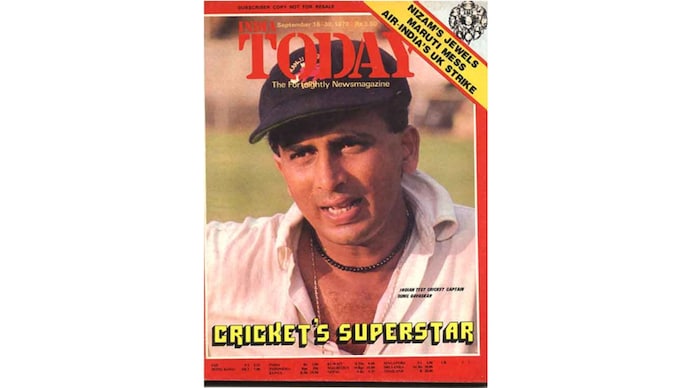
But it is the superstars of the game who epitomise cricket’s maniacal fervour in India, bestowing them with a near-mystical aura. And Indian cricket has no greater superstar at the moment than that stocky pocket-sized run machine, Sunil Gavaskar.
Now a boyish 30, Gavaskar has already ensured himself a permanent shrine in Cricket’s Hall of Fame. After his heroic double century in the Oval test, even Britain’s traditionally phlegmatic cricketing journalists penned uncharacteristic paeans of praise to "Sunny".
And if the Englishmen were tripping over one another to get back to office and paint the little man in glorious colours it was hardly surprising. Ray Robinson, one of the leading scribes of the game, has even written that Gavaskar is the "greatest star" currently "with a record second only to Sir Donald Bradman’s".
And if figures can impress, the Indian captain’s stand out above those of all others. No one apart from Sir Donald Bradman, who scored 29 centuries in 52 Tests, has scored 20 centuries in fewer Tests than Gavaskar who got them in 50 matches. Again, only the same two have crossed the 20-century mark in less than 100 innings. Bradman achieved this distinction in 80 innings and Gavaskar in 93.
But Gavaskar is one up on the great Australian in at least one way. He is the only batsman to have hit these many hundreds at the age of 30. Bradman had only 17 centuries in the record book when he was 30 before the Second World War interrupted his scoring spree.
Robinson’s contention of Gavaskar being the number two batsman of all times is borne out by a comparison of his figures with those of five other all-time greats-Sir Garfield Sobers, Neil Harvey, Hammond, Ken Barrington and Colin Cowdrey. Sobers and Harvey had scored a century once in slightly over three Tests, Barrington once in four and Cowdrey once in five. Gavaskar, by comparison, has averaged one century in every 2.5 Tests, or, every fifth innings.
Gavaskar, however, is hardly cut in the classic superstar mould. He is a short bantam rooster of a man who is modest to the point of being shy. His features are pleasant enough, but he lacks the brash showmanship of a Tony Greig, the cavalier air of a Garfield Sobers or the panther-like grace of a Rohan Kanhai, Gavaskar’s boyhood hero and the man he has named his three-year-old son after.
But along with son Rohan and attractive wife Marshneil nee Mehrotra, they are currently Indian cricket’s First Family. Their ground-floor apartment in Bombay’s crowded, predominantly middle class Dadar area has become a sort of Mecca for the faithful.
On a typically average day last week, just after Gavaskar’s return from the English tour, the doorbell rings early in the morning. Outside, on the doorstep, stands a wizened old man clutching the hand of a child. "Excuse me", he says hesitatingly, "is Sunil Gavaskar at home? I live in the next lane and my grandson would like to shake his hand. If he would be so kind?" Pammi, as Marshneil is known, looks helplessly at her mother-in-law.
Meenal Gavaskar, who, having more experience in these matters, smiles at the old man and calls out to Sunil. She then resumes her conversation on the phone, about the 10th identical call since the morning. "Yes, certainly, I will convey your good wishes to Sunil," she murmurs.
"Among the problems of being the wife of a celebrity are answering innumerable telephone calls from friends, well-wishers and fans", says Marshneil wearily. "The incessant ringing can drive a person around the bend." (Incidentally, Gavaskar’s telephone number is unlisted but that doesn’t seem to help). Gavaskar, emerging from his bedroom, displays no such irritation.
Smiling, unflappable and friendly, he goes to the door, picks up his four-year-old fan, and, in place of the requested handshake, plants a kiss on the child’s cheek. Seeing this, a gang of urchins peering in through the living room windows, raise a ragged cheer. Their hero has not let them down.
Throughout the incessant telephone calls, the constant stream of visitors, journalists and autograph-hunters, Gavaskar retains his characteristic cool. After all, it is his stoic patience that has made him the cricketing prodigy he is. He is currently a few strokes away from the magic 5,000-run milestone in test cricket with an incredible 20 centuries under his belt.
Last fortnight, Indian cricket’s mandarins acknowledged his worth by reinstating him as captain of the Indian Test team for the series against the Aussies. He was dropped after captaining the side against the West Indies earlier this year, but is back in favour after his blockbuster batting in the English tour.
And yet, Gavaskar is perhaps the only sports superstar in India who has genuinely disallowed success from going to his head. Two days after his return from a gruelling tour of England. and a day before he was flying to Madras to do battle with the Australians. Gavaskar insisted on playing a Kanga League cricket match for his old club -Dadar Union. "I must play at least one match for my local team," he says.
It is precisely that attitude that has triggered off the tonnes of fan mail that pour in through his letter-box each day. Enough to make even Amitabh Bachchan blush with embarrassment. Gavaskar estimates that there are about 400 letters currently lying unopened - "I just don’t have the physical ability to cope with all those letters," he complains good-naturedly.
Unlike other stars of his stature, Gavaskar is anything but a social animal. His idea of a pleasant evening is staying at home and horsing around with son Rohan, which, inevitably involves playing cricket. Rohan fancies himself a pace bowler and only answers when you call him "Thomson".
The minute dad gets home, Rohan hands him a bat, wipes imaginary sweat off his brow, polishes the ball on his shorts and hurls down a left-handed delivery across the length of the spacious drawing room. Each time he beats Gavaskar’s bat, a yell of "Howzatt" resounds through the apartment.
When his turn at the crease comes, Rohan rehearses a few strokes with his miniature Duncan-Fearnley bat made specially for him by the world-famous company. His batting talent is attested to by the fact that so far he has broken precisely one serving tray in the course of his "matches" with his father. "He plays his shots along the ground, like his father," says a deadpan Gavaskar.
But with all that cricket around him, Rohan has little time for anything else. "He doesn’t play with conventional toys, he won’t even look at them," says Gavaskar, betraying a shade of pride in his voice. Gavaskar readily admits that Rohan is a precocious child. "I leave his (Rohan’s) basic training to Pammi and my mother. They are responsible for his discipline. When I come home, my job is to play cricket with him, and spoil him."
Marshneil, the Kanpur girl whom Gavaskar married exactly five years ago, has obviously learned to live with the hassles of being a star’s spouse. She religiously files newspaper cuttings and photographs and helps Gavaskar out in answering his fan mail. Most times, she accompanies Gavaskar on his cricketing sojourns.
The Gavaskars are obviously a tightly-knit home-loving family with few differences in taste or viewpoints. One of the few areas of discord is that Gavaskar likes Hindi movies while Marshneil would rather leave them alone. Both hate socialising; "Maybe because I’m lazy", she says. "Sunil is a very level-headed person. He adjusts so beautifully that we almost never disagree seriously on anything."
But hastily amending her statement she said: "There is one thing we disagree on - his over-generosity." Marshneil still cannot forgive her husband for parting with his prize souvenirs, like the bat which he scored a double century against the West Indies with - Gavaskar merely gave it away to "a deserving cricketer".
But beneath that affable exterior, is a man deeply dedicated to the game. As secretary of the Players’ Association, Gavaskar has made every effort to get his fellow-cricketers a square deal, financially and otherwise. It was largely due to his efforts that advertisers can no longer reproduce pictures of test stars on score cards without paying out royalty. "Legally, these people are using the faces of the cricketers for the purpose of advertisement, and must part with some of the profits," he maintains. He has also played a major role in boosting the benevolent fund for cricketers started comparatively recently.
Not that Gavaskar is likely to utilise the fund for himself in the near future. Gavaskar is the only sports star in India apart from fellow cricketer Venkataraghavan, who is used by television and other media advertisers to endorse their products. That alone is enough to ensure his family a comfortable living. In addition, there is his monthly pay packet from his employers. Nirlon, where he works as a public relations officer. Then of course there are his non-taxable earnings from the game.
The fee for a test cricketer in the current series against the Australians is Rs 10,600 (Rs 5,000 cash, Rs 2,000 from the Bombay Cricket Association, Rs 2,000 from the Cricket Control Board and Rs 1,600 as boarding charges for eight days). Since India will be playing a total of 17 tests in the space of a few months, and Gavaskar is certain to play in all 17, he and his team mates will be pocketing a cool Rs 1.8 lakh at the end of the current season.
Financial rewards aside, Gavaskar’s unique colossus-like position in Indian Test cricket also makes him an ideal target for criticism. There are those who say that because of his status in the team, Gavaskar dictates his own terms to the Board.
The more unkind rumours are that he took on the captaincy against the West Indies because he was sure of an Indian victory. He then dropped out of the captaincy stakes in the England series because of the likelihood of a sound thrashing at the hands of Brearley and Co. And now that the Aussies are the underdogs in the current series, he has taken on the mantle once again.
He was roundly condemned for his tough stand in favour of Indian cricketers signing up with Packer’s All Stars. Neither has his recent appointment as Indian captain been unanimously acclaimed. "I think Venkat did a good job against England," says former Indian captain, Mansur Ali Khan Pataudi, who covered the English series as editor of Spurts world. "I personally feel Venkat should have been retained for at least two tests against the Australians.
Sunil as a captain was not particularly impressive." Other cricket writers, mainly from the South, have echoed Pataudi’s views. Gavaskar himself views his appointment as captain objectively. "I personally feel that I was a fairly good attacking captain. But when I had to fall back on the defensive and play a containing role, I didn’t enjoy the situation. I suppose I have to learn that end of it".
In fact, it was probably Gavaskar’s controversial statement to a Sportsweek journalist that he had not enjoyed being captain against the West Indies, that influenced the selectors’ decision to drop him from captaincy against the English side.
Gavaskar, however, claims that it was a flippant off-hand remark that was blown up out of context. Even former Indian captain, Ajit Wadekar, says that Gavaskar "looked a little out of sorts when the West Indies were batting well in the last series. I would caution him against letting things drift on the field"
Among the players he will play mother to in the current series, Gavaskar is undoubtedly a popular choice. "With him there is no bullshit. You know exactly where you stand. If you are being dropped from the team for a particular match, he is the only captain I know who will take you aside and explain exactly why it is being done. The rest just don’t give a damn," said a member of the current team who preferred to remain anonymous.
But Gavaskar is also in the unique position of being financially and professionally secure. Gundappa Vishwanath, Gavaskar’s brother-in-law, is perhaps another. The rest of their teammates are trapped in the flux that Indian cricket is currently in. The old workhorses like Bedi, Chandrashekhar and Venkat himself are on the verge of being put out to grass, while replacements are being tried out. Further, a situation like the current one where 17 test matches are due to be played over less than six months is fairly unusual. And deprived of test match earnings, Indian cricketers are financially insolvent. "You cannot make a living just playing cricket," says Ajit Wadekar, "unless you are in Sunil’s shoes. The highest payment for a first-class cricketer, apart from the tests, is Rs 50 a day for a Ranji Trophy match."
And, it is largely thanks to Packer that cricket bounties have reached the current level. What adds to the irony is the amount of money there really is in the game. In a cricket-happy country like India, the takings from even a non-test match are something phenomenal, far outpacing any other sport in the country. The men who hold the key to India’s cricket vaults are the members of the Cricket Control Board of India.
For last fortnight’s Australia-South Zone match, the Hyderabad Cricket Association paid the Board guarantee money of Rs 75,000. Cricket matches are also the only sporting events that are insured. The three-day Hyderabad match was insured against rain and riots for Rs 175,000 by the Association, which paid a premium of Rs 10,000.
For actual tests, the takings would be the envy of a Tata or a Birla. There are currently six test centres - with varying capacities - Bombay (45,000), Delhi (35,000), Calcutta (80,000), Madras (50.000), Bangalore (50,000), and Kanpur (30,000). Apart from the guarantee money paid to the cricket Board by the zonal associations (the average is Rs 5 lakh, or Rs 35 lakh for the series), players’ fees, travelling and boarding expenses for both teams will total around Rs 18 lakh.
The rest is pure profit. Calcutta, which charges the lowest ticket rates for a test match but has the largest capacity, is a good example. For the Australian test at Eden Gardens, for which no daily tickets will be sold, the gate money alone will work out to around Rs 55.45 lakh. Coupled with advertising and catering commissions, the gross earnings after expenses will touch around Rs 35 lakh. It is likely to be even higher for the India-Pakistan match. A rake-in of Rs 6 lakh per day for a five-day test in nothing to sneeze at.
The record gross takings for a smaller-capacity stadium like Bombay’s Wankhede touched Rs 45 lakh (in the West Indies test in 1974 75). The Wankhede will earn about Rs 4.5 lakh as guarantee money from peddling exclusive advertising rights to an agency plus 85 per cent of whatever is earned above that figure.
Where does all that money go? Certainly not for the benefit of the cricketers themselves. For the Hyderabad match last fortnight, the Board had paid to send down what was euphemistically known as the Chandgadkar sub-committee to recommend to the Board the "test match standard facilities" of Hyderabad’s Lal Bahadur stadium. The Chandgadkar sub-committee is only one of many such committees the Board constitutes, re-constitutes and dissolves like the rings in a touring circus.
A Board source admitted that sub-committees are created on the slightest excuse and most of the gate money collected from ardent cricket fans is usually spent on the travelling and other expenses of top Board officials. The source also admitted that the money could be better spent on nurturing cricket talent if the innumerable committees around the country were cut down and the work transacted through correspondence.
But that is an age-old refrain that is unlikely to influence the high priests of the game. It is money that makes the mare go, often to the detriment of other aspects of the game. The Hyderabad Association, for instance. cancelled one of the country’s major cricketing tournaments, the Moin-ud-Dowla tournament, for the South Zone Australia match.
The Board’s financial stranglehold on the game is best exemplified by the sponsored tournaments. ITC, the tobacco-hotel company, sponsors the Wills Trophy, the limited-over cricket tournament which is India’s nearest equivalent to England’s Prudential Cup. The entire gate money goes to the overflowing coffers of the Cricket Control Board. ITC handles all the promotional work, pays the players and also puts them up in its ITC-Sheraton hotels during the tournament. In return, all ITC gains is free advertising space.
This, tragically, is in sharp contrast to India’s smaller neighbour, Pakistan. Unlike India’s Board officials, who adopt a dog-in-the-manger attitude regarding Indian test stars playing professional cricket outside the country. Pakistan’s Cricket Board actually encourages its players to do so. And that is precisely the reason why Pakistan, with one-eighth the population, is way ahead of India as far as cricketing talent is concerned.
But that is not just the fault of the Board. Most Indian cricketers, for some strange reason, fight shy of playing county cricket in England, unlike the Pakistanis. "None of our chaps seem to want to play county cricket." says Pataudi, "maybe, it’s because the competition is too much. Our players seem chary of risking the embarrassment of not being picked for a county match, even though the money is much better." Of the current test crop, only Dilip Doshi, the spin bowler, has played in county cricket.
India’s star race bowler, Kapil Dev, has signed on with a Lancashire League club to play for them next season. "Perhaps the adulation of a million fans in India is worth more to them than the financial advantage and the experience gained by playing in English county cricket," said a former Test star - which would add credence to the famous quote by William Temple, Archbishop of Canterbury. "Personally," he said, "I have always looked on cricket as organised loafing."
Subscribe to India Today Magazine
Blinding, million-watt floodlights bathe the lush green stage in strobe-like brilliance. The audience is seated in plush tiers, the nine glasses and silver cutlery on the tables in front of them glittering in the artificial glare of the light. Suddenly, the rock band performing on a raised dais to one side of the huge stage breaks off in the middle of a song.
A catchy signature tune washes over the crowd from the gigantic speakers placed strategically around the oval-shaped hall. A pixie glass dome slides across the top of the hall, cutting out the night sounds of the world outside. The compere announces the start of the main entertainment feature on the programme - the show that most of the 75,000 spectators have come to see.
A roar of applause greets the stars of the show as they run out on to the Stage, led by bikini-clad cheer leaders, their purple, spangled outfits standing out starkly against the baize green stage floor. The performers scatter to various points of the stage, facing an arrow-straight fawn-coloured strip painted in the exact centre of the stage. Hidden microphones, strategically placed around the stage, amplify the action on the stage and the voices of the performers.
The crowd roars again as two more performers run out onto the stage carrying long aluminium objects. Their legs are covered in pink cowboy-like chaps; on their heads, garishly-coloured caps. The two men proceed to either end of the strip and stand facing each other. Directly behind each of them are three silver stokes, their tips buried in the stage floor. Seventy-five thousand pairs of eyes are rivet ted to the stage as the show begins accompanied by another roar of approval from the crowd.
The biggest nightclub in the world settles down to another stretch of uninterrupted entertainment. The gigantic neon lights outside the nightclub spell out the evening’s star turn - cricket. The performers - superstars flown in from the Caribbean to match their talents with the (ream of the British Isles.
Fiction? Maybe - now that the Kerry Packer cricket circus has wound up. But had the aggressive Australian TV tycoon not won his battle against the badly-shaken cricketing Establishment, the fiction would have become reality before anybody could say "Howzatt".
Packer’s original demand was exclusive rights for all cricket matches played in Australia for his private-owned channel Nine on Australia’s television network. It was only to put pressure on the international cricketing Establishment that Packer started "Pirating" the world’s top cricket talent for his World Cricket Series (WCS).
The ploy proved so effective that the Establishment eventually caved in to his demands rather than face the disastrous attendances at their test arenas. Now that Packer has got what he wanted, the WCS has been disbanded. An indication of the clout Packer wielded lies in the acknowledged fact that only three or four of the current Australian side in India will eventually find a place in the test team reinforced by the return of the Packerites.
That was Packer’s way of thumbing his nose at the international cricketing Establishment, and it proved a profitable one. It also proved a number of other equally significant points. In his own outlandish way, though most people refused or were unable to see it. Packer was a pioneer. He showed, with embarrassingly devastating success, that cricket could be made a glitter game. That there was more money and more excitement in buying up the game’s superstars, dolling them up in lavender outfits, and packaging them to an entertainment-starved public: at night, under floodlights, and with all the panache of an international circus king P. T. Barnum.
The crowds lapped it up and Packer lapped up the "filthy lucre". The purists curled up their stiff upper lips and stayed away. They branded Packer a pirate, a bloodthirsty, modern-day Captain Bluebeard brandishing a cheque book instead of a cutlass and looting the treasure that was rightfully theirs, but had never dared to exploit. Giving in to Packer’s demands was mere survival-reaction. By doing so, they were covertly admitting that he was doing a better job than they were - that the only way to save the game’s future, and theirs, was to give Packer what he wanted and thereby restore the status quo.
By then, Packer had proved his point. He had showed up the game for what it really was - the ultimate anachronism. a painful hangover from the British Raj. Certainly, in the age of the Concorde, instant food and automation, any game that takes six days to complete seems almost Victorian, totally out of step with the modern age.
That it is a Victorian legacy is evident from the fact that the only countries that indulge in it-Australia, the West Indies, New Zealand, India, Pakistan and South Africa-are all former colonies of the British Empire. In the rough, aggressive trend of modern sport, cricket has become the final refuge of the "Gentleman". Un-Emily post-like behaviour is considered "not quite cricket, old boy." Once Packer arrived on the scene, it was becoming rapidly evident that traditional cricket was passe; That the crowds at London’s hallowed Oval, in Melbourne and in Barbados were dwindling alarmingly.
But the message, like almost everything else, is yet to reach India. Here, it is carnival time once again. The entire nation has been afflicted with cricket fever. Last fortnight, Andhra Pradesh Government declared a state-wide holiday to allow its cricket-crazy public a glimpse of a second-string Australian Eleven take on South Zone. The cricket was uninspiring, dull, and a tedious affair.
But the jam-packed stands loved every minute of it. There were street urchins who couldn’t tell Rodney Hogg from Muhammad Ali. There were generously-endowed socialites in chiffons and silks who wouldn’t know a maiden over from a silly point. There were oily businessmen who were there because it was good for business - theirs. And there were the inevitable politicians to whom it was worth a fair number of votes to be seen there.
In fact, last month, shortly after the Australia-North Zone tie at Srinagar - the first cricket match played at the newly built stadium - Jammu and Kashmir Chief Minister Sheikh Abdullah announced that the state government would erect a test-class stadium so that Srinagar could become a cricket test venue. Abdullah was not doing so out of the goodness of his heart. It merely meant more votes come election time.
Cricket, in India, is perhaps the only event that can shoulder political events to the sidelines in the national media. There are more books written about cricket than any other game. Radio and television air cricket infinitely more than any other event, except political ones. When a test match is in session, entire offices empty out and the hapless city virtually comes to a standstill till the match is over. For the final half hour of the India-England cliff-hanger test at Oval early this month, almost the entire machinery ground to a halt as the nation held its collective breath.
Statistically, the wastage in terms of man-hours and money spent is mind-boggling. For the current Indo-Australian series, a total of 375,000 people will be viewing the six Tests and five zonal matches - spread across 46 days (31 for the Tests and 15 for the zonal matches). In other words, the number of man-days lost to the nation works out to an incredible 1.72 crore. In terms of money lost, at a conservative estimate of Rs 25 per day per person watching the series, would work out to a staggering Rs 43 crore.
Similarly, just for the Test matches, the total seat capacity at the six test centres, is around 275,000. Each person will be spending an average of Rs l00 per Test match - Rs 50 on the ticket and Rs 50 on items like food and cold drinks. By the time the current series is over, cricket fans will have spent Rs 2.75 crore in the tests alone. If the zonal matches are added, this will entail a further Rs 60 lakh a grand total of Rs 3.35 crore spent by Indians to watch more or less the same 22 men in action.
The figure is even more astonishing if one takes into account the people not seeing the match-the radio listeners. According to an estimate made for INDIA TODAY by media expert Dr N. Bhaskara Rao, the total cost of radio time on the national broadcasting hook-up for one five-day Test match is close to Rs 4 crore. For the entire series, the cost of radio time hovers around Rs 24 crore - almost 100 per cent more than any other sporting event. This is after one official listener reaction survey proved conclusively that 30 per cent of all listeners were against cricket commentaries being aired for such protracted periods.
An estimated 30 million people listen to cricket commentary on the radio. It has been computed that 10 million listen to the commentary constantly, another 10 million listen to it half the time and the third 10 million only a quarter of the time. In numerical terms, 17.5 million radio owners listen to the Test match commentary constantly. If half of the owners (about 80 lakh) are working people and the money lost to the country is Rs 10 per day per head (at an average earning capacity of Rs 400 per month). the total amount lost for the entire 31-day Test series is close to Rs 248 crore.
The extent of cricket mania in this country is best illustrated by the size of the cricket audience during the current series. According to an INDIA TODAY estimate, there will be a total of 8 lakh people watching the six Test matches on television.
On an average, one TV set is viewed by between five and six people. Which means that the total TV audience will be around 4.6 million. This coupled with the 3.0 million radio listeners and the 375,000 people physically watching the tests in the stadiums comes to an astounding 35 million - or, 5.5 per cent of the total Indian population. In other words, one in every twenty Indians will be engrossed in the Test series for the next two months. The money spent directly or indirectly over the same period is in the region of Rs 300 crore - equivalent to the combined annual budget of Punjab and Himachal Pradesh.
But it is the superstars of the game who epitomise cricket’s maniacal fervour in India, bestowing them with a near-mystical aura. And Indian cricket has no greater superstar at the moment than that stocky pocket-sized run machine, Sunil Gavaskar.
Now a boyish 30, Gavaskar has already ensured himself a permanent shrine in Cricket’s Hall of Fame. After his heroic double century in the Oval test, even Britain’s traditionally phlegmatic cricketing journalists penned uncharacteristic paeans of praise to "Sunny".
And if the Englishmen were tripping over one another to get back to office and paint the little man in glorious colours it was hardly surprising. Ray Robinson, one of the leading scribes of the game, has even written that Gavaskar is the "greatest star" currently "with a record second only to Sir Donald Bradman’s".
And if figures can impress, the Indian captain’s stand out above those of all others. No one apart from Sir Donald Bradman, who scored 29 centuries in 52 Tests, has scored 20 centuries in fewer Tests than Gavaskar who got them in 50 matches. Again, only the same two have crossed the 20-century mark in less than 100 innings. Bradman achieved this distinction in 80 innings and Gavaskar in 93.
But Gavaskar is one up on the great Australian in at least one way. He is the only batsman to have hit these many hundreds at the age of 30. Bradman had only 17 centuries in the record book when he was 30 before the Second World War interrupted his scoring spree.
Robinson’s contention of Gavaskar being the number two batsman of all times is borne out by a comparison of his figures with those of five other all-time greats-Sir Garfield Sobers, Neil Harvey, Hammond, Ken Barrington and Colin Cowdrey. Sobers and Harvey had scored a century once in slightly over three Tests, Barrington once in four and Cowdrey once in five. Gavaskar, by comparison, has averaged one century in every 2.5 Tests, or, every fifth innings.
Gavaskar, however, is hardly cut in the classic superstar mould. He is a short bantam rooster of a man who is modest to the point of being shy. His features are pleasant enough, but he lacks the brash showmanship of a Tony Greig, the cavalier air of a Garfield Sobers or the panther-like grace of a Rohan Kanhai, Gavaskar’s boyhood hero and the man he has named his three-year-old son after.
But along with son Rohan and attractive wife Marshneil nee Mehrotra, they are currently Indian cricket’s First Family. Their ground-floor apartment in Bombay’s crowded, predominantly middle class Dadar area has become a sort of Mecca for the faithful.
On a typically average day last week, just after Gavaskar’s return from the English tour, the doorbell rings early in the morning. Outside, on the doorstep, stands a wizened old man clutching the hand of a child. "Excuse me", he says hesitatingly, "is Sunil Gavaskar at home? I live in the next lane and my grandson would like to shake his hand. If he would be so kind?" Pammi, as Marshneil is known, looks helplessly at her mother-in-law.
Meenal Gavaskar, who, having more experience in these matters, smiles at the old man and calls out to Sunil. She then resumes her conversation on the phone, about the 10th identical call since the morning. "Yes, certainly, I will convey your good wishes to Sunil," she murmurs.
"Among the problems of being the wife of a celebrity are answering innumerable telephone calls from friends, well-wishers and fans", says Marshneil wearily. "The incessant ringing can drive a person around the bend." (Incidentally, Gavaskar’s telephone number is unlisted but that doesn’t seem to help). Gavaskar, emerging from his bedroom, displays no such irritation.
Smiling, unflappable and friendly, he goes to the door, picks up his four-year-old fan, and, in place of the requested handshake, plants a kiss on the child’s cheek. Seeing this, a gang of urchins peering in through the living room windows, raise a ragged cheer. Their hero has not let them down.
Throughout the incessant telephone calls, the constant stream of visitors, journalists and autograph-hunters, Gavaskar retains his characteristic cool. After all, it is his stoic patience that has made him the cricketing prodigy he is. He is currently a few strokes away from the magic 5,000-run milestone in test cricket with an incredible 20 centuries under his belt.
Last fortnight, Indian cricket’s mandarins acknowledged his worth by reinstating him as captain of the Indian Test team for the series against the Aussies. He was dropped after captaining the side against the West Indies earlier this year, but is back in favour after his blockbuster batting in the English tour.
And yet, Gavaskar is perhaps the only sports superstar in India who has genuinely disallowed success from going to his head. Two days after his return from a gruelling tour of England. and a day before he was flying to Madras to do battle with the Australians. Gavaskar insisted on playing a Kanga League cricket match for his old club -Dadar Union. "I must play at least one match for my local team," he says.
It is precisely that attitude that has triggered off the tonnes of fan mail that pour in through his letter-box each day. Enough to make even Amitabh Bachchan blush with embarrassment. Gavaskar estimates that there are about 400 letters currently lying unopened - "I just don’t have the physical ability to cope with all those letters," he complains good-naturedly.
Unlike other stars of his stature, Gavaskar is anything but a social animal. His idea of a pleasant evening is staying at home and horsing around with son Rohan, which, inevitably involves playing cricket. Rohan fancies himself a pace bowler and only answers when you call him "Thomson".
The minute dad gets home, Rohan hands him a bat, wipes imaginary sweat off his brow, polishes the ball on his shorts and hurls down a left-handed delivery across the length of the spacious drawing room. Each time he beats Gavaskar’s bat, a yell of "Howzatt" resounds through the apartment.
When his turn at the crease comes, Rohan rehearses a few strokes with his miniature Duncan-Fearnley bat made specially for him by the world-famous company. His batting talent is attested to by the fact that so far he has broken precisely one serving tray in the course of his "matches" with his father. "He plays his shots along the ground, like his father," says a deadpan Gavaskar.
But with all that cricket around him, Rohan has little time for anything else. "He doesn’t play with conventional toys, he won’t even look at them," says Gavaskar, betraying a shade of pride in his voice. Gavaskar readily admits that Rohan is a precocious child. "I leave his (Rohan’s) basic training to Pammi and my mother. They are responsible for his discipline. When I come home, my job is to play cricket with him, and spoil him."
Marshneil, the Kanpur girl whom Gavaskar married exactly five years ago, has obviously learned to live with the hassles of being a star’s spouse. She religiously files newspaper cuttings and photographs and helps Gavaskar out in answering his fan mail. Most times, she accompanies Gavaskar on his cricketing sojourns.
The Gavaskars are obviously a tightly-knit home-loving family with few differences in taste or viewpoints. One of the few areas of discord is that Gavaskar likes Hindi movies while Marshneil would rather leave them alone. Both hate socialising; "Maybe because I’m lazy", she says. "Sunil is a very level-headed person. He adjusts so beautifully that we almost never disagree seriously on anything."
But hastily amending her statement she said: "There is one thing we disagree on - his over-generosity." Marshneil still cannot forgive her husband for parting with his prize souvenirs, like the bat which he scored a double century against the West Indies with - Gavaskar merely gave it away to "a deserving cricketer".
But beneath that affable exterior, is a man deeply dedicated to the game. As secretary of the Players’ Association, Gavaskar has made every effort to get his fellow-cricketers a square deal, financially and otherwise. It was largely due to his efforts that advertisers can no longer reproduce pictures of test stars on score cards without paying out royalty. "Legally, these people are using the faces of the cricketers for the purpose of advertisement, and must part with some of the profits," he maintains. He has also played a major role in boosting the benevolent fund for cricketers started comparatively recently.
Not that Gavaskar is likely to utilise the fund for himself in the near future. Gavaskar is the only sports star in India apart from fellow cricketer Venkataraghavan, who is used by television and other media advertisers to endorse their products. That alone is enough to ensure his family a comfortable living. In addition, there is his monthly pay packet from his employers. Nirlon, where he works as a public relations officer. Then of course there are his non-taxable earnings from the game.
The fee for a test cricketer in the current series against the Australians is Rs 10,600 (Rs 5,000 cash, Rs 2,000 from the Bombay Cricket Association, Rs 2,000 from the Cricket Control Board and Rs 1,600 as boarding charges for eight days). Since India will be playing a total of 17 tests in the space of a few months, and Gavaskar is certain to play in all 17, he and his team mates will be pocketing a cool Rs 1.8 lakh at the end of the current season.
Financial rewards aside, Gavaskar’s unique colossus-like position in Indian Test cricket also makes him an ideal target for criticism. There are those who say that because of his status in the team, Gavaskar dictates his own terms to the Board.
The more unkind rumours are that he took on the captaincy against the West Indies because he was sure of an Indian victory. He then dropped out of the captaincy stakes in the England series because of the likelihood of a sound thrashing at the hands of Brearley and Co. And now that the Aussies are the underdogs in the current series, he has taken on the mantle once again.
He was roundly condemned for his tough stand in favour of Indian cricketers signing up with Packer’s All Stars. Neither has his recent appointment as Indian captain been unanimously acclaimed. "I think Venkat did a good job against England," says former Indian captain, Mansur Ali Khan Pataudi, who covered the English series as editor of Spurts world. "I personally feel Venkat should have been retained for at least two tests against the Australians.
Sunil as a captain was not particularly impressive." Other cricket writers, mainly from the South, have echoed Pataudi’s views. Gavaskar himself views his appointment as captain objectively. "I personally feel that I was a fairly good attacking captain. But when I had to fall back on the defensive and play a containing role, I didn’t enjoy the situation. I suppose I have to learn that end of it".
In fact, it was probably Gavaskar’s controversial statement to a Sportsweek journalist that he had not enjoyed being captain against the West Indies, that influenced the selectors’ decision to drop him from captaincy against the English side.
Gavaskar, however, claims that it was a flippant off-hand remark that was blown up out of context. Even former Indian captain, Ajit Wadekar, says that Gavaskar "looked a little out of sorts when the West Indies were batting well in the last series. I would caution him against letting things drift on the field"
Among the players he will play mother to in the current series, Gavaskar is undoubtedly a popular choice. "With him there is no bullshit. You know exactly where you stand. If you are being dropped from the team for a particular match, he is the only captain I know who will take you aside and explain exactly why it is being done. The rest just don’t give a damn," said a member of the current team who preferred to remain anonymous.
But Gavaskar is also in the unique position of being financially and professionally secure. Gundappa Vishwanath, Gavaskar’s brother-in-law, is perhaps another. The rest of their teammates are trapped in the flux that Indian cricket is currently in. The old workhorses like Bedi, Chandrashekhar and Venkat himself are on the verge of being put out to grass, while replacements are being tried out. Further, a situation like the current one where 17 test matches are due to be played over less than six months is fairly unusual. And deprived of test match earnings, Indian cricketers are financially insolvent. "You cannot make a living just playing cricket," says Ajit Wadekar, "unless you are in Sunil’s shoes. The highest payment for a first-class cricketer, apart from the tests, is Rs 50 a day for a Ranji Trophy match."
And, it is largely thanks to Packer that cricket bounties have reached the current level. What adds to the irony is the amount of money there really is in the game. In a cricket-happy country like India, the takings from even a non-test match are something phenomenal, far outpacing any other sport in the country. The men who hold the key to India’s cricket vaults are the members of the Cricket Control Board of India.
For last fortnight’s Australia-South Zone match, the Hyderabad Cricket Association paid the Board guarantee money of Rs 75,000. Cricket matches are also the only sporting events that are insured. The three-day Hyderabad match was insured against rain and riots for Rs 175,000 by the Association, which paid a premium of Rs 10,000.
For actual tests, the takings would be the envy of a Tata or a Birla. There are currently six test centres - with varying capacities - Bombay (45,000), Delhi (35,000), Calcutta (80,000), Madras (50.000), Bangalore (50,000), and Kanpur (30,000). Apart from the guarantee money paid to the cricket Board by the zonal associations (the average is Rs 5 lakh, or Rs 35 lakh for the series), players’ fees, travelling and boarding expenses for both teams will total around Rs 18 lakh.
The rest is pure profit. Calcutta, which charges the lowest ticket rates for a test match but has the largest capacity, is a good example. For the Australian test at Eden Gardens, for which no daily tickets will be sold, the gate money alone will work out to around Rs 55.45 lakh. Coupled with advertising and catering commissions, the gross earnings after expenses will touch around Rs 35 lakh. It is likely to be even higher for the India-Pakistan match. A rake-in of Rs 6 lakh per day for a five-day test in nothing to sneeze at.
The record gross takings for a smaller-capacity stadium like Bombay’s Wankhede touched Rs 45 lakh (in the West Indies test in 1974 75). The Wankhede will earn about Rs 4.5 lakh as guarantee money from peddling exclusive advertising rights to an agency plus 85 per cent of whatever is earned above that figure.
Where does all that money go? Certainly not for the benefit of the cricketers themselves. For the Hyderabad match last fortnight, the Board had paid to send down what was euphemistically known as the Chandgadkar sub-committee to recommend to the Board the "test match standard facilities" of Hyderabad’s Lal Bahadur stadium. The Chandgadkar sub-committee is only one of many such committees the Board constitutes, re-constitutes and dissolves like the rings in a touring circus.
A Board source admitted that sub-committees are created on the slightest excuse and most of the gate money collected from ardent cricket fans is usually spent on the travelling and other expenses of top Board officials. The source also admitted that the money could be better spent on nurturing cricket talent if the innumerable committees around the country were cut down and the work transacted through correspondence.
But that is an age-old refrain that is unlikely to influence the high priests of the game. It is money that makes the mare go, often to the detriment of other aspects of the game. The Hyderabad Association, for instance. cancelled one of the country’s major cricketing tournaments, the Moin-ud-Dowla tournament, for the South Zone Australia match.
The Board’s financial stranglehold on the game is best exemplified by the sponsored tournaments. ITC, the tobacco-hotel company, sponsors the Wills Trophy, the limited-over cricket tournament which is India’s nearest equivalent to England’s Prudential Cup. The entire gate money goes to the overflowing coffers of the Cricket Control Board. ITC handles all the promotional work, pays the players and also puts them up in its ITC-Sheraton hotels during the tournament. In return, all ITC gains is free advertising space.
This, tragically, is in sharp contrast to India’s smaller neighbour, Pakistan. Unlike India’s Board officials, who adopt a dog-in-the-manger attitude regarding Indian test stars playing professional cricket outside the country. Pakistan’s Cricket Board actually encourages its players to do so. And that is precisely the reason why Pakistan, with one-eighth the population, is way ahead of India as far as cricketing talent is concerned.
But that is not just the fault of the Board. Most Indian cricketers, for some strange reason, fight shy of playing county cricket in England, unlike the Pakistanis. "None of our chaps seem to want to play county cricket." says Pataudi, "maybe, it’s because the competition is too much. Our players seem chary of risking the embarrassment of not being picked for a county match, even though the money is much better." Of the current test crop, only Dilip Doshi, the spin bowler, has played in county cricket.
India’s star race bowler, Kapil Dev, has signed on with a Lancashire League club to play for them next season. "Perhaps the adulation of a million fans in India is worth more to them than the financial advantage and the experience gained by playing in English county cricket," said a former Test star - which would add credence to the famous quote by William Temple, Archbishop of Canterbury. "Personally," he said, "I have always looked on cricket as organised loafing."
Subscribe to India Today Magazine

