Why India's diamond city Surat keeps flooding every monsoon
Double whammy in July: record rain on July 8 killed 26 people while ordinary showers two weeks on inundated the city. Where does the fault line lie?
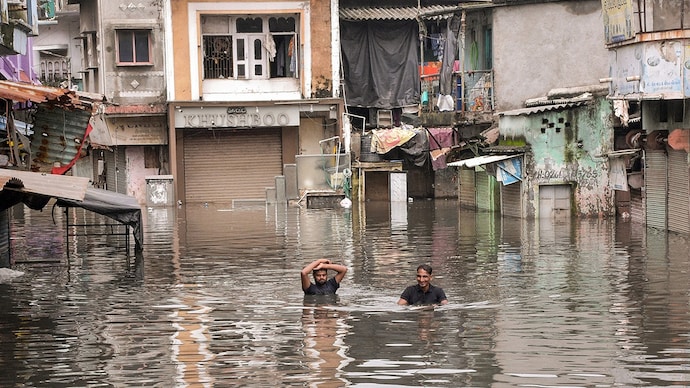
By the morning of July 8, the city had recorded 358 mm of rain in 24 hours, its heaviest single day on record and close to what Surat normally expects across the whole of July. Municipal commissioner M. Nagarajan told a review meeting chaired by chief minister Bhupendra Patel that nearly 30 per cent of the season’s rainfall had fallen on the city in that week alone.
Nine days later, merely moderate rain put roads in Vesu, New City Light and Althan under water. On July 20, an ordinary downpour met a high tide and floodwater entered at least 34 low-lying settlements. Schools shut again on July 24, and residents were still wading through flooded lanes on July 25. By then, Surat had banked close to 93 per cent of its seasonal average against roughly 52 per cent for Gujarat as a whole.
At least 26 people died in the July 8 flooding, according to Surat collector Tejas Parmar, from electrocution, drowning, lightning or falling trees. The municipal corporation noted waterlogging at 187 spots. Nagarajan put the count at 3,600 people rescued and 4,100 shifted to relief centres, with two National Disaster Response Force (NDRF) and five State Disaster Response Force (SDRF) teams still deployed.
No official survey of the losses has been published. The Confederation of All India Traders, whose Gujarat chapter president Pramod Bhagat has petitioned deputy chief minister Harsh Sanghavi and Parmar for an assessment, estimates more than 1,000 traders suffered losses. He put the damage at the Poddar Plaza mobile and electronics market on Varachha Road at close to Rs 200 crore and a comparable Rs 200 crore estimate for the textile industry, with over 1,000 shops and warehouses inundated across Bhathena, Udhna, Limbayat and Godadara.
In Sachin GIDC, industrialists who lost machinery and stock blamed poor drainage and pre-monsoon preparation. Traders were blunter. “All shops in this area are flooded, and business owners like me are suffering,” Mahesh Gadhiya of Yash Plaza Complex on Varachha Road told the media.
Daily life stopped. Schools, colleges and anganwadis shut and BRTS (Bus Rapid Transit System) routes were suspended. Commuters waded through the railway station underpass, and in Limbayat, two-wheelers vanished under water as fire crews and rescue teams reached by boat.
Rains lashed the wider south Gujarat region too, with Parmar noting that Palsana and Kamrej talukas had recorded the district’s heaviest rainfall. The NDRF rescued 67 people from a village in neighbouring Navsari. But Surat, dense and low-lying, absorbed the worst.
The questions on city dwellers’ minds today, and after every such incident, are why this pattern repeats season after season and doesn’t get fixed. The immediate answer is design. Indian stormwater networks are typically built to clear 12-20 mm of rain an hour while modern cloudbursts deliver several times that. But Surat’s real vulnerability is its khadis, the interlinked creek network that drains the city.
When Kankara Khadi overflows, water backflows into Mithi Khadi and enters homes in Limbayat. Stretches of Koyali Khadi are being fully concretised, cutting natural capacity, and the silt dredged during pre-monsoon desilting is dumped on the banks, only to wash back in with the first heavy rain.
Layered on that is geography. Surat sits at the Tapi estuary, where a high tide shuts the exit, which is what turned an ordinary spell into a flood on July 20. Town planning schemes have been drawn without reference to natural contours, creeks have been filled and coastal regulation rules treated loosely. Citizen expert groups set this out in two reports, ‘Whose Fault, Whose Sin, Whose Cost?’ in 2024 and ‘Invited Disaster: Khadi Floods in Surat’ in 2025. Neither produced a post-monsoon action plan.
Historically, Surat has experienced major floods approximately 20 times since the 1700s, including significant modern events in 2002 and 2006. However, the crisis has intensified recently, with consecutive monsoon flooding recorded in both 2024 and June 2025.
The last time it flooded miserably was in August 2006, when the Ukai dam released water into a swollen Tapi and 80-95 per cent of the city went under for four days. Official deaths were put at 120 to 150, unofficial estimates ran far higher, and damage was assessed between Rs 9,500 crore and Rs 21,000 crore. Two citizen inquiries called it mismanagement, not a natural disaster.
Twenty years on, the state has announced a Rs 550 crore relief package and, as chief minister Patel said at Althan, Rs 500 crore for creek development as a permanent fix for the city’s recurring tidal flooding. For the umpteenth time, the people of Surat are hoping the old diagnosis and tall budgetary allocation yield solutions, not empty promises and another inundated season.
Subscribe to India Today Magazine
By the morning of July 8, the city had recorded 358 mm of rain in 24 hours, its heaviest single day on record and close to what Surat normally expects across the whole of July. Municipal commissioner M. Nagarajan told a review meeting chaired by chief minister Bhupendra Patel that nearly 30 per cent of the season’s rainfall had fallen on the city in that week alone.
Nine days later, merely moderate rain put roads in Vesu, New City Light and Althan under water. On July 20, an ordinary downpour met a high tide and floodwater entered at least 34 low-lying settlements. Schools shut again on July 24, and residents were still wading through flooded lanes on July 25. By then, Surat had banked close to 93 per cent of its seasonal average against roughly 52 per cent for Gujarat as a whole.
At least 26 people died in the July 8 flooding, according to Surat collector Tejas Parmar, from electrocution, drowning, lightning or falling trees. The municipal corporation noted waterlogging at 187 spots. Nagarajan put the count at 3,600 people rescued and 4,100 shifted to relief centres, with two National Disaster Response Force (NDRF) and five State Disaster Response Force (SDRF) teams still deployed.
No official survey of the losses has been published. The Confederation of All India Traders, whose Gujarat chapter president Pramod Bhagat has petitioned deputy chief minister Harsh Sanghavi and Parmar for an assessment, estimates more than 1,000 traders suffered losses. He put the damage at the Poddar Plaza mobile and electronics market on Varachha Road at close to Rs 200 crore and a comparable Rs 200 crore estimate for the textile industry, with over 1,000 shops and warehouses inundated across Bhathena, Udhna, Limbayat and Godadara.
In Sachin GIDC, industrialists who lost machinery and stock blamed poor drainage and pre-monsoon preparation. Traders were blunter. “All shops in this area are flooded, and business owners like me are suffering,” Mahesh Gadhiya of Yash Plaza Complex on Varachha Road told the media.
Daily life stopped. Schools, colleges and anganwadis shut and BRTS (Bus Rapid Transit System) routes were suspended. Commuters waded through the railway station underpass, and in Limbayat, two-wheelers vanished under water as fire crews and rescue teams reached by boat.
Rains lashed the wider south Gujarat region too, with Parmar noting that Palsana and Kamrej talukas had recorded the district’s heaviest rainfall. The NDRF rescued 67 people from a village in neighbouring Navsari. But Surat, dense and low-lying, absorbed the worst.
The questions on city dwellers’ minds today, and after every such incident, are why this pattern repeats season after season and doesn’t get fixed. The immediate answer is design. Indian stormwater networks are typically built to clear 12-20 mm of rain an hour while modern cloudbursts deliver several times that. But Surat’s real vulnerability is its khadis, the interlinked creek network that drains the city.
When Kankara Khadi overflows, water backflows into Mithi Khadi and enters homes in Limbayat. Stretches of Koyali Khadi are being fully concretised, cutting natural capacity, and the silt dredged during pre-monsoon desilting is dumped on the banks, only to wash back in with the first heavy rain.
Layered on that is geography. Surat sits at the Tapi estuary, where a high tide shuts the exit, which is what turned an ordinary spell into a flood on July 20. Town planning schemes have been drawn without reference to natural contours, creeks have been filled and coastal regulation rules treated loosely. Citizen expert groups set this out in two reports, ‘Whose Fault, Whose Sin, Whose Cost?’ in 2024 and ‘Invited Disaster: Khadi Floods in Surat’ in 2025. Neither produced a post-monsoon action plan.
Historically, Surat has experienced major floods approximately 20 times since the 1700s, including significant modern events in 2002 and 2006. However, the crisis has intensified recently, with consecutive monsoon flooding recorded in both 2024 and June 2025.
The last time it flooded miserably was in August 2006, when the Ukai dam released water into a swollen Tapi and 80-95 per cent of the city went under for four days. Official deaths were put at 120 to 150, unofficial estimates ran far higher, and damage was assessed between Rs 9,500 crore and Rs 21,000 crore. Two citizen inquiries called it mismanagement, not a natural disaster.
Twenty years on, the state has announced a Rs 550 crore relief package and, as chief minister Patel said at Althan, Rs 500 crore for creek development as a permanent fix for the city’s recurring tidal flooding. For the umpteenth time, the people of Surat are hoping the old diagnosis and tall budgetary allocation yield solutions, not empty promises and another inundated season.
Subscribe to India Today Magazine
By the morning of July 8, the city had recorded 358 mm of rain in 24 hours, its heaviest single day on record and close to what Surat normally expects across the whole of July. Municipal commissioner M. Nagarajan told a review meeting chaired by chief minister Bhupendra Patel that nearly 30 per cent of the season’s rainfall had fallen on the city in that week alone.
Nine days later, merely moderate rain put roads in Vesu, New City Light and Althan under water. On July 20, an ordinary downpour met a high tide and floodwater entered at least 34 low-lying settlements. Schools shut again on July 24, and residents were still wading through flooded lanes on July 25. By then, Surat had banked close to 93 per cent of its seasonal average against roughly 52 per cent for Gujarat as a whole.
At least 26 people died in the July 8 flooding, according to Surat collector Tejas Parmar, from electrocution, drowning, lightning or falling trees. The municipal corporation noted waterlogging at 187 spots. Nagarajan put the count at 3,600 people rescued and 4,100 shifted to relief centres, with two National Disaster Response Force (NDRF) and five State Disaster Response Force (SDRF) teams still deployed.
No official survey of the losses has been published. The Confederation of All India Traders, whose Gujarat chapter president Pramod Bhagat has petitioned deputy chief minister Harsh Sanghavi and Parmar for an assessment, estimates more than 1,000 traders suffered losses. He put the damage at the Poddar Plaza mobile and electronics market on Varachha Road at close to Rs 200 crore and a comparable Rs 200 crore estimate for the textile industry, with over 1,000 shops and warehouses inundated across Bhathena, Udhna, Limbayat and Godadara.
In Sachin GIDC, industrialists who lost machinery and stock blamed poor drainage and pre-monsoon preparation. Traders were blunter. “All shops in this area are flooded, and business owners like me are suffering,” Mahesh Gadhiya of Yash Plaza Complex on Varachha Road told the media.
Daily life stopped. Schools, colleges and anganwadis shut and BRTS (Bus Rapid Transit System) routes were suspended. Commuters waded through the railway station underpass, and in Limbayat, two-wheelers vanished under water as fire crews and rescue teams reached by boat.
Rains lashed the wider south Gujarat region too, with Parmar noting that Palsana and Kamrej talukas had recorded the district’s heaviest rainfall. The NDRF rescued 67 people from a village in neighbouring Navsari. But Surat, dense and low-lying, absorbed the worst.
The questions on city dwellers’ minds today, and after every such incident, are why this pattern repeats season after season and doesn’t get fixed. The immediate answer is design. Indian stormwater networks are typically built to clear 12-20 mm of rain an hour while modern cloudbursts deliver several times that. But Surat’s real vulnerability is its khadis, the interlinked creek network that drains the city.
When Kankara Khadi overflows, water backflows into Mithi Khadi and enters homes in Limbayat. Stretches of Koyali Khadi are being fully concretised, cutting natural capacity, and the silt dredged during pre-monsoon desilting is dumped on the banks, only to wash back in with the first heavy rain.
Layered on that is geography. Surat sits at the Tapi estuary, where a high tide shuts the exit, which is what turned an ordinary spell into a flood on July 20. Town planning schemes have been drawn without reference to natural contours, creeks have been filled and coastal regulation rules treated loosely. Citizen expert groups set this out in two reports, ‘Whose Fault, Whose Sin, Whose Cost?’ in 2024 and ‘Invited Disaster: Khadi Floods in Surat’ in 2025. Neither produced a post-monsoon action plan.
Historically, Surat has experienced major floods approximately 20 times since the 1700s, including significant modern events in 2002 and 2006. However, the crisis has intensified recently, with consecutive monsoon flooding recorded in both 2024 and June 2025.
The last time it flooded miserably was in August 2006, when the Ukai dam released water into a swollen Tapi and 80-95 per cent of the city went under for four days. Official deaths were put at 120 to 150, unofficial estimates ran far higher, and damage was assessed between Rs 9,500 crore and Rs 21,000 crore. Two citizen inquiries called it mismanagement, not a natural disaster.
Twenty years on, the state has announced a Rs 550 crore relief package and, as chief minister Patel said at Althan, Rs 500 crore for creek development as a permanent fix for the city’s recurring tidal flooding. For the umpteenth time, the people of Surat are hoping the old diagnosis and tall budgetary allocation yield solutions, not empty promises and another inundated season.
Subscribe to India Today Magazine

