Know your laws: Wangchuk case raises a bigger question on hunger strikes
From Irom Sharmila to Sonam Wangchuk, India's history of hunger strikes meets a new legal question: when does a protest become attempted suicide, and how far can the State go to intervene?
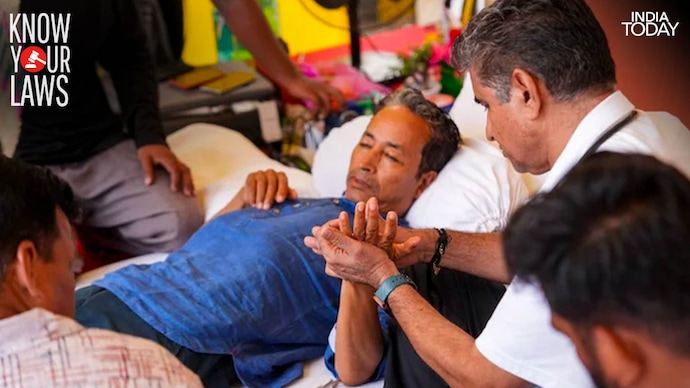
In India, hunger strikes, jal satyagrahas and even extreme forms of protest have long been used to challenge government policies. But the hospitalisation of activist Sonam Wangchuk during his hunger strike has brought an old question into sharper focus: how far can the State go to protect a protester's life, and at what point does intervention begin to clash with the right to protest?
Wangchuk, who was on the 20th day of his hunger strike, was picked up from Jantar Mantar and admitted to Delhi's Safdarjung Hospital. His wife and lawyers have alleged that no documentation or detention order was shown to them. The police, however, said the action was taken on the orders of the Delhi High Court.
The episode has raised questions not only about Wangchuk's hospitalisation, but also about the way Indian law views hunger strikes as a form of protest.
The Bharatiya Nyaya Sanhita has introduced a provision that did not exist in the Indian Penal Code. Section 226 of the BNS makes it an offence to attempt suicide with the intention of compelling or restraining a public servant from discharging their official duty.
The provision says: "Whoever attempts to commit suicide with the intent to compel or restrain any public servant from discharging his official duty shall be punished with simple imprisonment for a term which may extend to one year, or with fine, or with both, or with community service."
The provision has acquired significance amid the continuing debate over hunger strikes and other forms of protest against government action.
Recently, at a gathering of businesspersons, lawyers and journalists in Delhi, Solicitor General of India Tushar Mehta said the old IPC had given priority in the numbering of sections to the sedition provision, which protected the government, over provisions that protected citizens.
"Now Bharatiya Nyaya Sanhita has given chronology of sections according to what is important to citizens today," he said.
But the BNS also contains Section 226, which specifically deals with an attempt to commit suicide to compel a public servant to act or refrain from acting in the discharge of their official duty.
THE LAW HAS LONG RECOGNISED HUNGER STRIKES AS PROTEST
The question is not new.
In the Ramlila Maidan case in 2012, the Supreme Court acknowledged the widespread acceptance of hunger strikes as a method of protest.
"The threat of going on a hunger strike extended by Baba Ramdev to personify his stand on the issues raised, cannot be termed as unconstitutional or barred under any law. It is a form of protest which has been accepted, both historically and legally in our constitutional jurisprudence," the court said.
In its 2018 verdict in the Mazdoor Kisan Shakti Sangathan case, the Supreme Court recognised that Article 19 protects the right to peaceful assembly and protest against government action or decision-making as a basic feature of a democratic system.
The court also said the police could frame guidelines to regulate protests and demonstrations, but such regulation could not become a complete ban.
India's history of hunger strikes as a form of protest stretches from Mahatma Gandhi's Satyagraha during the colonial period to protests by retired soldiers seeking One Rank One Pension.
For nearly 15 years, Irom Sharmila was in and out of jail and hospital during her hunger strike. She was force-fed through a nasal tube. In 2014, a Manipur court ordered her release, accepting that her fast was a "political demand through a lawful means" rather than an attempt to take her own life.
The legal position, however, has changed since then.
Irom Sharmila could be arrested because the IPC criminalised an attempt to commit suicide, allowing the police and administration to intervene to prevent the commission of the offence.
In 2017, the Mental Healthcare Act brought in provisions saying that people attempting suicide should not face prosecution but should receive medical help.
The new BNS provision, however, specifically criminalises an attempt to commit suicide when it is used to compel or restrain a public servant from discharging their official duty.
LEGAL EXPERTS QUESTION THE APPLICATION OF SECTION 226
Speaking to India Today, senior advocate Gopal Sankarnarayanan said there did not appear to be an FIR against Wangchuk.
"Fasts cannot in any case be treated as attempt to suicide. Would you arrest a person in the first minute of his fast saying he is attempting suicide? At what stage do you say it is an attempt? If at all, Section 226 applies to cases where someone stands on a bridge or brandishes a gun and makes threats against the State. If there has been no FIR, the detention of Sonam is illegal and he must be released forthwith," he said.
Senior lawyer and former ASG Sidharth Luthra also raised questions about the right to protest and the State's response to such demonstrations.
"The law may eventually determine how far the State must go to preserve life during an indefinite fast. The larger question is whether those who rule us in a democracy consider why the need for an indefinite fast?" Luthra said in a social media post.
He added that peaceful dissent should not be ignored at the peril of a citizen's health.
"The validity of the concerns that drive a person to fast unto death is not to be dealt with as a medical situation, but the final language of someone who believes the cause that they espouse peacefully is no longer being heard. A nation which holds freedom of expression as a fundamental right can only be strengthened by its willingness to engage with peaceful dissent," he said.
Senior advocate Sanjoy Ghosh also questioned the police intervention in Wangchuk's protest. He said criminal procedure laws did not allow the police to detain or arrest someone unless a cognisable offence was being committed.
Ghosh described the High Court order as a "fig leaf" and questioned the need for such a PIL and order during a protest.
"The BNS replaced Section 309 IPC with Section 226, criminalising suicide only to a limited extent, ie when it is used to compel a public servant to exercise or desist from exercising any lawful action. Perhaps this was enacted keeping the Anna Hazare episode in mind," Ghosh said.
He added that Section 170 of the BNSS, which replaced Section 151 of the CrPC, permits arrest only in relation to a cognisable offence.
"Section 226 BNS is not a cognisable offence. Hence the police has used the fig leaf of the Delhi High Court order," he said.
THE DELHI HIGH COURT ORDER AND THE QUESTIONS IT RAISES
Wangchuk was admitted to Safdarjung Hospital on Saturday. On Sunday, the Delhi High Court convened a special bench to hear a plea filed by his wife, Gitanjali Angmo, who sought his discharge from the hospital and permission to transfer him to another hospital.
The proceedings brought the legal questions into sharper focus.
The bench of Justice Mini Pushkarna recorded that Wangchuk was not in detention and that there was no FIR against him. At the same time, it held that the government's decision to pick him up from Jantar Mantar and transfer him to Safdarjung Hospital was justified because of his "precarious health condition".
Additional Solicitor General Chetan Sharma argued that Wangchuk's health condition could have "serious consequences" and that the government therefore had to ensure his safety.
"In prevailing circumstances, government has to be extra careful. Whatever happens to him will have consequences," the ASG argued.
The court accepted this argument as a justification for his hospitalisation.
The bench also asked Wangchuk to cooperate with the doctors monitoring his health and said medical treatment would be decided by the medical board with Wangchuk's consent.
However, the court did not pass an order allowing his family to transfer him to another hospital. Nor did it hold that Wangchuk had been denied his right as a citizen to decide on his own medical treatment.
The court's order, in fact, acknowledges that Wangchuk is not under detention.
That leaves the central question at the heart of the controversy: if a citizen is not under detention, why is he being kept in a particular hospital when his family wants to shift him to another medical facility?
And can the government or the court justify keeping someone in a particular hospital because of the fear of "serious consequences outside"?
The Sonam Wangchuk case has therefore brought together questions of personal autonomy, medical consent, the right to protest and the State's duty to preserve life.
The answers could determine how India's legal system approaches one of the country's oldest forms of political dissent: the hunger strike.
In India, hunger strikes, jal satyagrahas and even extreme forms of protest have long been used to challenge government policies. But the hospitalisation of activist Sonam Wangchuk during his hunger strike has brought an old question into sharper focus: how far can the State go to protect a protester's life, and at what point does intervention begin to clash with the right to protest?
Wangchuk, who was on the 20th day of his hunger strike, was picked up from Jantar Mantar and admitted to Delhi's Safdarjung Hospital. His wife and lawyers have alleged that no documentation or detention order was shown to them. The police, however, said the action was taken on the orders of the Delhi High Court.
The episode has raised questions not only about Wangchuk's hospitalisation, but also about the way Indian law views hunger strikes as a form of protest.
The Bharatiya Nyaya Sanhita has introduced a provision that did not exist in the Indian Penal Code. Section 226 of the BNS makes it an offence to attempt suicide with the intention of compelling or restraining a public servant from discharging their official duty.
The provision says: "Whoever attempts to commit suicide with the intent to compel or restrain any public servant from discharging his official duty shall be punished with simple imprisonment for a term which may extend to one year, or with fine, or with both, or with community service."
The provision has acquired significance amid the continuing debate over hunger strikes and other forms of protest against government action.
Recently, at a gathering of businesspersons, lawyers and journalists in Delhi, Solicitor General of India Tushar Mehta said the old IPC had given priority in the numbering of sections to the sedition provision, which protected the government, over provisions that protected citizens.
"Now Bharatiya Nyaya Sanhita has given chronology of sections according to what is important to citizens today," he said.
But the BNS also contains Section 226, which specifically deals with an attempt to commit suicide to compel a public servant to act or refrain from acting in the discharge of their official duty.
THE LAW HAS LONG RECOGNISED HUNGER STRIKES AS PROTEST
The question is not new.
In the Ramlila Maidan case in 2012, the Supreme Court acknowledged the widespread acceptance of hunger strikes as a method of protest.
"The threat of going on a hunger strike extended by Baba Ramdev to personify his stand on the issues raised, cannot be termed as unconstitutional or barred under any law. It is a form of protest which has been accepted, both historically and legally in our constitutional jurisprudence," the court said.
In its 2018 verdict in the Mazdoor Kisan Shakti Sangathan case, the Supreme Court recognised that Article 19 protects the right to peaceful assembly and protest against government action or decision-making as a basic feature of a democratic system.
The court also said the police could frame guidelines to regulate protests and demonstrations, but such regulation could not become a complete ban.
India's history of hunger strikes as a form of protest stretches from Mahatma Gandhi's Satyagraha during the colonial period to protests by retired soldiers seeking One Rank One Pension.
For nearly 15 years, Irom Sharmila was in and out of jail and hospital during her hunger strike. She was force-fed through a nasal tube. In 2014, a Manipur court ordered her release, accepting that her fast was a "political demand through a lawful means" rather than an attempt to take her own life.
The legal position, however, has changed since then.
Irom Sharmila could be arrested because the IPC criminalised an attempt to commit suicide, allowing the police and administration to intervene to prevent the commission of the offence.
In 2017, the Mental Healthcare Act brought in provisions saying that people attempting suicide should not face prosecution but should receive medical help.
The new BNS provision, however, specifically criminalises an attempt to commit suicide when it is used to compel or restrain a public servant from discharging their official duty.
LEGAL EXPERTS QUESTION THE APPLICATION OF SECTION 226
Speaking to India Today, senior advocate Gopal Sankarnarayanan said there did not appear to be an FIR against Wangchuk.
"Fasts cannot in any case be treated as attempt to suicide. Would you arrest a person in the first minute of his fast saying he is attempting suicide? At what stage do you say it is an attempt? If at all, Section 226 applies to cases where someone stands on a bridge or brandishes a gun and makes threats against the State. If there has been no FIR, the detention of Sonam is illegal and he must be released forthwith," he said.
Senior lawyer and former ASG Sidharth Luthra also raised questions about the right to protest and the State's response to such demonstrations.
"The law may eventually determine how far the State must go to preserve life during an indefinite fast. The larger question is whether those who rule us in a democracy consider why the need for an indefinite fast?" Luthra said in a social media post.
He added that peaceful dissent should not be ignored at the peril of a citizen's health.
"The validity of the concerns that drive a person to fast unto death is not to be dealt with as a medical situation, but the final language of someone who believes the cause that they espouse peacefully is no longer being heard. A nation which holds freedom of expression as a fundamental right can only be strengthened by its willingness to engage with peaceful dissent," he said.
Senior advocate Sanjoy Ghosh also questioned the police intervention in Wangchuk's protest. He said criminal procedure laws did not allow the police to detain or arrest someone unless a cognisable offence was being committed.
Ghosh described the High Court order as a "fig leaf" and questioned the need for such a PIL and order during a protest.
"The BNS replaced Section 309 IPC with Section 226, criminalising suicide only to a limited extent, ie when it is used to compel a public servant to exercise or desist from exercising any lawful action. Perhaps this was enacted keeping the Anna Hazare episode in mind," Ghosh said.
He added that Section 170 of the BNSS, which replaced Section 151 of the CrPC, permits arrest only in relation to a cognisable offence.
"Section 226 BNS is not a cognisable offence. Hence the police has used the fig leaf of the Delhi High Court order," he said.
THE DELHI HIGH COURT ORDER AND THE QUESTIONS IT RAISES
Wangchuk was admitted to Safdarjung Hospital on Saturday. On Sunday, the Delhi High Court convened a special bench to hear a plea filed by his wife, Gitanjali Angmo, who sought his discharge from the hospital and permission to transfer him to another hospital.
The proceedings brought the legal questions into sharper focus.
The bench of Justice Mini Pushkarna recorded that Wangchuk was not in detention and that there was no FIR against him. At the same time, it held that the government's decision to pick him up from Jantar Mantar and transfer him to Safdarjung Hospital was justified because of his "precarious health condition".
Additional Solicitor General Chetan Sharma argued that Wangchuk's health condition could have "serious consequences" and that the government therefore had to ensure his safety.
"In prevailing circumstances, government has to be extra careful. Whatever happens to him will have consequences," the ASG argued.
The court accepted this argument as a justification for his hospitalisation.
The bench also asked Wangchuk to cooperate with the doctors monitoring his health and said medical treatment would be decided by the medical board with Wangchuk's consent.
However, the court did not pass an order allowing his family to transfer him to another hospital. Nor did it hold that Wangchuk had been denied his right as a citizen to decide on his own medical treatment.
The court's order, in fact, acknowledges that Wangchuk is not under detention.
That leaves the central question at the heart of the controversy: if a citizen is not under detention, why is he being kept in a particular hospital when his family wants to shift him to another medical facility?
And can the government or the court justify keeping someone in a particular hospital because of the fear of "serious consequences outside"?
The Sonam Wangchuk case has therefore brought together questions of personal autonomy, medical consent, the right to protest and the State's duty to preserve life.
The answers could determine how India's legal system approaches one of the country's oldest forms of political dissent: the hunger strike.
In India, hunger strikes, jal satyagrahas and even extreme forms of protest have long been used to challenge government policies. But the hospitalisation of activist Sonam Wangchuk during his hunger strike has brought an old question into sharper focus: how far can the State go to protect a protester's life, and at what point does intervention begin to clash with the right to protest?
Wangchuk, who was on the 20th day of his hunger strike, was picked up from Jantar Mantar and admitted to Delhi's Safdarjung Hospital. His wife and lawyers have alleged that no documentation or detention order was shown to them. The police, however, said the action was taken on the orders of the Delhi High Court.
The episode has raised questions not only about Wangchuk's hospitalisation, but also about the way Indian law views hunger strikes as a form of protest.
The Bharatiya Nyaya Sanhita has introduced a provision that did not exist in the Indian Penal Code. Section 226 of the BNS makes it an offence to attempt suicide with the intention of compelling or restraining a public servant from discharging their official duty.
The provision says: "Whoever attempts to commit suicide with the intent to compel or restrain any public servant from discharging his official duty shall be punished with simple imprisonment for a term which may extend to one year, or with fine, or with both, or with community service."
The provision has acquired significance amid the continuing debate over hunger strikes and other forms of protest against government action.
Recently, at a gathering of businesspersons, lawyers and journalists in Delhi, Solicitor General of India Tushar Mehta said the old IPC had given priority in the numbering of sections to the sedition provision, which protected the government, over provisions that protected citizens.
"Now Bharatiya Nyaya Sanhita has given chronology of sections according to what is important to citizens today," he said.
But the BNS also contains Section 226, which specifically deals with an attempt to commit suicide to compel a public servant to act or refrain from acting in the discharge of their official duty.
THE LAW HAS LONG RECOGNISED HUNGER STRIKES AS PROTEST
The question is not new.
In the Ramlila Maidan case in 2012, the Supreme Court acknowledged the widespread acceptance of hunger strikes as a method of protest.
"The threat of going on a hunger strike extended by Baba Ramdev to personify his stand on the issues raised, cannot be termed as unconstitutional or barred under any law. It is a form of protest which has been accepted, both historically and legally in our constitutional jurisprudence," the court said.
In its 2018 verdict in the Mazdoor Kisan Shakti Sangathan case, the Supreme Court recognised that Article 19 protects the right to peaceful assembly and protest against government action or decision-making as a basic feature of a democratic system.
The court also said the police could frame guidelines to regulate protests and demonstrations, but such regulation could not become a complete ban.
India's history of hunger strikes as a form of protest stretches from Mahatma Gandhi's Satyagraha during the colonial period to protests by retired soldiers seeking One Rank One Pension.
For nearly 15 years, Irom Sharmila was in and out of jail and hospital during her hunger strike. She was force-fed through a nasal tube. In 2014, a Manipur court ordered her release, accepting that her fast was a "political demand through a lawful means" rather than an attempt to take her own life.
The legal position, however, has changed since then.
Irom Sharmila could be arrested because the IPC criminalised an attempt to commit suicide, allowing the police and administration to intervene to prevent the commission of the offence.
In 2017, the Mental Healthcare Act brought in provisions saying that people attempting suicide should not face prosecution but should receive medical help.
The new BNS provision, however, specifically criminalises an attempt to commit suicide when it is used to compel or restrain a public servant from discharging their official duty.
LEGAL EXPERTS QUESTION THE APPLICATION OF SECTION 226
Speaking to India Today, senior advocate Gopal Sankarnarayanan said there did not appear to be an FIR against Wangchuk.
"Fasts cannot in any case be treated as attempt to suicide. Would you arrest a person in the first minute of his fast saying he is attempting suicide? At what stage do you say it is an attempt? If at all, Section 226 applies to cases where someone stands on a bridge or brandishes a gun and makes threats against the State. If there has been no FIR, the detention of Sonam is illegal and he must be released forthwith," he said.
Senior lawyer and former ASG Sidharth Luthra also raised questions about the right to protest and the State's response to such demonstrations.
"The law may eventually determine how far the State must go to preserve life during an indefinite fast. The larger question is whether those who rule us in a democracy consider why the need for an indefinite fast?" Luthra said in a social media post.
He added that peaceful dissent should not be ignored at the peril of a citizen's health.
"The validity of the concerns that drive a person to fast unto death is not to be dealt with as a medical situation, but the final language of someone who believes the cause that they espouse peacefully is no longer being heard. A nation which holds freedom of expression as a fundamental right can only be strengthened by its willingness to engage with peaceful dissent," he said.
Senior advocate Sanjoy Ghosh also questioned the police intervention in Wangchuk's protest. He said criminal procedure laws did not allow the police to detain or arrest someone unless a cognisable offence was being committed.
Ghosh described the High Court order as a "fig leaf" and questioned the need for such a PIL and order during a protest.
"The BNS replaced Section 309 IPC with Section 226, criminalising suicide only to a limited extent, ie when it is used to compel a public servant to exercise or desist from exercising any lawful action. Perhaps this was enacted keeping the Anna Hazare episode in mind," Ghosh said.
He added that Section 170 of the BNSS, which replaced Section 151 of the CrPC, permits arrest only in relation to a cognisable offence.
"Section 226 BNS is not a cognisable offence. Hence the police has used the fig leaf of the Delhi High Court order," he said.
THE DELHI HIGH COURT ORDER AND THE QUESTIONS IT RAISES
Wangchuk was admitted to Safdarjung Hospital on Saturday. On Sunday, the Delhi High Court convened a special bench to hear a plea filed by his wife, Gitanjali Angmo, who sought his discharge from the hospital and permission to transfer him to another hospital.
The proceedings brought the legal questions into sharper focus.
The bench of Justice Mini Pushkarna recorded that Wangchuk was not in detention and that there was no FIR against him. At the same time, it held that the government's decision to pick him up from Jantar Mantar and transfer him to Safdarjung Hospital was justified because of his "precarious health condition".
Additional Solicitor General Chetan Sharma argued that Wangchuk's health condition could have "serious consequences" and that the government therefore had to ensure his safety.
"In prevailing circumstances, government has to be extra careful. Whatever happens to him will have consequences," the ASG argued.
The court accepted this argument as a justification for his hospitalisation.
The bench also asked Wangchuk to cooperate with the doctors monitoring his health and said medical treatment would be decided by the medical board with Wangchuk's consent.
However, the court did not pass an order allowing his family to transfer him to another hospital. Nor did it hold that Wangchuk had been denied his right as a citizen to decide on his own medical treatment.
The court's order, in fact, acknowledges that Wangchuk is not under detention.
That leaves the central question at the heart of the controversy: if a citizen is not under detention, why is he being kept in a particular hospital when his family wants to shift him to another medical facility?
And can the government or the court justify keeping someone in a particular hospital because of the fear of "serious consequences outside"?
The Sonam Wangchuk case has therefore brought together questions of personal autonomy, medical consent, the right to protest and the State's duty to preserve life.
The answers could determine how India's legal system approaches one of the country's oldest forms of political dissent: the hunger strike.

