Amarnath ice lingam melts just 5 days into the 57-day Yatra. Who's to blame?
The Amarnath Yatra, a year after the Pahalgam terror attack, which hit tourism and pilgrimage, has drawn record pilgrims. But the sacred ice lingam in the cave shrine has shrunk dramatically in just five days. Over 50 days of the pilgrimage are still to go. Is climate change alone to blame, or is there more to the story?
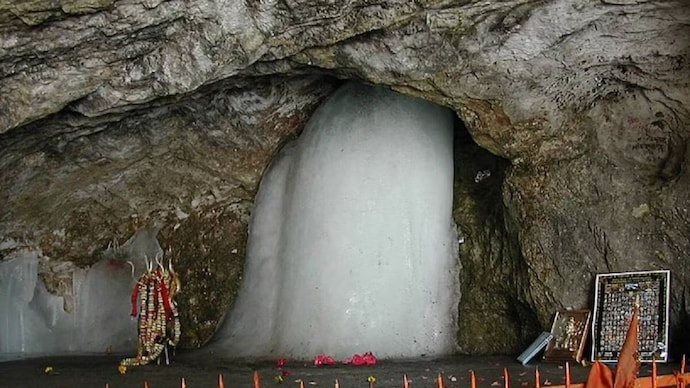
A year after the Pahalgam terror attack hit pilgrimage and tourism in Jammu and Kashmir, the ongoing Amarnath Yatra is witnessing an overwhelming response from devotees. With record numbers of devotees returning to the Amarnath cave shrine, the naturally formed ice lingam, also called the Baba Barfani, has melted by over 90%. Some reports even say that the ice lingam has almost disappeared just five days into the 57-day Yatra. People on social media have also claimed that the Amarnath ice lingam shrunk just days into the pilgrimage in Jammu and Kashmir.
Raising an alarm, and sharing images of the shrinking lingam, People's Democratic Party (PDF) leader, Iltija Mufti, questioned the management of the pilgrimage during the Amarnath Yatra and sought intervention. Raising concerns over the environmental impact on the cave shrine, Mufti referred to a Supreme Court-mandated cap on daily pilgrims, which she said was 10,000. Mufti's statement on X came even as authorities celebrated a sharp rise in pilgrim turnout after last year's terror attack.
The shrinking of the sacred ice formation, which has been revered for centuries as Baba Barfani, has reignited an old debate. Is climate change melting the ice lingam earlier than before every year? Are rising pilgrim numbers and expanding infrastructure inside the fragile Himalayan ecosystem accelerating the lingam's shrinking?
The Amarnath Cave Shrine is located at an altitude of about 3,888 metres (12,756 feet) in the Himalayas of Jammu and Kashmir's Anantnag district. It's nestled beneath the Lidder Valley in the Kashmir Himalayas. Pilgrims can reach the shrine via the traditional 48-km Pahalgam route or the shorter but steeper 14-km Baltal route.
The pilgrims worship the naturally formed ice lingam, which is a seasonal ice stalagmite that waxes and wanes with the cave's temperature and weather conditions.
IS RECORD PILGRIM FOOTFALL AT AMARNATH BEHIND EARLY MELTING OF LINGAM?
The Amarnath Yatra began on July 3 this year under unprecedented security following the April 2025 Pahalgam terror attack that killed 26 civilians. Despite security concerns, pilgrim numbers have surged.
At least 93,000 pilgrims visited the shrine in the first four days.
An Instagram video showed a woman climbing the Amarnath Yatra's Baltal route with a wooden stick, a forearm crutch and prosthetic limbs.
According to The Hindu newspaper, more than 32,000 devotees had offered prayers by July 5, while over 20,000 pilgrims visited the shrine on the second day of the Yatra alone. This was the highest second-day footfall in several years. Jammu and Kashmir Lieutenant Governor Manoj Sinha, who also heads the Shri Amarnath Shrine Board (SASB), described it as a "massive surge" compared to the previous four years.
The administration, however, simultaneously expressed concern over thousands of unregistered pilgrims arriving without mandatory health certificates or RFID registration, warning that they were straining both security arrangements and infrastructure, reported the newspaper.
"We are seeing a large influx of unregistered pilgrims. I strongly urge those without prior registration to remain patient and wait for their turn. This cooperation is essential for a smooth and seamless Yatra experience," Sinha said.
The Board has capped daily pilgrim numbers at 10,000 each along the Pahalgam and Baltal routes.
On being asked if there should be a limit on the number of pilgrims visiting the Amarnath cave shrine, Jammu and Kashmir CM Abdullah said a cap had already been placed by the Supreme Court, reported PTI.
HAS AMARNATH ICE LINGAM REALLY MELTED?
News reports from the shrine and accounts from devotees and journalists show that the ice lingam has shrunk dramatically within the first week of the Amarnath Yatra.
"Once again, the naturally formed Shiv lingam at Holy Amarnath Cave has melted within the first week of Amarnath Yatra," India Today journalist from the Srinagar Bureau, Ashraf Wani, posted on X on July 6, while hashtagging global warming and Kashmir.
"Only a week into Amarnath Yatra and the naturally formed lingam has already melted," PDP's Iltija Mufti, the daughter of former Jammu and Kashmir CM Mehbooba Mufti, posted on X, asking if the proposed ropeway to the cave shrine was at all needed.
Srinagar-based entrepreneur, Vineet Kaul, who goes by the name GuyFromValley on X, said the Amarnath ice lingam "has not melted like this for the first time", noting that similar early melting occurred in years such as 2004, 2006, 2007, 2016 and 2020. He, however, stressed that this example should not be used to ignore the issue.
Calling any proposed ropeway near the shrine "absolutely abhorrent", Kaul argued that while infrastructure and safety should improve, the area's ecology and sanctity must be preserved.
Some news reports claimed the ice formation had melted by over 90%. Others suggested it had almost completely disappeared. At the time of filing this report, the Shrine Board had not issued any statement or an official scientific assessment quantifying the extent of the melting.
A devotee from Indore, Madhya Pradesh, who visited the cave shrine during the initial days of the Yatra, told India Today TV that the shrinking of the ice lingam was clearly visible.
"The ice lingam has melted to some extent. This year, it has melted a little earlier than usual. The changing weather is also affecting people's faith in a way, because earlier Baba would give darshan to devotees for around 40 to 45 days. In recent years, however, the duration has reduced to barely five to seven days. This time, we had darshan on the fourth day of the Yatra, but the ice lingam had already melted significantly. It has become much smaller," he told India Today TV.
The naturally formed ice stalagmite waxes and wanes every year depending on snowfall, cave temperatures, humidity and weather conditions. Its size has never remained constant across pilgrimage seasons and years.
SO, WHY IS CLIMATE CHANGE THE BIGGEST FACTOR?
Scientists have repeatedly warned that the Himalayas are warming faster than many other mountain systems globally. Rising average temperatures, changing snowfall patterns and retreating glaciers have become increasingly visible across Jammu and Kashmir.
Media reports this week pointed to unusually warm conditions around the cave and surrounding glaciers as one of the principal reasons for the rapid melting of the ice stalagmite. The Amarnath cave lies at an altitude of nearly 3,900 metres. Even slight increases in ambient temperature, combined with changes in humidity inside the cave, can affect the growth and survival of the naturally forming ice structure.
Also, this is also not the first such episode. According to a report in AajTak Digital, the ice lingam melted within 29 days in 2018, 38 days in 2020, 28 days in 2022 and within about a week in 2024. This year, the melting appears to have occurred even earlier.
Weather or climate change might not be the only factor behind the quick melting of the lingam.
Over the past two decades, the Amaranth route has undergone significant changes. Roads have been widened, temporary accommodation has expanded, langars (community kitchens) have moved closer to the shrine, electricity and solar lighting have been introduced, and heavy machinery has been used to improve access. Recently, the Centre also approved a ropeway project. Discussions continue on a proposed tunnel between Sheshnag and Panchtarni.
While these steps have and would make the pilgrimage safer and more accessible, the cumulative impact of infrastructure expansion and rising human activity in an ecologically sensitive region might be altering the cave's microclimate. Therefore, a growing number of pilgrims adds to those concerns.
Congress national spokesperson Ashwani Handa urged Lieutenant Governor Manoj Sinha to order an "independent scientific study" to examine whether the recently built rain shelter near the Amarnath Cave was "altering the local microclimate and contributing to the faster melting of the Holy Ice Lingam". Handa on X said a "transparent, evidence-based assessment" was needed to protect both the shrine's sanctity and the fragile Himalayan environment.
According to an AajTak Digital report, annual pilgrim numbers, which were around one lakh two decades ago, crossed six lakh in 2011 and 2012. After a dip after the Covid pandemic and the Pahalgam attack, pilgrim numbers have risen again. LG Sinha also flagged the influx of unregistered pilgrims, warning that it was putting pressure on both security and the Yatra's infrastructure.
At present, there is no official or scientific study attributing the early melting of the lingam to a single cause. But the episode has highlighted the need to strike a balance between facilitating one of India's largest pilgrimages and preserving the fragile Himalayan ecosystem that sustains the sacred ice lingam that's revered by lakhs and crores of Hindus.
A year after the Pahalgam terror attack hit pilgrimage and tourism in Jammu and Kashmir, the ongoing Amarnath Yatra is witnessing an overwhelming response from devotees. With record numbers of devotees returning to the Amarnath cave shrine, the naturally formed ice lingam, also called the Baba Barfani, has melted by over 90%. Some reports even say that the ice lingam has almost disappeared just five days into the 57-day Yatra. People on social media have also claimed that the Amarnath ice lingam shrunk just days into the pilgrimage in Jammu and Kashmir.
Raising an alarm, and sharing images of the shrinking lingam, People's Democratic Party (PDF) leader, Iltija Mufti, questioned the management of the pilgrimage during the Amarnath Yatra and sought intervention. Raising concerns over the environmental impact on the cave shrine, Mufti referred to a Supreme Court-mandated cap on daily pilgrims, which she said was 10,000. Mufti's statement on X came even as authorities celebrated a sharp rise in pilgrim turnout after last year's terror attack.
The shrinking of the sacred ice formation, which has been revered for centuries as Baba Barfani, has reignited an old debate. Is climate change melting the ice lingam earlier than before every year? Are rising pilgrim numbers and expanding infrastructure inside the fragile Himalayan ecosystem accelerating the lingam's shrinking?
The Amarnath Cave Shrine is located at an altitude of about 3,888 metres (12,756 feet) in the Himalayas of Jammu and Kashmir's Anantnag district. It's nestled beneath the Lidder Valley in the Kashmir Himalayas. Pilgrims can reach the shrine via the traditional 48-km Pahalgam route or the shorter but steeper 14-km Baltal route.
The pilgrims worship the naturally formed ice lingam, which is a seasonal ice stalagmite that waxes and wanes with the cave's temperature and weather conditions.
IS RECORD PILGRIM FOOTFALL AT AMARNATH BEHIND EARLY MELTING OF LINGAM?
The Amarnath Yatra began on July 3 this year under unprecedented security following the April 2025 Pahalgam terror attack that killed 26 civilians. Despite security concerns, pilgrim numbers have surged.
At least 93,000 pilgrims visited the shrine in the first four days.
An Instagram video showed a woman climbing the Amarnath Yatra's Baltal route with a wooden stick, a forearm crutch and prosthetic limbs.
According to The Hindu newspaper, more than 32,000 devotees had offered prayers by July 5, while over 20,000 pilgrims visited the shrine on the second day of the Yatra alone. This was the highest second-day footfall in several years. Jammu and Kashmir Lieutenant Governor Manoj Sinha, who also heads the Shri Amarnath Shrine Board (SASB), described it as a "massive surge" compared to the previous four years.
The administration, however, simultaneously expressed concern over thousands of unregistered pilgrims arriving without mandatory health certificates or RFID registration, warning that they were straining both security arrangements and infrastructure, reported the newspaper.
"We are seeing a large influx of unregistered pilgrims. I strongly urge those without prior registration to remain patient and wait for their turn. This cooperation is essential for a smooth and seamless Yatra experience," Sinha said.
The Board has capped daily pilgrim numbers at 10,000 each along the Pahalgam and Baltal routes.
On being asked if there should be a limit on the number of pilgrims visiting the Amarnath cave shrine, Jammu and Kashmir CM Abdullah said a cap had already been placed by the Supreme Court, reported PTI.
HAS AMARNATH ICE LINGAM REALLY MELTED?
News reports from the shrine and accounts from devotees and journalists show that the ice lingam has shrunk dramatically within the first week of the Amarnath Yatra.
"Once again, the naturally formed Shiv lingam at Holy Amarnath Cave has melted within the first week of Amarnath Yatra," India Today journalist from the Srinagar Bureau, Ashraf Wani, posted on X on July 6, while hashtagging global warming and Kashmir.
"Only a week into Amarnath Yatra and the naturally formed lingam has already melted," PDP's Iltija Mufti, the daughter of former Jammu and Kashmir CM Mehbooba Mufti, posted on X, asking if the proposed ropeway to the cave shrine was at all needed.
Srinagar-based entrepreneur, Vineet Kaul, who goes by the name GuyFromValley on X, said the Amarnath ice lingam "has not melted like this for the first time", noting that similar early melting occurred in years such as 2004, 2006, 2007, 2016 and 2020. He, however, stressed that this example should not be used to ignore the issue.
Calling any proposed ropeway near the shrine "absolutely abhorrent", Kaul argued that while infrastructure and safety should improve, the area's ecology and sanctity must be preserved.
Some news reports claimed the ice formation had melted by over 90%. Others suggested it had almost completely disappeared. At the time of filing this report, the Shrine Board had not issued any statement or an official scientific assessment quantifying the extent of the melting.
A devotee from Indore, Madhya Pradesh, who visited the cave shrine during the initial days of the Yatra, told India Today TV that the shrinking of the ice lingam was clearly visible.
"The ice lingam has melted to some extent. This year, it has melted a little earlier than usual. The changing weather is also affecting people's faith in a way, because earlier Baba would give darshan to devotees for around 40 to 45 days. In recent years, however, the duration has reduced to barely five to seven days. This time, we had darshan on the fourth day of the Yatra, but the ice lingam had already melted significantly. It has become much smaller," he told India Today TV.
The naturally formed ice stalagmite waxes and wanes every year depending on snowfall, cave temperatures, humidity and weather conditions. Its size has never remained constant across pilgrimage seasons and years.
SO, WHY IS CLIMATE CHANGE THE BIGGEST FACTOR?
Scientists have repeatedly warned that the Himalayas are warming faster than many other mountain systems globally. Rising average temperatures, changing snowfall patterns and retreating glaciers have become increasingly visible across Jammu and Kashmir.
Media reports this week pointed to unusually warm conditions around the cave and surrounding glaciers as one of the principal reasons for the rapid melting of the ice stalagmite. The Amarnath cave lies at an altitude of nearly 3,900 metres. Even slight increases in ambient temperature, combined with changes in humidity inside the cave, can affect the growth and survival of the naturally forming ice structure.
Also, this is also not the first such episode. According to a report in AajTak Digital, the ice lingam melted within 29 days in 2018, 38 days in 2020, 28 days in 2022 and within about a week in 2024. This year, the melting appears to have occurred even earlier.
Weather or climate change might not be the only factor behind the quick melting of the lingam.
Over the past two decades, the Amaranth route has undergone significant changes. Roads have been widened, temporary accommodation has expanded, langars (community kitchens) have moved closer to the shrine, electricity and solar lighting have been introduced, and heavy machinery has been used to improve access. Recently, the Centre also approved a ropeway project. Discussions continue on a proposed tunnel between Sheshnag and Panchtarni.
While these steps have and would make the pilgrimage safer and more accessible, the cumulative impact of infrastructure expansion and rising human activity in an ecologically sensitive region might be altering the cave's microclimate. Therefore, a growing number of pilgrims adds to those concerns.
Congress national spokesperson Ashwani Handa urged Lieutenant Governor Manoj Sinha to order an "independent scientific study" to examine whether the recently built rain shelter near the Amarnath Cave was "altering the local microclimate and contributing to the faster melting of the Holy Ice Lingam". Handa on X said a "transparent, evidence-based assessment" was needed to protect both the shrine's sanctity and the fragile Himalayan environment.
According to an AajTak Digital report, annual pilgrim numbers, which were around one lakh two decades ago, crossed six lakh in 2011 and 2012. After a dip after the Covid pandemic and the Pahalgam attack, pilgrim numbers have risen again. LG Sinha also flagged the influx of unregistered pilgrims, warning that it was putting pressure on both security and the Yatra's infrastructure.
At present, there is no official or scientific study attributing the early melting of the lingam to a single cause. But the episode has highlighted the need to strike a balance between facilitating one of India's largest pilgrimages and preserving the fragile Himalayan ecosystem that sustains the sacred ice lingam that's revered by lakhs and crores of Hindus.

