Swords, religious chants: CJP's Jantar Mantar protest at risk of being hijacked
Communal slogans, Nihangs carrying weapons, unannounced marches and smaller gatherings are now defining the Cockroach Janta Party's (CJP's) protest at New Delhi's Jantar Mantar. The core issue of education now seems to have been lost in the chaos, and there are risks of diverse interests hijacking the protest.
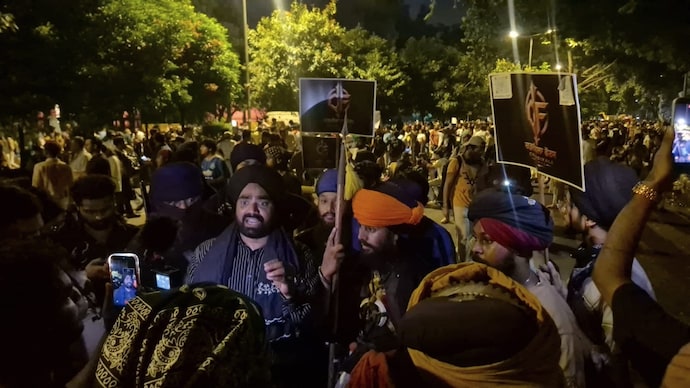

"Musalman Jai Shri Ram nahi bolte, Bharat Mata ki Jai nahi bolte," rang out a voice on a loudspeaker at New Delhi's Jantar Mantar at around 10.30pm on Wednesday night. Within moments, sections of the crowd echoed it. Almost as quickly, the group on the loudspeaker responded with chants of "Nara-e-Takbir, Allahu Akbar", "Jai Shri Ram" and "Bharat Mata ki Jai". The sloganeering continued for several minutes as hundreds watched, some joining in, others recording the spectacle on their mobile phones.
Barely a few metres from the Jantar Mantar — near Tolstoy Marg — around the same time stood Nihangs, members of the Sikh warrior order, holding swords, ceremonial kirpans and long spears in front of Delhi Police and Rapid Action Force (RAF) personnel. Some of them raised their weapons in the air as a flex, while others posed for photographs. The display drew applause from some in the crowd of protesters.
If people arrived at Jantar Mantar without the prior knowledge as to why the protesters had gathered there, it would be difficult for them to guess that this was an agitation over the NEET-UG paper leak and that the resignation of Union Education Minister Dharmendra Pradhan was among the demands.
India Today Digital has been reporting from the ground from the very first day of the protest when Cockroach Janta Party (CJP) founder Abhijeet Dipke landed there on June 6. We have seen the interest build and footfall increase as activist Sonam Wangchuk's hunger strike progressed.
But the scene at the protest site at Jantar Mantar has changed dramatically after July 20, when a march to Parliament was foiled by the alleged use of excessive force. Such has been the change that it no longer seems to be a protest by the CJP. The protest has grown and the CJP leadership seems no longer in control. There is a real risk of the protest already being hijacked, if it hasn't already been.
Lieutenant General Satish Dua (retired), who spearheaded the planning of the Uri surgical strike against Pakistani terrorists in 2016, on Thursday highlighted that concern. "...A vacuum in communication allows an otherwise peaceful, issue-based youth protest to be hijacked by outside elements seeking to exploit the situation. What began as a protest in Delhi is now spreading nationwide," General Dua posted on Instagram.
A YouTuber was brutally thrashed and almost lynched on Wednesday night and on Thursday, protesters clashed with a group of Nihangs at Jantar Mantar. Then there is the regular heckling of Delhi Police and RAF personnel on duty. The security personnel are showing unusual restraint after facing backlash over the July 20 action.
It seems the CJP protest at Jantar Mantar is a powder keg that can explode with just one spark.
CJP PROTEST WAS UNIFIED BECAUSE OF SONAM WANGCHUK
On the very first day, the scattered nature of the protest was visible. But it was a small gathering and could be managed. Any semblance of order emerged only after the arrival of educationist and activist Sonam Wangchuk. The scattered crowd came to listen to him as he addressed the gathering.
The designated protest site in the national capital has been occupied for weeks by the Dipke-founded CJP and, all through, Wangchuk has been the magnet. What initially drew a scattered group of protesters gradually transformed into a national movement after Wangchuk began an indefinite hunger strike.
Wangchuk's presence gave the agitation something it had previously lacked — a unifying face that people could identify.
Students travelled from different states. Volunteers managed the crowds. Doctors monitored Wangchuk's health while visitors lined up to express solidarity.
Wangchuk was forcibly removed from Jantar Mantar and taken to a hospital on July 18.
While Wangchuk was on the stage, the focus remained firmly on education, examination reforms and government accountability. Today, with Wangchuk away, that focus is increasingly difficult to identify.
ONE PLACE, MANY GROUPINGS, ALL UNORGANISED
Walk beyond the CJP's main stage occupied by Dipke and his aides Saurav Das and Ashutosh Ranka, and the protest begins to look like several demonstrations unfolding at the same venue.
Different groups gather in clusters, each raising their own slogans. Some discuss educational reforms, while others debate unrelated political issues and communal angles. Several participants appear to have arrived simply because the protest has become a focal point of public anger.
The further one moves from the main stage of Jantar Mantar, the less visible the organisers become. That shift became particularly evident after the July 20 "Chalo Sansad" march of the CJP.
The police action during the march, including the use of lathis and tear gas, dramatically expanded public participation. Thousands who had never visited Jantar Mantar before arrived over the next couple of days, expressing anger over the crackdown rather than only on the issue of the examination itself.
The swelling crowds brought fresh energy to the movement. They also made it significantly harder to define.
UNKNOWN GROUP'S MARCH TURNS VIOLENT, CLASH WITH POLICE
On Wednesday night, the changing character of the protest spilled beyond Jantar Mantar.
A large crowd marched through New Delhi's Connaught Place without any announced programme and later turned violent. According to police, protesters clashed with personnel, threw stones and damaged police vehicles during the unrest. The episode echoed the confrontations seen during the July 20 march towards Parliament.
On the ground, it was difficult to identify who was leading many of these gatherings. Unlike the earlier phase of the protest, where CJP volunteers directed movement and speeches followed a schedule, many groups now appeared to organise themselves.
There are slogans. There is anger. But there is very little coordination that's visible. The diversity of participants has also become more pronounced.
Among those present were Nihangs displaying weapons, supporters raising issues unrelated to education, and visitors who openly admitted they had come because they wanted to experience a mass protest.
Two young men from Darjeeling were among them. "We have heard about Bodoland demands from our elders, but we had never seen anything like this," Janggit Singh told India Today Digital.
"Now I am here seeing such a huge crowd. The energy is great. I want to stay here for a few more days," Janggit added.
His interest was not centred on the NEET controversy. Instead, Janggit spoke about the excitement of participating in a large public movement and the broader desire for "systemic change".
Such conversations reflected how the protest had begun attracting people whose motivations extend beyond the issue that originally brought youths to Jantar Mantar.
WOMEN'S SAFETY CONCERNS GROW AMID RISING UNCERTAINTY
The changing composition of the crowd has also raised safety concerns. During India Today Digital's overnight visit, a young woman resting in Jantar Mantar alleged that a man attempted to sexually assault her. People nearby quickly intervened. The man was slapped, punched and kicked before being pushed away by the crowd.
However, he was not handed over to the police. Those present appeared reluctant to prolong the confrontation, saying that it could disrupt the protest itself. Whether more such incidents have gone unreported is impossible to determine.
Yet the episode showed one of the practical challenges of prolonged mass gatherings where thousands move in and out each day, and organisers exercise limited control over everyone present.
Perhaps the most striking change, however, is not the size of the crowd but the changing nature of its conversations. In its early days, discussions centred on examination leaks, students' futures and educational accountability. Today, conversations frequently drift towards religion, identity, regional movements and broader political grievances.
People arriving at the protest ground get acquainted and form small groups. They volunteer and coordinate among themselves. However, there is no overall coordination from the CJP through online groups. Mobile data services seem to have been blocked in and around the protest site, which makes maintaining such groups impossible. So, there is no real-time communication from the CJP's leadership for the thousands of people floating around.
CJP'S FADING CONTROL OVER THE PROTEST AT JANTAR MANTAR
The education issue that united the protest often competes for attention with causes that have little direct connection to it. Such transformations are not unique to this movement. Large protests often devolve into platforms where different groups seek visibility for their own concerns.
Whether that broadening strengthens or weakens a movement depends largely on whether organisers can retain a clear sense of purpose. For the Cockroach Janta Party, that challenge appears increasingly visible. Its posters are still visible on the ground. Its volunteers continue to make announcements.
But outside that immediate area, the protest often appears to operate independently of the organisation that began it. That does not necessarily mean the original demands have disappeared.
Students continue to arrive. Speeches demanding accountability continue. Families still visit to express solidarity with the protest.
Yet those voices now compete with a growing chorus of unrelated slogans, political messages and spontaneous mobilisations.
The July 20 police crackdown gave the movement unprecedented momentum. It brought thousands to Jantar Mantar and transformed what had been a relatively small sit-in into one of the country's largest ongoing protests. But the same momentum has made the protest more difficult to define.
The crowds are bigger. The anger is deeper. The causes are now more numerous.
And as the movement continues to grow, the question confronting both its organisers and its supporters is becoming increasingly urgent. Can a protest remain focused once it becomes a platform for every grievance, or will it be hijacked into something its founders never intended? At Jantar Mantar today, that answer is still unfolding, one slogan, one crowd and one new arrival at a time.
"Musalman Jai Shri Ram nahi bolte, Bharat Mata ki Jai nahi bolte," rang out a voice on a loudspeaker at New Delhi's Jantar Mantar at around 10.30pm on Wednesday night. Within moments, sections of the crowd echoed it. Almost as quickly, the group on the loudspeaker responded with chants of "Nara-e-Takbir, Allahu Akbar", "Jai Shri Ram" and "Bharat Mata ki Jai". The sloganeering continued for several minutes as hundreds watched, some joining in, others recording the spectacle on their mobile phones.
Barely a few metres from the Jantar Mantar — near Tolstoy Marg — around the same time stood Nihangs, members of the Sikh warrior order, holding swords, ceremonial kirpans and long spears in front of Delhi Police and Rapid Action Force (RAF) personnel. Some of them raised their weapons in the air as a flex, while others posed for photographs. The display drew applause from some in the crowd of protesters.
If people arrived at Jantar Mantar without the prior knowledge as to why the protesters had gathered there, it would be difficult for them to guess that this was an agitation over the NEET-UG paper leak and that the resignation of Union Education Minister Dharmendra Pradhan was among the demands.
India Today Digital has been reporting from the ground from the very first day of the protest when Cockroach Janta Party (CJP) founder Abhijeet Dipke landed there on June 6. We have seen the interest build and footfall increase as activist Sonam Wangchuk's hunger strike progressed.
But the scene at the protest site at Jantar Mantar has changed dramatically after July 20, when a march to Parliament was foiled by the alleged use of excessive force. Such has been the change that it no longer seems to be a protest by the CJP. The protest has grown and the CJP leadership seems no longer in control. There is a real risk of the protest already being hijacked, if it hasn't already been.
Lieutenant General Satish Dua (retired), who spearheaded the planning of the Uri surgical strike against Pakistani terrorists in 2016, on Thursday highlighted that concern. "...A vacuum in communication allows an otherwise peaceful, issue-based youth protest to be hijacked by outside elements seeking to exploit the situation. What began as a protest in Delhi is now spreading nationwide," General Dua posted on Instagram.
A YouTuber was brutally thrashed and almost lynched on Wednesday night and on Thursday, protesters clashed with a group of Nihangs at Jantar Mantar. Then there is the regular heckling of Delhi Police and RAF personnel on duty. The security personnel are showing unusual restraint after facing backlash over the July 20 action.
It seems the CJP protest at Jantar Mantar is a powder keg that can explode with just one spark.
CJP PROTEST WAS UNIFIED BECAUSE OF SONAM WANGCHUK
On the very first day, the scattered nature of the protest was visible. But it was a small gathering and could be managed. Any semblance of order emerged only after the arrival of educationist and activist Sonam Wangchuk. The scattered crowd came to listen to him as he addressed the gathering.
The designated protest site in the national capital has been occupied for weeks by the Dipke-founded CJP and, all through, Wangchuk has been the magnet. What initially drew a scattered group of protesters gradually transformed into a national movement after Wangchuk began an indefinite hunger strike.
Wangchuk's presence gave the agitation something it had previously lacked — a unifying face that people could identify.
Students travelled from different states. Volunteers managed the crowds. Doctors monitored Wangchuk's health while visitors lined up to express solidarity.
Wangchuk was forcibly removed from Jantar Mantar and taken to a hospital on July 18.
While Wangchuk was on the stage, the focus remained firmly on education, examination reforms and government accountability. Today, with Wangchuk away, that focus is increasingly difficult to identify.
ONE PLACE, MANY GROUPINGS, ALL UNORGANISED
Walk beyond the CJP's main stage occupied by Dipke and his aides Saurav Das and Ashutosh Ranka, and the protest begins to look like several demonstrations unfolding at the same venue.
Different groups gather in clusters, each raising their own slogans. Some discuss educational reforms, while others debate unrelated political issues and communal angles. Several participants appear to have arrived simply because the protest has become a focal point of public anger.
The further one moves from the main stage of Jantar Mantar, the less visible the organisers become. That shift became particularly evident after the July 20 "Chalo Sansad" march of the CJP.
The police action during the march, including the use of lathis and tear gas, dramatically expanded public participation. Thousands who had never visited Jantar Mantar before arrived over the next couple of days, expressing anger over the crackdown rather than only on the issue of the examination itself.
The swelling crowds brought fresh energy to the movement. They also made it significantly harder to define.
UNKNOWN GROUP'S MARCH TURNS VIOLENT, CLASH WITH POLICE
On Wednesday night, the changing character of the protest spilled beyond Jantar Mantar.
A large crowd marched through New Delhi's Connaught Place without any announced programme and later turned violent. According to police, protesters clashed with personnel, threw stones and damaged police vehicles during the unrest. The episode echoed the confrontations seen during the July 20 march towards Parliament.
On the ground, it was difficult to identify who was leading many of these gatherings. Unlike the earlier phase of the protest, where CJP volunteers directed movement and speeches followed a schedule, many groups now appeared to organise themselves.
There are slogans. There is anger. But there is very little coordination that's visible. The diversity of participants has also become more pronounced.
Among those present were Nihangs displaying weapons, supporters raising issues unrelated to education, and visitors who openly admitted they had come because they wanted to experience a mass protest.
Two young men from Darjeeling were among them. "We have heard about Bodoland demands from our elders, but we had never seen anything like this," Janggit Singh told India Today Digital.
"Now I am here seeing such a huge crowd. The energy is great. I want to stay here for a few more days," Janggit added.
His interest was not centred on the NEET controversy. Instead, Janggit spoke about the excitement of participating in a large public movement and the broader desire for "systemic change".
Such conversations reflected how the protest had begun attracting people whose motivations extend beyond the issue that originally brought youths to Jantar Mantar.
WOMEN'S SAFETY CONCERNS GROW AMID RISING UNCERTAINTY
The changing composition of the crowd has also raised safety concerns. During India Today Digital's overnight visit, a young woman resting in Jantar Mantar alleged that a man attempted to sexually assault her. People nearby quickly intervened. The man was slapped, punched and kicked before being pushed away by the crowd.
However, he was not handed over to the police. Those present appeared reluctant to prolong the confrontation, saying that it could disrupt the protest itself. Whether more such incidents have gone unreported is impossible to determine.
Yet the episode showed one of the practical challenges of prolonged mass gatherings where thousands move in and out each day, and organisers exercise limited control over everyone present.
Perhaps the most striking change, however, is not the size of the crowd but the changing nature of its conversations. In its early days, discussions centred on examination leaks, students' futures and educational accountability. Today, conversations frequently drift towards religion, identity, regional movements and broader political grievances.
People arriving at the protest ground get acquainted and form small groups. They volunteer and coordinate among themselves. However, there is no overall coordination from the CJP through online groups. Mobile data services seem to have been blocked in and around the protest site, which makes maintaining such groups impossible. So, there is no real-time communication from the CJP's leadership for the thousands of people floating around.
CJP'S FADING CONTROL OVER THE PROTEST AT JANTAR MANTAR
The education issue that united the protest often competes for attention with causes that have little direct connection to it. Such transformations are not unique to this movement. Large protests often devolve into platforms where different groups seek visibility for their own concerns.
Whether that broadening strengthens or weakens a movement depends largely on whether organisers can retain a clear sense of purpose. For the Cockroach Janta Party, that challenge appears increasingly visible. Its posters are still visible on the ground. Its volunteers continue to make announcements.
But outside that immediate area, the protest often appears to operate independently of the organisation that began it. That does not necessarily mean the original demands have disappeared.
Students continue to arrive. Speeches demanding accountability continue. Families still visit to express solidarity with the protest.
Yet those voices now compete with a growing chorus of unrelated slogans, political messages and spontaneous mobilisations.
The July 20 police crackdown gave the movement unprecedented momentum. It brought thousands to Jantar Mantar and transformed what had been a relatively small sit-in into one of the country's largest ongoing protests. But the same momentum has made the protest more difficult to define.
The crowds are bigger. The anger is deeper. The causes are now more numerous.
And as the movement continues to grow, the question confronting both its organisers and its supporters is becoming increasingly urgent. Can a protest remain focused once it becomes a platform for every grievance, or will it be hijacked into something its founders never intended? At Jantar Mantar today, that answer is still unfolding, one slogan, one crowd and one new arrival at a time.
"Musalman Jai Shri Ram nahi bolte, Bharat Mata ki Jai nahi bolte," rang out a voice on a loudspeaker at New Delhi's Jantar Mantar at around 10.30pm on Wednesday night. Within moments, sections of the crowd echoed it. Almost as quickly, the group on the loudspeaker responded with chants of "Nara-e-Takbir, Allahu Akbar", "Jai Shri Ram" and "Bharat Mata ki Jai". The sloganeering continued for several minutes as hundreds watched, some joining in, others recording the spectacle on their mobile phones.
Barely a few metres from the Jantar Mantar — near Tolstoy Marg — around the same time stood Nihangs, members of the Sikh warrior order, holding swords, ceremonial kirpans and long spears in front of Delhi Police and Rapid Action Force (RAF) personnel. Some of them raised their weapons in the air as a flex, while others posed for photographs. The display drew applause from some in the crowd of protesters.
If people arrived at Jantar Mantar without the prior knowledge as to why the protesters had gathered there, it would be difficult for them to guess that this was an agitation over the NEET-UG paper leak and that the resignation of Union Education Minister Dharmendra Pradhan was among the demands.
India Today Digital has been reporting from the ground from the very first day of the protest when Cockroach Janta Party (CJP) founder Abhijeet Dipke landed there on June 6. We have seen the interest build and footfall increase as activist Sonam Wangchuk's hunger strike progressed.
But the scene at the protest site at Jantar Mantar has changed dramatically after July 20, when a march to Parliament was foiled by the alleged use of excessive force. Such has been the change that it no longer seems to be a protest by the CJP. The protest has grown and the CJP leadership seems no longer in control. There is a real risk of the protest already being hijacked, if it hasn't already been.
Lieutenant General Satish Dua (retired), who spearheaded the planning of the Uri surgical strike against Pakistani terrorists in 2016, on Thursday highlighted that concern. "...A vacuum in communication allows an otherwise peaceful, issue-based youth protest to be hijacked by outside elements seeking to exploit the situation. What began as a protest in Delhi is now spreading nationwide," General Dua posted on Instagram.
A YouTuber was brutally thrashed and almost lynched on Wednesday night and on Thursday, protesters clashed with a group of Nihangs at Jantar Mantar. Then there is the regular heckling of Delhi Police and RAF personnel on duty. The security personnel are showing unusual restraint after facing backlash over the July 20 action.
It seems the CJP protest at Jantar Mantar is a powder keg that can explode with just one spark.
CJP PROTEST WAS UNIFIED BECAUSE OF SONAM WANGCHUK
On the very first day, the scattered nature of the protest was visible. But it was a small gathering and could be managed. Any semblance of order emerged only after the arrival of educationist and activist Sonam Wangchuk. The scattered crowd came to listen to him as he addressed the gathering.
The designated protest site in the national capital has been occupied for weeks by the Dipke-founded CJP and, all through, Wangchuk has been the magnet. What initially drew a scattered group of protesters gradually transformed into a national movement after Wangchuk began an indefinite hunger strike.
Wangchuk's presence gave the agitation something it had previously lacked — a unifying face that people could identify.
Students travelled from different states. Volunteers managed the crowds. Doctors monitored Wangchuk's health while visitors lined up to express solidarity.
Wangchuk was forcibly removed from Jantar Mantar and taken to a hospital on July 18.
While Wangchuk was on the stage, the focus remained firmly on education, examination reforms and government accountability. Today, with Wangchuk away, that focus is increasingly difficult to identify.
ONE PLACE, MANY GROUPINGS, ALL UNORGANISED
Walk beyond the CJP's main stage occupied by Dipke and his aides Saurav Das and Ashutosh Ranka, and the protest begins to look like several demonstrations unfolding at the same venue.
Different groups gather in clusters, each raising their own slogans. Some discuss educational reforms, while others debate unrelated political issues and communal angles. Several participants appear to have arrived simply because the protest has become a focal point of public anger.
The further one moves from the main stage of Jantar Mantar, the less visible the organisers become. That shift became particularly evident after the July 20 "Chalo Sansad" march of the CJP.
The police action during the march, including the use of lathis and tear gas, dramatically expanded public participation. Thousands who had never visited Jantar Mantar before arrived over the next couple of days, expressing anger over the crackdown rather than only on the issue of the examination itself.
The swelling crowds brought fresh energy to the movement. They also made it significantly harder to define.
UNKNOWN GROUP'S MARCH TURNS VIOLENT, CLASH WITH POLICE
On Wednesday night, the changing character of the protest spilled beyond Jantar Mantar.
A large crowd marched through New Delhi's Connaught Place without any announced programme and later turned violent. According to police, protesters clashed with personnel, threw stones and damaged police vehicles during the unrest. The episode echoed the confrontations seen during the July 20 march towards Parliament.
On the ground, it was difficult to identify who was leading many of these gatherings. Unlike the earlier phase of the protest, where CJP volunteers directed movement and speeches followed a schedule, many groups now appeared to organise themselves.
There are slogans. There is anger. But there is very little coordination that's visible. The diversity of participants has also become more pronounced.
Among those present were Nihangs displaying weapons, supporters raising issues unrelated to education, and visitors who openly admitted they had come because they wanted to experience a mass protest.
Two young men from Darjeeling were among them. "We have heard about Bodoland demands from our elders, but we had never seen anything like this," Janggit Singh told India Today Digital.
"Now I am here seeing such a huge crowd. The energy is great. I want to stay here for a few more days," Janggit added.
His interest was not centred on the NEET controversy. Instead, Janggit spoke about the excitement of participating in a large public movement and the broader desire for "systemic change".
Such conversations reflected how the protest had begun attracting people whose motivations extend beyond the issue that originally brought youths to Jantar Mantar.
WOMEN'S SAFETY CONCERNS GROW AMID RISING UNCERTAINTY
The changing composition of the crowd has also raised safety concerns. During India Today Digital's overnight visit, a young woman resting in Jantar Mantar alleged that a man attempted to sexually assault her. People nearby quickly intervened. The man was slapped, punched and kicked before being pushed away by the crowd.
However, he was not handed over to the police. Those present appeared reluctant to prolong the confrontation, saying that it could disrupt the protest itself. Whether more such incidents have gone unreported is impossible to determine.
Yet the episode showed one of the practical challenges of prolonged mass gatherings where thousands move in and out each day, and organisers exercise limited control over everyone present.
Perhaps the most striking change, however, is not the size of the crowd but the changing nature of its conversations. In its early days, discussions centred on examination leaks, students' futures and educational accountability. Today, conversations frequently drift towards religion, identity, regional movements and broader political grievances.
People arriving at the protest ground get acquainted and form small groups. They volunteer and coordinate among themselves. However, there is no overall coordination from the CJP through online groups. Mobile data services seem to have been blocked in and around the protest site, which makes maintaining such groups impossible. So, there is no real-time communication from the CJP's leadership for the thousands of people floating around.
CJP'S FADING CONTROL OVER THE PROTEST AT JANTAR MANTAR
The education issue that united the protest often competes for attention with causes that have little direct connection to it. Such transformations are not unique to this movement. Large protests often devolve into platforms where different groups seek visibility for their own concerns.
Whether that broadening strengthens or weakens a movement depends largely on whether organisers can retain a clear sense of purpose. For the Cockroach Janta Party, that challenge appears increasingly visible. Its posters are still visible on the ground. Its volunteers continue to make announcements.
But outside that immediate area, the protest often appears to operate independently of the organisation that began it. That does not necessarily mean the original demands have disappeared.
Students continue to arrive. Speeches demanding accountability continue. Families still visit to express solidarity with the protest.
Yet those voices now compete with a growing chorus of unrelated slogans, political messages and spontaneous mobilisations.
The July 20 police crackdown gave the movement unprecedented momentum. It brought thousands to Jantar Mantar and transformed what had been a relatively small sit-in into one of the country's largest ongoing protests. But the same momentum has made the protest more difficult to define.
The crowds are bigger. The anger is deeper. The causes are now more numerous.
And as the movement continues to grow, the question confronting both its organisers and its supporters is becoming increasingly urgent. Can a protest remain focused once it becomes a platform for every grievance, or will it be hijacked into something its founders never intended? At Jantar Mantar today, that answer is still unfolding, one slogan, one crowd and one new arrival at a time.

