Why is Delhi targeting bikes first in its EV drive?
The Delhi government has announced its electric vehicle (EV) policy that will stop registration of petrol two-wheelers from April 1, 2028. Why is the policy focusing on two-wheelers and three-wheelers first? Here's all you need to know.
For years, Delhi's electric vehicle policy remained parked in the slow lane, stalled by debates over hybrids, charging stations, and the economics of going fully electric. But when the capital finally hit the accelerator, it did not begin with luxury electric sedans or family SUVs. It chose the humble motorcycle and scooter.
From April 1, 2028, Delhi residents will no longer be able to register a new petrol-powered two-wheeler. Simply put, if one bought a bike after that date, it would have to be electric. The Rekha Gupta-led BJP government on Monday (June 29) announced the Delhi Electric Vehicle (EV) Policy. The government said that the aim of the policy is to achieve a minimum 30% electrification of Delhi's vehicle fleet by March 31, 2030, when the policy rolls out.
At first glance, the decision might appear unusual. Cars occupy more road space, consume more fuel and dominate conversations around electric mobility. Yet the Delhi government's new EV Policy makes motorcycles and scooters the centrepiece of its clean-air strategy.
The reason lies not in what occupies the most space on Delhi's roads, but in what occupies the largest share of them.
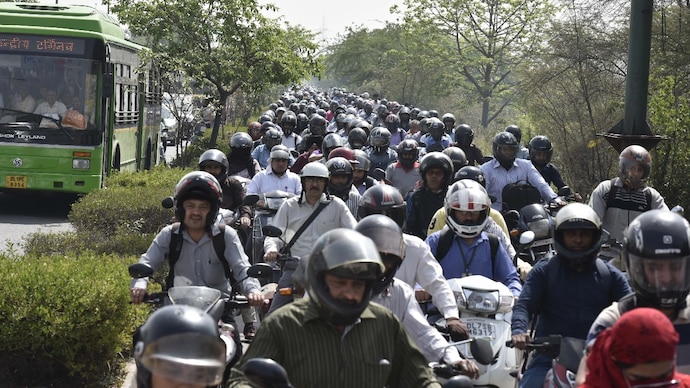
DELHI'S POLLUTION PROBLEM IS WEARING A HELMET
Delhi's air pollution is often blamed on diesel trucks, stubble burning of crops or construction dust. But transport remains one of the city's biggest pollution sources, particularly during the winters.
According to the latest report that was cited by the Delhi Cabinet while clearing the policy, the Commission for Air Quality Management (CAQM) revealed that vehicular emissions contributed around 23% of Delhi's PM2.5 pollution during winter, making transport the single largest source of pollution in the city.
And among vehicles, two-wheelers dominate the scenario.
The CAQM estimated that around 67% of Delhi's entire vehicle stock consists of motorcycles and scooters. In other words, nearly two out of every three vehicles on Delhi's roads are two-wheelers.
This sheer volume changes the pollution equation in the national capital.
An earlier IIT Kanpur study estimated that around one-third of all vehicular PM2.5 and PM10 emissions in Delhi came from two-wheelers alone. To put that into perspective, if all vehicles emitted 300 kilograms of harmful particulate matter, motorcycles and scooters would account for nearly 100 kilograms.
Niharika Rai, principal secretary and commissioner of Delhi's Transport Department, while speaking on the EV Policy, cited a separate 2008 study and said that commercial goods vehicles accounted for 33% of vehicular pollution in Delhi, while two- and three-wheelers contributed 46%.
Similarly, a 2021 draft emissions inventory prepared by think tank, The Energy and Resources Institute (TERI), concluded that vehicles remained the single largest contributor to Delhi's PM2.5 pollution during much of the pollution season. Across the National Capital Region (NCR), two-wheelers alone accounted for 31% of transport-related PM2.5 emissions and more than half of CO emissions.
Simply put, cleaning up Delhi's air requires cleaning up its fossil fuel-propelled two-wheelers first, and that is what the government is actually doing now.
WHY DELHI GOVERNMENT'S EV POLICY DOESN'T INCLUDE CARS
The simple answer to this question is the infrastructure. The biggest hurdle to electric vehicle mobility has never been the vehicle. It has been charging.
Electric vehicles require widespread public charging stations. Cars are especially used for longer trips, they consume larger batteries, and take more time to recharge. Commercial vehicles face an even greater challenge. They usually require rapid charging or battery-swapping networks to minimise downtime.
But the story of two-wheelers is different.
Most motorcycles and scooters in Delhi are used for daily commutes of relatively short distances. Their batteries are significantly smaller, can often be removed for charging indoors, and in many cases riders can simply plug them into a normal household socket overnight.
Battery swapping is also considerably easier and cheaper for two-wheelers than for larger vehicles. In metro cities like New Delhi, the expansion of two-wheeler battery-charging infrastructure (like battery-swapping points) has made electric scooters more practical for daily use. The growth of quick-commerce and last-mile logistics companies has accelerated adoption by driving demand for electric two-wheelers.
That means Delhi can begin reducing emissions immediately without first building a citywide charging ecosystem comparable to what electric cars would require.
The government is nevertheless planning for future growth. Under the new policy, Delhi aims to establish more than 32,000 public charging points through the PM E-Drive scheme and state funding.
But the two-wheeler strategy gives policymakers something they have struggled to achieve for years: a transition that does not entirely depend on charging infrastructure being fully built before adoption begins.
WHY DELHI GOVT CHOSE PURE EVs OVER HYBRIDS
The other significant shift in the policy is what the Delhi government has chosen not to support under the newly adopted EV policy.
Earlier drafts of the policy had proposed road tax and registration concessions for strong hybrid cars costing up to Rs 30 lakh. Several mobility experts argue that hybrids could act as a "bridge technology" until charging infrastructure matures.
That proposal has now been dropped entirely by the government of Delhi.
Instead, the Delhi government has decided to back only "pure battery electric vehicles".
The new policy provides 100% exemption from road tax and registration charges for eligible electric vehicles and introduces purchase incentives of up to Rs 30,000 for electric two-wheelers in the first year, Rs 20,000 in the second and Rs 10,000 in the third year.
Passenger electric auto-rickshaws, like the toto and tirri, would receive incentives of up to Rs 50,000, while owners scrapping older BS-IV or older vehicles would also receive financial assistance.
The policy message of the Delhi government is clear that rather than treating hybrids as a stepping stone, the national capital wants to accelerate directly towards zero-emission vehicles.
WHAT IS THE CURRENT STATUS OF ELECTRIC TWO-WHEELERS IN DELHI?
The numbers also reveal just how ambitious the policy is. Today, electric two-wheelers remain a relatively small part of Delhi's market and roads.
In 2025, only 36,962 electric two-wheelers were registered out of 4,92,288 total two-wheeler registrations, which is roughly, just 7.5%. The year before, the share was similarly modest, with 31,094 electric registrations out of 4,15,336, according to The Indian Express newspaper.
So, from April 1, 2028, every newly registered motorcycle or scooter in Delhi must be electric.
That means moving from a market where fewer than one in twelve new two-wheelers is electric to one where every new two-wheeler must be electric in less than two years.
Few Indian cities have attempted such a rapid transition, and experts are calling this move by the Delhi government a "game changer".
GOVERNMENT'S EV PUSH, BUT DOES DELHI HAVE ENOUGH CHARGING POINTS?
Not everyone is convinced that the city is ready for the EV push.
Industry experts have repeatedly pointed to "Delhi's shortage of charging stations and battery-swapping facilities", arguing that infrastructure should precede mandates rather than follow them.
The government believes the two could happen simultaneously. Its planned investment of Rs 15,000 crore aims to expand charging infrastructure while encouraging adoption through financial incentives.
The success of the policy might ultimately depend on whether infrastructure grows at the same pace as consumer demand.
WHY BIKES BECAME DELHI'S FIRST EV TEST DRIVE?
To answer this question, there is a simple calculation. If the objective is to reduce pollution quickly, policymakers must begin where the largest number of polluting vehicles exist.
Cars do dominate the conversation around electric mobility, but motorcycles dominate Delhi's roads.
They are responsible for a disproportionately large share of vehicular emissions, require far less charging infrastructure than cars, can often be charged at home, and are already used for short urban commutes, ideally suited to electric mobility. Delhi's long-awaited EV policy is therefore not simply about replacing petrol with batteries.
It is about tackling the city's biggest transport problem first. Rather than waiting for the perfect charging ecosystem for every vehicle class, the capital has chosen to electrify the segment that could offer the quickest environmental gains.
In Delhi's battle against pollution, the road to cleaner air might well begin with the vehicle most residents ride every day.
For years, Delhi's electric vehicle policy remained parked in the slow lane, stalled by debates over hybrids, charging stations, and the economics of going fully electric. But when the capital finally hit the accelerator, it did not begin with luxury electric sedans or family SUVs. It chose the humble motorcycle and scooter.
From April 1, 2028, Delhi residents will no longer be able to register a new petrol-powered two-wheeler. Simply put, if one bought a bike after that date, it would have to be electric. The Rekha Gupta-led BJP government on Monday (June 29) announced the Delhi Electric Vehicle (EV) Policy. The government said that the aim of the policy is to achieve a minimum 30% electrification of Delhi's vehicle fleet by March 31, 2030, when the policy rolls out.
At first glance, the decision might appear unusual. Cars occupy more road space, consume more fuel and dominate conversations around electric mobility. Yet the Delhi government's new EV Policy makes motorcycles and scooters the centrepiece of its clean-air strategy.
The reason lies not in what occupies the most space on Delhi's roads, but in what occupies the largest share of them.
DELHI'S POLLUTION PROBLEM IS WEARING A HELMET
Delhi's air pollution is often blamed on diesel trucks, stubble burning of crops or construction dust. But transport remains one of the city's biggest pollution sources, particularly during the winters.
According to the latest report that was cited by the Delhi Cabinet while clearing the policy, the Commission for Air Quality Management (CAQM) revealed that vehicular emissions contributed around 23% of Delhi's PM2.5 pollution during winter, making transport the single largest source of pollution in the city.
And among vehicles, two-wheelers dominate the scenario.
The CAQM estimated that around 67% of Delhi's entire vehicle stock consists of motorcycles and scooters. In other words, nearly two out of every three vehicles on Delhi's roads are two-wheelers.
This sheer volume changes the pollution equation in the national capital.
An earlier IIT Kanpur study estimated that around one-third of all vehicular PM2.5 and PM10 emissions in Delhi came from two-wheelers alone. To put that into perspective, if all vehicles emitted 300 kilograms of harmful particulate matter, motorcycles and scooters would account for nearly 100 kilograms.
Niharika Rai, principal secretary and commissioner of Delhi's Transport Department, while speaking on the EV Policy, cited a separate 2008 study and said that commercial goods vehicles accounted for 33% of vehicular pollution in Delhi, while two- and three-wheelers contributed 46%.
Similarly, a 2021 draft emissions inventory prepared by think tank, The Energy and Resources Institute (TERI), concluded that vehicles remained the single largest contributor to Delhi's PM2.5 pollution during much of the pollution season. Across the National Capital Region (NCR), two-wheelers alone accounted for 31% of transport-related PM2.5 emissions and more than half of CO emissions.
Simply put, cleaning up Delhi's air requires cleaning up its fossil fuel-propelled two-wheelers first, and that is what the government is actually doing now.
WHY DELHI GOVERNMENT'S EV POLICY DOESN'T INCLUDE CARS
The simple answer to this question is the infrastructure. The biggest hurdle to electric vehicle mobility has never been the vehicle. It has been charging.
Electric vehicles require widespread public charging stations. Cars are especially used for longer trips, they consume larger batteries, and take more time to recharge. Commercial vehicles face an even greater challenge. They usually require rapid charging or battery-swapping networks to minimise downtime.
But the story of two-wheelers is different.
Most motorcycles and scooters in Delhi are used for daily commutes of relatively short distances. Their batteries are significantly smaller, can often be removed for charging indoors, and in many cases riders can simply plug them into a normal household socket overnight.
Battery swapping is also considerably easier and cheaper for two-wheelers than for larger vehicles. In metro cities like New Delhi, the expansion of two-wheeler battery-charging infrastructure (like battery-swapping points) has made electric scooters more practical for daily use. The growth of quick-commerce and last-mile logistics companies has accelerated adoption by driving demand for electric two-wheelers.
That means Delhi can begin reducing emissions immediately without first building a citywide charging ecosystem comparable to what electric cars would require.
The government is nevertheless planning for future growth. Under the new policy, Delhi aims to establish more than 32,000 public charging points through the PM E-Drive scheme and state funding.
But the two-wheeler strategy gives policymakers something they have struggled to achieve for years: a transition that does not entirely depend on charging infrastructure being fully built before adoption begins.
WHY DELHI GOVT CHOSE PURE EVs OVER HYBRIDS
The other significant shift in the policy is what the Delhi government has chosen not to support under the newly adopted EV policy.
Earlier drafts of the policy had proposed road tax and registration concessions for strong hybrid cars costing up to Rs 30 lakh. Several mobility experts argue that hybrids could act as a "bridge technology" until charging infrastructure matures.
That proposal has now been dropped entirely by the government of Delhi.
Instead, the Delhi government has decided to back only "pure battery electric vehicles".
The new policy provides 100% exemption from road tax and registration charges for eligible electric vehicles and introduces purchase incentives of up to Rs 30,000 for electric two-wheelers in the first year, Rs 20,000 in the second and Rs 10,000 in the third year.
Passenger electric auto-rickshaws, like the toto and tirri, would receive incentives of up to Rs 50,000, while owners scrapping older BS-IV or older vehicles would also receive financial assistance.
The policy message of the Delhi government is clear that rather than treating hybrids as a stepping stone, the national capital wants to accelerate directly towards zero-emission vehicles.
WHAT IS THE CURRENT STATUS OF ELECTRIC TWO-WHEELERS IN DELHI?
The numbers also reveal just how ambitious the policy is. Today, electric two-wheelers remain a relatively small part of Delhi's market and roads.
In 2025, only 36,962 electric two-wheelers were registered out of 4,92,288 total two-wheeler registrations, which is roughly, just 7.5%. The year before, the share was similarly modest, with 31,094 electric registrations out of 4,15,336, according to The Indian Express newspaper.
So, from April 1, 2028, every newly registered motorcycle or scooter in Delhi must be electric.
That means moving from a market where fewer than one in twelve new two-wheelers is electric to one where every new two-wheeler must be electric in less than two years.
Few Indian cities have attempted such a rapid transition, and experts are calling this move by the Delhi government a "game changer".
GOVERNMENT'S EV PUSH, BUT DOES DELHI HAVE ENOUGH CHARGING POINTS?
Not everyone is convinced that the city is ready for the EV push.
Industry experts have repeatedly pointed to "Delhi's shortage of charging stations and battery-swapping facilities", arguing that infrastructure should precede mandates rather than follow them.
The government believes the two could happen simultaneously. Its planned investment of Rs 15,000 crore aims to expand charging infrastructure while encouraging adoption through financial incentives.
The success of the policy might ultimately depend on whether infrastructure grows at the same pace as consumer demand.
WHY BIKES BECAME DELHI'S FIRST EV TEST DRIVE?
To answer this question, there is a simple calculation. If the objective is to reduce pollution quickly, policymakers must begin where the largest number of polluting vehicles exist.
Cars do dominate the conversation around electric mobility, but motorcycles dominate Delhi's roads.
They are responsible for a disproportionately large share of vehicular emissions, require far less charging infrastructure than cars, can often be charged at home, and are already used for short urban commutes, ideally suited to electric mobility. Delhi's long-awaited EV policy is therefore not simply about replacing petrol with batteries.
It is about tackling the city's biggest transport problem first. Rather than waiting for the perfect charging ecosystem for every vehicle class, the capital has chosen to electrify the segment that could offer the quickest environmental gains.
In Delhi's battle against pollution, the road to cleaner air might well begin with the vehicle most residents ride every day.

