If women need to be 'expert mothers', why no one asks men to become 'expert fathers'?
Anandiben Patel's call for women to become expert mothers before pursuing top careers has revived questions about unequal expectations. The debate has turned to why parenting excellence is demanded of women but not of men.
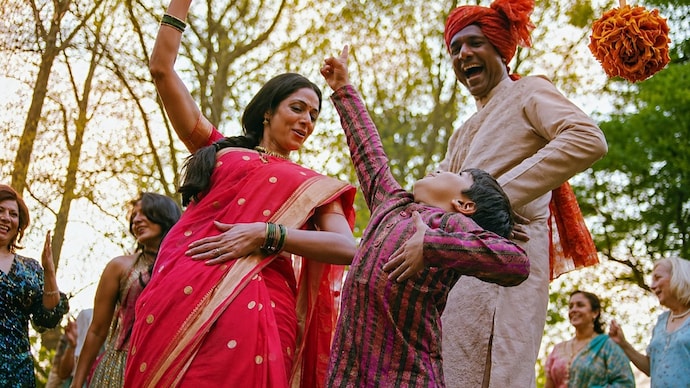
When Uttar Pradesh Governor Anandiben Patel advised women to become "expert mothers" before aspiring to become IAS officers or teachers, one question was impossible to ignore: why wasn't the same advice meant for men? Isn't raising a child supposed to be an equal responsibility? Atleast, that's the ideal we claim to be moving towards.
At a time when India is finally celebrating fathers taking paternity leave, changing diapers, packing lunch boxes, cooking dinner and even moving in with their wives' parents to provide support, telling women that motherhood must come before ambition feels like turning the clock backwards.
Just remind us, in case we have missed it, of a convocation where men have been told: "Become an expert father before becoming an IAS officer." Or "Learn childcare before dreaming of bureaucracy."Or "Perfect parenting before chasing ambition."
Exactly.
Because society assumes three things without much thought: a man's career is non-negotiable, fatherhood will somehow happen alongside it, and women will continue to shoulder the larger share of caregiving.
Women, meanwhile, still seem to need permission to dream.
The 'expert father' doesn't even exist
One of the most striking observations came from Maitrayee Sen, a PhD scholar at Ashoka University.
"The question itself exposes the double standard," she says. "We don't even have a cultural concept of an 'expert father'. No governor stands at a podium urging young men to first become expert fathers before aspiring to civil service."
Historically, she explains, women have been tied to caregiving and the domestic sphere, while men have been associated with careers and leadership. The result is a lopsided set of expectations. Fathers are applauded for being present. Mothers are expected to excel at work while also managing childcare, household responsibilities and the invisible emotional labour that keeps families running.
Sociologists have long described this phenomenon. Arlie Hochschild famously called it the "second shift"—the unpaid work women begin once their paid workday ends.
Girls are raised differently long before they become mothers.
Perhaps the conditioning begins much earlier than motherhood itself. Girls start internalising these expectations in childhood. By the time they are 11 or 12, many are already told they will one day move into another household, behave a certain way, care for a family and eventually raise children.
Boys, on the other hand, are largely raised with a different script: study well, get into a good college, build a successful career.
By adulthood, these messages become so deeply ingrained that asking women to prioritise motherhood before ambition no longer sounds unusual, it sounds normal.
Patriarchy hurts men too
Simantini Ghosh, Assistant Professor of Psychology at AshokaUniversity, is also quick to point out that these expectations do not benefit men either.
When caregiving is automatically assigned to women, men are simultaneously burdened with being the primary providers. Losing a job, she says, can become deeply tied to a man's sense of identity and self-worth, while social conditioning often discourages men from seeking emotional or mental health support.
"Patriarchal notions hurt both men and women," she says, "just in different ways."
Parenting is a shared responsibility, not a woman's test
Communications specialist Saudamini Ali Khan believes the imbalance has become so familiar that society has simply renamed it culture.
"Parenthood begins with two people. Yet excellence in parenting is demanded almost exclusively of one," she says.
Fathers are often celebrated for participating in parenting, while mothers quietly carry the relentless and invisible work of raising children, managing households and providing emotional support.
"If raising children is society's highest calling,"she asks, "why is it treated as a woman's test and a man's choice?"
She argues that the conversation should move beyond asking women to become "expert mothers" and instead focus on becoming an "expert society"—one that supports women whether they choose motherhood or not, and raises fathers to be equal parents rather than occasional helpers.
Perhaps that's why Priyanka Chopra's words from a 2018 interview still ring true today: "When we talk about equality and opportunity, we are talking about cerebral opportunity. Give women the ability to get the job, to be the CEO, and don't question her choice or her drive to be someone."
Eight years later, women are still being told to prove themselves at home before they prove themselves at work. Maybe the question was never whether women could become expert mothers. Maybe it is why we have neve rexpected men to become expert fathers.
When Uttar Pradesh Governor Anandiben Patel advised women to become "expert mothers" before aspiring to become IAS officers or teachers, one question was impossible to ignore: why wasn't the same advice meant for men? Isn't raising a child supposed to be an equal responsibility? Atleast, that's the ideal we claim to be moving towards.
At a time when India is finally celebrating fathers taking paternity leave, changing diapers, packing lunch boxes, cooking dinner and even moving in with their wives' parents to provide support, telling women that motherhood must come before ambition feels like turning the clock backwards.
Just remind us, in case we have missed it, of a convocation where men have been told: "Become an expert father before becoming an IAS officer." Or "Learn childcare before dreaming of bureaucracy."Or "Perfect parenting before chasing ambition."
Exactly.
Because society assumes three things without much thought: a man's career is non-negotiable, fatherhood will somehow happen alongside it, and women will continue to shoulder the larger share of caregiving.
Women, meanwhile, still seem to need permission to dream.
The 'expert father' doesn't even exist
One of the most striking observations came from Maitrayee Sen, a PhD scholar at Ashoka University.
"The question itself exposes the double standard," she says. "We don't even have a cultural concept of an 'expert father'. No governor stands at a podium urging young men to first become expert fathers before aspiring to civil service."
Historically, she explains, women have been tied to caregiving and the domestic sphere, while men have been associated with careers and leadership. The result is a lopsided set of expectations. Fathers are applauded for being present. Mothers are expected to excel at work while also managing childcare, household responsibilities and the invisible emotional labour that keeps families running.
Sociologists have long described this phenomenon. Arlie Hochschild famously called it the "second shift"—the unpaid work women begin once their paid workday ends.
Girls are raised differently long before they become mothers.
Perhaps the conditioning begins much earlier than motherhood itself. Girls start internalising these expectations in childhood. By the time they are 11 or 12, many are already told they will one day move into another household, behave a certain way, care for a family and eventually raise children.
Boys, on the other hand, are largely raised with a different script: study well, get into a good college, build a successful career.
By adulthood, these messages become so deeply ingrained that asking women to prioritise motherhood before ambition no longer sounds unusual, it sounds normal.
Patriarchy hurts men too
Simantini Ghosh, Assistant Professor of Psychology at AshokaUniversity, is also quick to point out that these expectations do not benefit men either.
When caregiving is automatically assigned to women, men are simultaneously burdened with being the primary providers. Losing a job, she says, can become deeply tied to a man's sense of identity and self-worth, while social conditioning often discourages men from seeking emotional or mental health support.
"Patriarchal notions hurt both men and women," she says, "just in different ways."
Parenting is a shared responsibility, not a woman's test
Communications specialist Saudamini Ali Khan believes the imbalance has become so familiar that society has simply renamed it culture.
"Parenthood begins with two people. Yet excellence in parenting is demanded almost exclusively of one," she says.
Fathers are often celebrated for participating in parenting, while mothers quietly carry the relentless and invisible work of raising children, managing households and providing emotional support.
"If raising children is society's highest calling,"she asks, "why is it treated as a woman's test and a man's choice?"
She argues that the conversation should move beyond asking women to become "expert mothers" and instead focus on becoming an "expert society"—one that supports women whether they choose motherhood or not, and raises fathers to be equal parents rather than occasional helpers.
Perhaps that's why Priyanka Chopra's words from a 2018 interview still ring true today: "When we talk about equality and opportunity, we are talking about cerebral opportunity. Give women the ability to get the job, to be the CEO, and don't question her choice or her drive to be someone."
Eight years later, women are still being told to prove themselves at home before they prove themselves at work. Maybe the question was never whether women could become expert mothers. Maybe it is why we have neve rexpected men to become expert fathers.

