Assam | The other Gogoi
Himanta has a convenient political foe—and it's not state Congress chief Gaurav Gogoi. It's the firebrand Akhil Gogoi, whose headline-making politics fits his needs
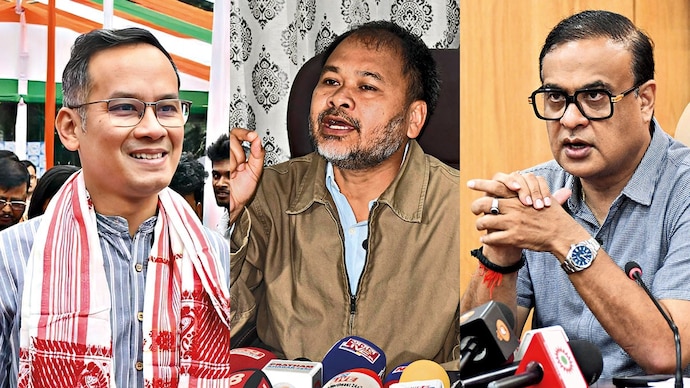
In Assam’s political sphere, personalised as it is, there exists a binary—all of the ruling sphere is dominated, of course, by chief minister Himanta Biswa Sarma. In the oppositional space, there looms a Gogoi. No, not Gaurav Gogoi, the state Congress chief whose political inheritance and organisational backing make him not just the textbook challenger but also a more recognisable face beyond Assam. Instead, it’s the unyieldingly combative Raijor Dal president Akhil Gogoi who seems to fill that end of the spectrum. Sarma and he appear to be in a two-man theatre of their own—bitter adversaries, frequently trading sensational allegations and personal attacks. Yet, this image of hostility conceals a curious convergence of interests. Both have reasons to keep the other at the centre of Assam’s political discourse. What that does by default, even without any formal understanding between the two, is help keep Gaurav in partial eclipse.
In Assam’s political sphere, personalised as it is, there exists a binary—all of the ruling sphere is dominated, of course, by chief minister Himanta Biswa Sarma. In the oppositional space, there looms a Gogoi. No, not Gaurav Gogoi, the state Congress chief whose political inheritance and organisational backing make him not just the textbook challenger but also a more recognisable face beyond Assam. Instead, it’s the unyieldingly combative Raijor Dal president Akhil Gogoi who seems to fill that end of the spectrum. Sarma and he appear to be in a two-man theatre of their own—bitter adversaries, frequently trading sensational allegations and personal attacks. Yet, this image of hostility conceals a curious convergence of interests. Both have reasons to keep the other at the centre of Assam’s political discourse. What that does by default, even without any formal understanding between the two, is help keep Gaurav in partial eclipse.
In Assam’s political sphere, personalised as it is, there exists a binary—all of the ruling sphere is dominated, of course, by chief minister Himanta Biswa Sarma. In the oppositional space, there looms a Gogoi. No, not Gaurav Gogoi, the state Congress chief whose political inheritance and organisational backing make him not just the textbook challenger but also a more recognisable face beyond Assam. Instead, it’s the unyieldingly combative Raijor Dal president Akhil Gogoi who seems to fill that end of the spectrum. Sarma and he appear to be in a two-man theatre of their own—bitter adversaries, frequently trading sensational allegations and personal attacks. Yet, this image of hostility conceals a curious convergence of interests. Both have reasons to keep the other at the centre of Assam’s political discourse. What that does by default, even without any formal understanding between the two, is help keep Gaurav in partial eclipse.
This works well for the other two. For Sarma, Akhil is a more convenient Opposition face than Gaurav. For Akhil, confrontation with Sarma provides the sort of high-octane visibility and stature that his party’s limited electoral strength cannot deliver by itself. The pattern of exchanges between Sarma and Akhil in recent weeks offers a revealing glimpse into this unusual equation—if it wasn’t cussed confrontation, you’d think of it as collaboration.
GATHERING THE SPOTLIGHT
On November 22, Akhil released what he described as a six-page transcript of a leaked telephone conversation in which Jorhat businessman Sibchand Hatibaruah allegedly said Assam’s forest minister had tasked him to run a “timber syndicate”. Pouncing on those words, Akhil declared: “Our forest minister Jayanta Mallabaruah has been stripped.” Unless Hatibaruah and two others were arrested, Akhil declared, he would conclude that syndicates in Assam were operating “100 per cent” on Sarma’s orders. Note, these are not independently established facts. Their status is that of pure allegations.
That’s territory Akhil doesn’t fear to tread. On November 9, he had called Sarma Assam’s “mafia raja”, alleging that police had escorted at least 30 coal trucks to Meghalaya instead of seizing them. On November 18, he accused Mallabaruah of amassing wealth, alleging his declared assets had grown 307 per cent in five years. Linking him to coal and other alleged syndicates, Akhil demanded answers from the CM.
Yet, barely six weeks before the leaked audio surfaced, the same government had conceded almost all of Akhil’s demands during a prolonged agitation for flood relief.
By publicly negotiating via two senior cabinet ministers, Sarma handed Akhil a visible victory. Akhil ended his 316-hour protest by giving the government credit for meeting his demands. Earlier, when Sarma waded through floodwaters alongside him, Akhil had been effusive in his praise. “I have never seen such a chief minister,” he remarked. He soon mean-reverted, complaining the relief fell below promise.
The sequence captured the paradox of the relationship. “It’s not merely adversarial. They are, in many ways, complementary,” says Vikas Tripathi, associate professor, Gauhati University. He sees here signs of the BJP strategy of engaging regional foes to keep them within its sphere of influence. “As a dominant system, the BJP prefers an opposition it can manage. Akhil fits this arrangement,” Tripathi explains.
The 2026 assembly election demonstrated the imbalance. The BJP won 82 of Assam’s 126 seats, the Congress secured a mere 19 of the 100-odd it contested, Raijor Dal got just two; Akhil retained Sivasagar by 17,272 votes. But, for contrast, Gaurav, a third-term Lok Sabha MP, lost Jorhat by 23,182 votes. His father Tarun Gogoi, Assam’s CM for 15 years, had won the Jorhat parliamentary seat twice decades ago. But the legacy, Gaurav’s own personal following, his party’s pan-Assam presence—sometimes all of that seems to get dwarfed by Akhil’s headline-making activist politics.
A MERCURIAL PATH
For all his stridency, Akhil’s shifting stances have been noticed. Last November, he declared “no power in the world” could break Opposition unity. Yet, on March 8, he walked out of seat-sharing talks, blaming Gaurav’s “arrogance”. He walked back in, contesting within a six-party Opposition front. Post-results, he accused the Congress of running a tame campaign and demanded Gaurav’s resignation as its state chief. The Congress broke the tie-up in September. On November 17, Akhil accused it of treating regional parties as “primary enemies”.
Each barb from this flank forces Gaurav’s party to defend itself against another Opposition party, rather than focus its attacks on the BJP. As for Akhil, his profile is amplified regardless of which party attacks him. A senior BJP leader admits to a kind of unsigned synergy: Akhil wouldn’t mind cornering “all anti-BJP votes”; BJP wouldn’t mind either.
The Congress is well aware of this. “There’s no doubt Sarma wants Akhil to stay relevant—he’s an enemy who can be managed,” says former party MP Abdul Khaleq. Akhil vehemently rejects any suggestion of a compact with Sarma, describing it as an insult to his politics—count 19 months in detention post the anti-CAA protests. “Those who ridicule our uncompromising struggle forgot that when the main Opposition party surrenders, it’s Raijor Dal and Akhil Gogoi who raise the voice of ordinary people,” he says.Those very words go to show the peril he holds for his namesake.

