Glaciers to foblets | Luxury water
From low-minerality, silky sips to naturally carbonated volcanic springs, water is finally having its fine-dining moment.
As a growing number of diners trade single malts for single-source water, the demand for sophisticated alternatives has skyrocketed. In response, water is being elevated with the same reverence once reserved for fine wines and vintage spirits, and I, for one, am a recent convert. I used to think water was just water, something to be gulped down between courses. That changed when I was handed a glass of Svalbari. Harvested from 4,000-year-old icebergs, it was velvety, almost sweet, and remarkably light. In that moment, I realised that the liquid in my hand had as much personality, terroir, and history as the vintage Bordeaux sitting next to it. It is a realisation spreading across the globe. With the rise of sober-curious culture, water has shed its image as a mere utility. It is now being served with the same ceremony and price tag once reserved for rare spirits. High-end restaurants and luxury retreats are now moving beyond creative zero proof drinks to embrace fine waters from extraordinary origins like volcanoes, ancient springs, and polar icebergs. Technical specs like zero nitrate levels, Total Dissolved Solids (TDS), and pH balances have become the new indicators of status on the dining table.
As a growing number of diners trade single malts for single-source water, the demand for sophisticated alternatives has skyrocketed. In response, water is being elevated with the same reverence once reserved for fine wines and vintage spirits, and I, for one, am a recent convert. I used to think water was just water, something to be gulped down between courses. That changed when I was handed a glass of Svalbari. Harvested from 4,000-year-old icebergs, it was velvety, almost sweet, and remarkably light. In that moment, I realised that the liquid in my hand had as much personality, terroir, and history as the vintage Bordeaux sitting next to it. It is a realisation spreading across the globe. With the rise of sober-curious culture, water has shed its image as a mere utility. It is now being served with the same ceremony and price tag once reserved for rare spirits. High-end restaurants and luxury retreats are now moving beyond creative zero proof drinks to embrace fine waters from extraordinary origins like volcanoes, ancient springs, and polar icebergs. Technical specs like zero nitrate levels, Total Dissolved Solids (TDS), and pH balances have become the new indicators of status on the dining table.
THE NEW VINTAGE
The shift from tap to terroir is best exemplified by The Inn at Little Washington in Virginia. In December 2024, the Michelin-starred destination debuted a menu led by chef Patrick O’Connell and The Inn’s water sommelier Cameron Smith. Selections range from a $9 Italian Ferrarelle to a $95 bottle of Berg, hand-harvested from 15,000-year-old Canadian icebergs. “Guests are blown away,” says Smith. “Most have never had any choice beyond the standard still, sparkling or tap. They are fascinated to meet a certified water sommelier and learn about each water’s source—whether it’s a spring, artesian well, glacier, rainwater, or even mist and to hear about its geological journey that gives it its unique mineral profile. For many, this level of detail and storytelling about something as fundamental as water is an entirely new world.”
In late 2025, Cheshire’s La Popote became one of the first in the UK to debut a dedicated water menu. Curated by sommelier Doran Binder to complement chef Joseph Rawlins’ French cuisine, the list features fine water detailed by origin, mineral profile, and mouthfeel. To preserve these nuances, the water is served with deliberate ceremony—poured into elegant stemware at room temperature. While still a novelty in the UK, the concept was pioneered over a decade ago in California by renowned water sommelier Martin Riese who launched a 44-page guide at Los Angeles’ Ray’s and Stark Bar in 2013. His debut featured 20 varieties from 10 countries, complete with tasting notes, mineral analysis, and bottle photography.
YES, WATER HAS TASTE!
Like wine, unprocessed water carries a distinct terroir dictated by Total Dissolved Solids (TDS) which is the concentration of minerals, salts and metals absorbed from the earth. “These natural elements can render a sip unexpectedly fruity, distinctly salty or even slightly bitter. A low TDS offers crisp, neutral lightness whereas a high TDS yields a bold, almost savoury profile. To put things in perspective, distilled water carries a TDS of zero, while seawater sits at a dense 30,000,” explains India’s first certified water sommelier Ganesh Iyer.
Beyond TDS, pH levels define the finish. High-alkaline waters are prized for a velvety, slightly sweet mouthfeel, while Zero Nitrate levels signal a source untouched by pollutants for centuries. “No two natural waters are identical, even if sourced just two metres apart. Seasonal shifts like rainfall and petrichor alter the minerality underground, changing the taste entirely,” says Avanti Mehta, India’s youngest water sommelier. Her family owns the Aava mineral water brand.
THE ART OF WATER PAIRING
Water pairing is becoming as precise as wine service, governed by a simple rule: match the water’s weight to the dish’s intensity. A low-TDS still water is the ideal companion for delicate raw seafood, as its neutral profile won’t mask the ingredients. Conversely, a high-mineral, naturally carbonated water provides the sharp contrast needed to cut through the richness of a prime rib or aged wagyu. “A naturally carbonated water with good sodium pairs perfectly with the rawness of a seafood salad,” says Iyer. “For a robust biryani, a natural mineral water with a TDS of 220-350 mg, like Veen, is better. If you prefer bubbles with a barbeque, go for something with a larger carbonation like San Pellegrino.” For dessert, Iyer suggests a bold contrast. “The natural sodium in Spain’s Vichy Catalan creates a brilliant counterpoint to a chocolate mousse.”
The extremes of the water world also serve functional roles. Hungary’s Hunyadi Jnos is so salty (TDS of 30,200) that it nearly tastes like seawater and been used to tackle inflammation and bloating. “You’d actually spit it out on its own,” notes Mehta, “but pair it with a piece of goat cheese and it tastes remarkable.” Meanwhile, Slovenia’s ROI sourced from underground springs contains approximately 1300 mg of magnesium per litre. Because magnesium is a critical electrolyte depleted by alcohol, a single ‘shot’ of ROI after a night of heavy drinking can help to recover from a hangover.
WHY WATER CAN COST MORE THAN WINE
What justifies a five-figure price tag for a bottle of water? According to Iyer, it’s the uniqueness of the origin and the complexity of procurement that dictates the price. “Sometimes, the source could be 4,000 years old. Take Svalbari (Rs. 10,800 per 750ml), which requires a 15-day Arctic expedition to harvest specific icebergs in Norway’s remote fjords.” Similarly, Amazon Air Water (Rs. 11,000 (per 750ml) captures moisture directly from the Amazon. Because the water never touches the ground, it maintains an exceptionally low TDS (Total Dissolved Solids). In Hawaii, Kona Deep is desalinated and bottled from 3,000 feet below the ocean surface. However, the primary price driver is the journey from source to table. “For premium waters, 90% of the cost is logistics. Because brands like Svalbari must be bottled at their singular, protected origin before global shipping, the supply chain is as rare as the liquid itself,” says Mehta. Ultimately, the premium isn’t for hydration; it is for the infrastructure required to deliver an untouched piece of the natural world.
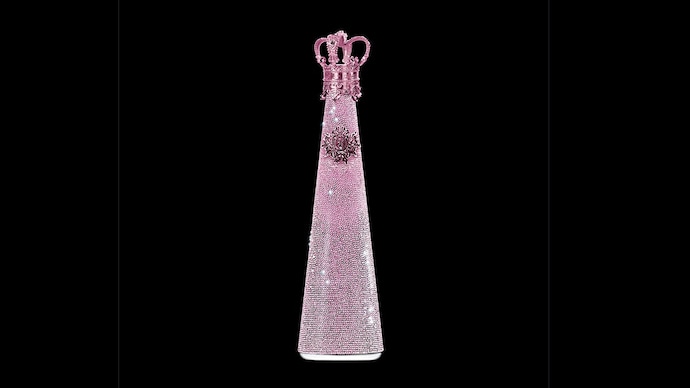
In the upper echelons of hydration, water is a collector’s item. The most expensive, Acqua di Cristallo Tributo a Modigliani, is a Rs. 50 lakh ($60,000) 24-carat gold vessel containing a blend of Icelandic, Fijian and French springs infused with 23-carat gold dust. Other ultra-luxury staples include Japan’s Swarovski-encrusted Fillico Jewelry Water (Rs. 1.15 lakh/litre) and the crystal-clad Hollywood favourite, Bling H2O (Rs. 2.2 lakh).
This appetite for high-end hydration has firmly landed in India. As early as 2018, Malaki introduced 24K gold-flake water at `899 (330ml), while Finland’s VEEN, sourced from Bhutanese aquifers, has become a staple at 5-star hotels and high-end restaurants across India. At Food Stories gourmet stores, sales of premium water tripled in 2025. According to co-founder Avni Biyani, the chain recently imported the light and creamy Saratoga Spring Water from New York. Despite a price tag of Rs. 799 for a 355ml bottle, the stock sold out within days.
As the last drop of the 4,000-year-old ice melts away in my glass, it becomes clear that we are no longer just drinking to quench our thirst. We are drinking to taste a moment in time, a connection to the wild.

