COP31 | The climate divide
India returned from the global climate summit with its targets intact but little headway on demands for finance, technology and equity, highlighting the widening chasm between developed and developing nations
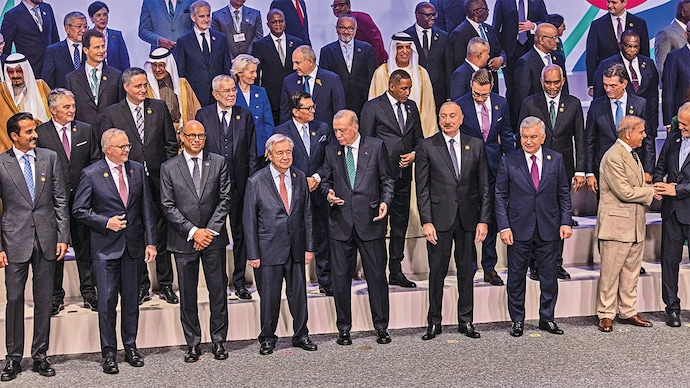
It was already two days past the deadline of the UN Climate Change Conference (COP31) when India took the floor in Antalya, the Turkish resort city hosting the summit, on November 22. Speaking for the Like-Minded Developing Countries, a bloc that also includes China, Egypt and Saudi Arabia, India’s climate change negotiator Amandeep Garg said they were disappointed that developed nations had refused to discuss climate finance and had called the subject “dead in the water”. The summit’s proposed overarching agreement, the Antalya Pact, especially its goal to increase electricity’s share of final global energy consumption to 35 per cent by 2035, met the same fate. At least 32 countries rejected its final draft, leaving COP31 without a cover decision. No UN climate conference had ended that way since Copenhagen in 2009.
It was already two days past the deadline of the UN Climate Change Conference (COP31) when India took the floor in Antalya, the Turkish resort city hosting the summit, on November 22. Speaking for the Like-Minded Developing Countries, a bloc that also includes China, Egypt and Saudi Arabia, India’s climate change negotiator Amandeep Garg said they were disappointed that developed nations had refused to discuss climate finance and had called the subject “dead in the water”. The summit’s proposed overarching agreement, the Antalya Pact, especially its goal to increase electricity’s share of final global energy consumption to 35 per cent by 2035, met the same fate. At least 32 countries rejected its final draft, leaving COP31 without a cover decision. No UN climate conference had ended that way since Copenhagen in 2009.
It was already two days past the deadline of the UN Climate Change Conference (COP31) when India took the floor in Antalya, the Turkish resort city hosting the summit, on November 22. Speaking for the Like-Minded Developing Countries, a bloc that also includes China, Egypt and Saudi Arabia, India’s climate change negotiator Amandeep Garg said they were disappointed that developed nations had refused to discuss climate finance and had called the subject “dead in the water”. The summit’s proposed overarching agreement, the Antalya Pact, especially its goal to increase electricity’s share of final global energy consumption to 35 per cent by 2035, met the same fate. At least 32 countries rejected its final draft, leaving COP31 without a cover decision. No UN climate conference had ended that way since Copenhagen in 2009.
Indian diplomats told india today that New Delhi had not brought down the pact. Objections came mainly from the European Union, Britain and small island states, which rejected a text with no mention of fossil fuels. India said it was “not comfortable” with parts of the draft but was prepared to move forward. Union environment minister Bhupender Yadav later said that India had “engaged constructively till the very end”.
India, therefore, returned with its national energy targets intact but little progress on its demands on climate finance, equity, technology and trade. The outcome captures the tension in its climate diplomacy. In its November 18 national statement, India argued that countries enriched by two centuries of largely unchecked emissions should bear a greater burden. The remaining global carbon budget must be shared equitably, India maintained, calling it “non-negotiable”. The country sought promised climate finance, opposed trade measures that penalise developing economies and said the UN’s work programme on emission cuts should guide rather than prescribe.
This position follows our longstanding principle of common but differentiated responsibilities. At Glasgow in 2021, India and China had the language on coal changed from “phase-out” to “phase-down”; a year later, at Sharm el-Sheikh, India proposed that all fossil fuels, not coal alone, be phased out; at Dubai in 2023, India accepted transition away from fossil fuels in energy systems, provided the shift was “just, orderly and equitable”.
India’s objections also extend to the use of climate policy as a trade instrument. Its steel and aluminium exporters face the EU’s Carbon Border Adjustment Mechanism, which imposes a charge on the carbon emissions embedded in certain imports. A senior commerce ministry official argues that it penalises Indian industry. The India-EU free trade agreement, concluded in late January, secured no exemption; exports of the two metals to the EU had already fallen 25 per cent—from $7.71 billion (Rs 71,000 crore) in FY24 to $5.82 billion (Rs 53,500 crore) in FY25.
THE COAL PARADOX
India wants to set the pace of its own energy transition. Its 2035 climate pledge promises about 60 per cent installed electricity capacity from non-fossil sources, “with the help of transfer of technology and low-cost international finance”. The country has made rapid progress in building renewable capacity, but seven of every 10 units of its electricity still come from fossil fuels, mostly coal.
In Antalya, the draft pact moved further from India’s position as negotiations progressed. Its first version proposed tripling adaptation finance—the funding that developed countries provide to help developing nations cope with climate impacts such as floods, droughts and rising sea levels—to at least $120 billion (Rs 11 lakh crore) a year by 2035; the second dropped the figure. It retained a proposal put forward by the Turkish COP31 presidency, dubbed the “35 by 35” target, under which electricity would meet 35 per cent of the world’s final energy needs by 2035. India and its partners opposed inserting a voluntary pledge into a negotiated UN decision. In the closing plenary, India said the draft ignored equity and failed to address whose emissions, “both past and continuing”, had consumed the carbon budget.
India’s transition itself is moving faster than its targets. Non-fossil capacity reached 308 GW at the end of September, 55 per cent of installed capacity; solar accounted for nearly 175 GW. A record 55.3 GW was added in FY26, almost twice the previous year. India achieved its 2030 target of 50 per cent non-fossil installed capacity five years early and now aims for 500 GW by 2030. Its 2035 pledge also commits India to a 47 per cent cut in the emissions intensity of GDP—the amount of greenhouse gases emitted per unit of economic output—from 2005 levels. Climate Action Tracker, which monitors national pledges, estimates both targets could be met on current policies—possibly by 2030.
Installed capacity, however, is not the same as electricity generated. In FY26, non-fossil sources supplied 29.2 per cent of India’s electricity. Solar generation falls after sunset, when demand remains high, and coal fills the gap. Coal generation declined in 2025, according to the Centre for Research on Energy and Clean Air (CREA), but India still has about 231 GW of coal and lignite capacity, with a strong pipeline of new projects, says energy think tank Ember.
Thermal plants are also under strain. Their average plant load factor—the share of potential output actually generated—was 65.2 per cent in FY26, according to the Central Electricity Authority (CEA). The rating agency ICRA expects it to remain between 65 and 66 per cent in FY27. At midday, solar pushes many coal plants to their technical minimum of 55 per cent. A CEA panel has reportedly backed two-shift operation for 151 ageing units; NTPC says many plants cannot run below that level. CREA estimates that reaching 500 GW of non-fossil capacity by 2030 would leave little room for further growth in coal-fired generation.
WHO PAYS?
Renewables, meanwhile, are losing some of the support that helped build them. The 100 per cent waiver on inter-state transmission charges for solar and wind projects ended in June 2025. It is being reduced by 25 percentage points annually, reaching zero by June 2028. In Rajasthan, more than 4 GW of commissioned capacity faced near-total shutdown during peak solar hours earlier this year because transmission lines were full. ICRA estimates a third of new renewable capacity faces curtailment.
The International Energy Agency’s annual efficiency report says disruption in the Strait of Hormuz curtailed supplies and pushed up prices, hitting energy-importing Asian countries hardest. India, which imports 88-89 per cent of its crude oil requirement, is particularly exposed. “Energy efficiency is one of the most powerful tools countries have to strengthen energy security,” said the agency’s executive director, Fatih Birol.
With the pact abandoned, “35 by 35” survives only as a voluntary pledge backed by about 80 countries. India was not alone in its disappointment over finance. Raju Pandit Chhetri, a Nepali negotiator for the Least Developed Countries and executive director of the think tank Prakriti Resources Centre, called it “very disappointing that adaptation financing has been completely ignored”. Harjeet Singh, founding director of the Satat Sampada Climate Foundation and global convenor of the Fill the Fund campaign, was even blunter. “With the $120 billion figure deleted and the tripling pathway pushed to 2027, the message to the world’s most vulnerable was clear: you’re on your own,” he said.
The rich countries had their reasons. Wars in Iran and Ukraine have reportedly stretched budgets; negotiators also pointed to the absence of the US, whose coordination with China has helped close deals at previous summits. Whatever the cause, the adaptation target goes to next year’s talks without a figure or base year. For India, this has direct economic consequences. Renewable energy developers in India face borrowing costs of 10-12 per cent, compared with just 3-5 per cent in advanced economies, making clean-energy projects more expensive to finance. The Union Cabinet has approved Rs 14,500 crore in viability gap funding to support 92 GWh of energy storage. Coal plants running fewer hours must recover fixed costs from fewer units, while distribution companies carry losses of about Rs 6.47 lakh crore. Without concessional finance from abroad, more of the bill will fall on consumers or state budgets. Saudi Arabia and Russia opposed references to coal, oil and gas in the final draft, which instead called for more carbon capture. India’s closing statement also avoided fossil fuels.
The collapse does not undo the 2023 Dubai agreement or India’s net-zero target for 2070. The Just Transition Work Programme was extended by a reported three years; a dedicated Just Transition Mechanism, which India wants grounded in equity, is expected at COP32 in Addis Ababa. Until then, the fine print of its own pledge applies—60 per cent non-fossil capacity by 2035, contingent on technology transfer and low-cost international finance. Antalya, however, offered no clarity on where either would come from.

