The pain of Partition that can never be shared or captured by cinema
Actor Sunny Deol's Batwara 1947 has reignited debate over how Partition is portrayed on screen. Accounts drawn from Professer Ishtiaq Ahmad's research underline why those wounds resist cinematic closure.
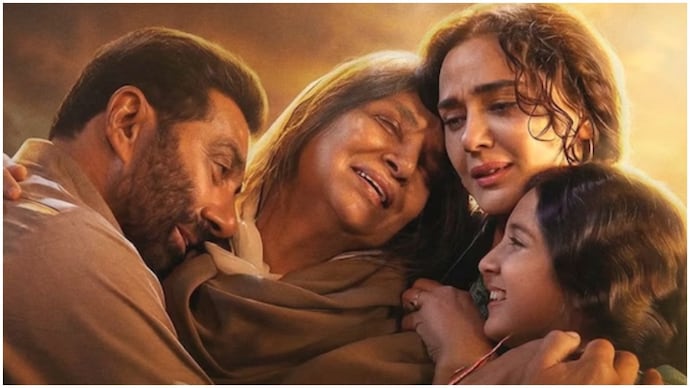
Tara Singh from the movie Gadar becomes Sikandar Mirza in Batwara 1947, protecting a Hindu woman in Pakistan. Critics of the script find this story untenable, as the 1947 Partition showed no mercy to the other side. While promoting his film, Sunny, in the words of his late father Dharmendra, said, "Hindustan maa hai toh Pakistan mausi” (Hindustan is mother, Pakistan is aunt).
Neighbouring countries should share cordial relations, but conveying that message through the cruellest memories of the past seems unfair. It is not right to reopen old wounds in the name of healing.
The film is based on Pakistani author Asghar Wajahat’s 1989 play, Jis Lahore Nai Vekhya, O Jamya E Nai (Whoever hasn’t seen Lahore, hasn’t been born). The play was banned in Pakistan amid allegations that it romanticised humanity while overlooking the brutal realities of the time.
There was also some debate around Diljit Dosanjh’s film Main Vaapas Aaunga, which released before Batwara 1947. The film’s message was that people on both sides of the Partition suffered. Undoubtedly, that is true. However, when it was suggested that people on both sides endured equal levels of violence, a reckoning began.
It is often said, “old sayings are like buried corpses, destined to be unearthed.” Some events and tragedies in history are much like these buried corpses, coming flooding back to life the moment they are mentioned. The memories of Partition are one such example, the pain of which can never truly be shared.
A three-hour film or a four-minute song cannot even come close to capturing that horror. Partition stories have little room for drama, let alone background music or songs.
5 bloody stories of the real Partition
In his landmark book, The Punjab: Bloodied, Partitioned, and Cleansed, Professor Ishtiaq Ahmad, Professor Emeritus at Stockholm University in Sweden and a renowned historian, offers a chilling and unbiased account of the 1947 Partition. Ahmad draws on British government secret reports, newspapers from the era and, most importantly, interviews with eyewitnesses, victims and even perpetrators of the massacres on both sides of the border.
What happened in Punjab between March and December 1947 was not merely the Partition of India—it was one of the most horrific episodes of ethnic cleansing in human history. These five of the most painful incidents, drawn from Ahmad’s book, illustrate how the wounds of Partition run far deeper and remain far more indelible than anything that can be captured on the cinematic screen.
1. The night of the dreaded well in Thoha Khalsa: women jumping into wells to save their honour
In March 1947, even before the official date for India’s independence and Partition had been decided, horrific violence against Sikhs and Hindus erupted in the rural areas of Rawalpindi (West Punjab). Thoha Khalsa was a small, picturesque village in the Rawalpindi district.
According to eyewitness accounts recorded in Ishtiaq Ahmed’s book, an armed mob surrounded the village in the second week of March. The men in the village were poorly armed and unable to defend themselves effectively. The attackers demanded that they either convert to Islam or hand over their sisters and daughters.
The decision taken by the village women and elders was chilling. According to Lajwanti, an elderly woman from the village, and other eyewitness accounts, around 90 Sikh women and girls gathered and decided that death was preferable to having their honour violated by the attackers.
Holding infants in their arms and chanting “Waheguru,” the women, one after another, jumped into the village’s deep well. Soon, it was filled with their bodies. Those who jumped in first drowned, while those who followed were left in agony as the water level fell and the well could no longer accommodate them.
And Thoha Khalsa was not an isolated case. In dozens of villages across Jhelum, Rawalpindi and Multan, fathers reportedly beheaded their own daughters with their swords to prevent them from falling into the hands of attackers.
Can a film ever truly capture the pain of a father who was forced to take the life of his own child?
2. Sheikhupura Rice Mill Massacre: Hundreds of bodies strewn across a single compound
When the Radcliffe Line was announced in August 1947 and Sheikhupura (West Punjab) became part of Pakistan, the Hindus and Sikhs who had been living there for centuries suddenly became strangers and helpless on their own land.
Rumours and panic gripped the town of Sheikhupura. The administration and local officials offered assurances of safety to non-Muslims and urged them to seek refuge in the premises of a large rice mill and a gurdwara. Hundreds of families, along with their children, elderly people and belongings, gathered in the mill’s premises, hoping the army and police would protect them.
But the truth that Ishtiaq Ahmed reveals in his book is chilling. On August 25 and 26, 1947, the local police and a rioting mob surrounded the rice mill. People were forced out under the pretext that they would be loaded onto army trucks and sent to India, so they should leave in small groups.
As soon as people came out, they were showered with bullets. Those who remained hidden inside the mill were attacked from inside. Innocent children hiding behind sacks of rice were speared, and the entire compound was set on fire. According to eyewitnesses, 3,000 to 4,000 innocent people were massacred inside the Sheikhupura Rice Mill in that single day. For days, there was no one to collect the bodies, and the stench of rotting corpses permeated the entire city.
3. 'Trains of Death': When only dead bodies arrived at stations, not passengers
During the horrific period of 1947, trains were no longer a means of crossing the border, but rather a moving crematorium. Arrivals at Amritsar, Lahore, Gujranwala, Gujarat (Pakistan) and Ambala railway stations presented a barbaric scene.
Ishtiaq Ahmed’s book details that the violence wasn’t concentrated on one side. Train routes on both sides had become bloody theatres. In August and September 1947, trains were conspiratorially stopped in uninhabited areas, sometimes by placing stones on the tracks, sometimes by knocking down signals.
As soon as the train stopped, armed mobs hiding in the bushes attacked the carriages. Spears and swords were thrust through the windows and doors. Bullets were fired. Those carriages that were locked from the inside were doused with petrol and set ablaze.
When these trains arrived at their destination stations, such as Lahore to Amritsar or Amritsar to Lahore, the platforms would fall silent. All the train carriages would be filled with nothing but mutilated bodies. Blood would drip from the bottom of the carriages. Sometimes, the attackers would write on the train carriages, "This is our gift."
Each train carried 1,000 to 1,500 bodies. Sometimes, the rioters left the train driver alive so that he could drive the blood-soaked train to the border to instil terror in the people on the other side.
4. The 'convoys' and the Balloki Headworks massacre: Thousands of refugees on foot massacred
When trains and roads became a death trap, people were left with only one option: to leave their homes on foot. These weren’t just groups of 100 or 200 people, but rather huge groups of 50,000 to 100,000, called caravans. These caravans were 10 kilometres long, dragging their cattle and young children through the dust and mud.
In his book, Ishtiaq Ahmad details the massacre at Balloki Headworks and the bridges over the Ravi and Sutlej rivers. As these large convoys attempted to cross the narrow river bridges or headworks, they were ambushed from both sides.
That year, the monsoon rains were torrential. Armed rioters were approaching from behind, while hunger, exhaustion and cholera were raging on the other. Elderly people or young children who collapsed along the way were forced to be left behind by their relatives accompanying the convoy, because stopping meant the entire family would be slaughtered.
The Ravi River near the Balloki Headworks flowed with human corpses and blood for weeks. Eyewitnesses reported that the river’s water had become so toxic and bloody that, for weeks, people in nearby villages were afraid to touch it, let alone drink it.
5. Abduction of innocents, scars on bodies and lost identities
The most horrific and shameful aspect of the tragedy of 1947 was the brutality against women. In his book, Ahmed reveals the horrifying truth that rioters used women’s bodies as a platform for their hatred and victory.
An estimated 75,000 to 100,000 women were abducted in 1947. They were paraded naked through markets, their breasts were cut off, and their bodies were tattooed with religious symbols and hateful words.
The tragedy didn’t end there. After 1948, when the governments of India and Pakistan, under an agreement, launched a search-and-recovery operation to locate these abducted women and return them to their families, a new wave of psychological torture began.
Many families refused to take back their own daughters and daughters-in-law. Many women who had lived with their captors and had children were forcibly taken away from their children and sent across borders. This administrative and social cruelty pushed thousands of women into a lifelong world of anonymity, where they had no past and no future.
That wound of history which cannot be contained on any screen
While we watch films like Sunny Deol’s Batwara 1947 or get emotional over Diljit Dosanjh’s musical numbers, we should also remember that art and cinema have their limits. Cinema has a hero, action and, finally, the story ends with a background score.
In reality, no Partition story had a happy ending. The pain of 1947 is a wound that can never be shared, for only a mother who threw her children into a well and then jumped in herself could understand its pain. The pain of a father who slit his daughter’s throat to save her honour from a mob cannot be recreated on screen. And no music can describe the silence of a train carriage carrying only mutilated corpses.
The history of 1947 isn’t meant to teach us hatred towards another community. It’s meant to remind us that when the poison of politics and religious fanaticism seeps into the minds of ordinary people, centuries-old civilisation and humanity can be reduced to ashes overnight. The stories of Partition offer a chance to cry or be emotional, but they don’t offer emotional closure.Su
Tara Singh from the movie Gadar becomes Sikandar Mirza in Batwara 1947, protecting a Hindu woman in Pakistan. Critics of the script find this story untenable, as the 1947 Partition showed no mercy to the other side. While promoting his film, Sunny, in the words of his late father Dharmendra, said, "Hindustan maa hai toh Pakistan mausi” (Hindustan is mother, Pakistan is aunt).
Neighbouring countries should share cordial relations, but conveying that message through the cruellest memories of the past seems unfair. It is not right to reopen old wounds in the name of healing.
The film is based on Pakistani author Asghar Wajahat’s 1989 play, Jis Lahore Nai Vekhya, O Jamya E Nai (Whoever hasn’t seen Lahore, hasn’t been born). The play was banned in Pakistan amid allegations that it romanticised humanity while overlooking the brutal realities of the time.
There was also some debate around Diljit Dosanjh’s film Main Vaapas Aaunga, which released before Batwara 1947. The film’s message was that people on both sides of the Partition suffered. Undoubtedly, that is true. However, when it was suggested that people on both sides endured equal levels of violence, a reckoning began.
It is often said, “old sayings are like buried corpses, destined to be unearthed.” Some events and tragedies in history are much like these buried corpses, coming flooding back to life the moment they are mentioned. The memories of Partition are one such example, the pain of which can never truly be shared.
A three-hour film or a four-minute song cannot even come close to capturing that horror. Partition stories have little room for drama, let alone background music or songs.
5 bloody stories of the real Partition
In his landmark book, The Punjab: Bloodied, Partitioned, and Cleansed, Professor Ishtiaq Ahmad, Professor Emeritus at Stockholm University in Sweden and a renowned historian, offers a chilling and unbiased account of the 1947 Partition. Ahmad draws on British government secret reports, newspapers from the era and, most importantly, interviews with eyewitnesses, victims and even perpetrators of the massacres on both sides of the border.
What happened in Punjab between March and December 1947 was not merely the Partition of India—it was one of the most horrific episodes of ethnic cleansing in human history. These five of the most painful incidents, drawn from Ahmad’s book, illustrate how the wounds of Partition run far deeper and remain far more indelible than anything that can be captured on the cinematic screen.
1. The night of the dreaded well in Thoha Khalsa: women jumping into wells to save their honour
In March 1947, even before the official date for India’s independence and Partition had been decided, horrific violence against Sikhs and Hindus erupted in the rural areas of Rawalpindi (West Punjab). Thoha Khalsa was a small, picturesque village in the Rawalpindi district.
According to eyewitness accounts recorded in Ishtiaq Ahmed’s book, an armed mob surrounded the village in the second week of March. The men in the village were poorly armed and unable to defend themselves effectively. The attackers demanded that they either convert to Islam or hand over their sisters and daughters.
The decision taken by the village women and elders was chilling. According to Lajwanti, an elderly woman from the village, and other eyewitness accounts, around 90 Sikh women and girls gathered and decided that death was preferable to having their honour violated by the attackers.
Holding infants in their arms and chanting “Waheguru,” the women, one after another, jumped into the village’s deep well. Soon, it was filled with their bodies. Those who jumped in first drowned, while those who followed were left in agony as the water level fell and the well could no longer accommodate them.
And Thoha Khalsa was not an isolated case. In dozens of villages across Jhelum, Rawalpindi and Multan, fathers reportedly beheaded their own daughters with their swords to prevent them from falling into the hands of attackers.
Can a film ever truly capture the pain of a father who was forced to take the life of his own child?
2. Sheikhupura Rice Mill Massacre: Hundreds of bodies strewn across a single compound
When the Radcliffe Line was announced in August 1947 and Sheikhupura (West Punjab) became part of Pakistan, the Hindus and Sikhs who had been living there for centuries suddenly became strangers and helpless on their own land.
Rumours and panic gripped the town of Sheikhupura. The administration and local officials offered assurances of safety to non-Muslims and urged them to seek refuge in the premises of a large rice mill and a gurdwara. Hundreds of families, along with their children, elderly people and belongings, gathered in the mill’s premises, hoping the army and police would protect them.
But the truth that Ishtiaq Ahmed reveals in his book is chilling. On August 25 and 26, 1947, the local police and a rioting mob surrounded the rice mill. People were forced out under the pretext that they would be loaded onto army trucks and sent to India, so they should leave in small groups.
As soon as people came out, they were showered with bullets. Those who remained hidden inside the mill were attacked from inside. Innocent children hiding behind sacks of rice were speared, and the entire compound was set on fire. According to eyewitnesses, 3,000 to 4,000 innocent people were massacred inside the Sheikhupura Rice Mill in that single day. For days, there was no one to collect the bodies, and the stench of rotting corpses permeated the entire city.
3. 'Trains of Death': When only dead bodies arrived at stations, not passengers
During the horrific period of 1947, trains were no longer a means of crossing the border, but rather a moving crematorium. Arrivals at Amritsar, Lahore, Gujranwala, Gujarat (Pakistan) and Ambala railway stations presented a barbaric scene.
Ishtiaq Ahmed’s book details that the violence wasn’t concentrated on one side. Train routes on both sides had become bloody theatres. In August and September 1947, trains were conspiratorially stopped in uninhabited areas, sometimes by placing stones on the tracks, sometimes by knocking down signals.
As soon as the train stopped, armed mobs hiding in the bushes attacked the carriages. Spears and swords were thrust through the windows and doors. Bullets were fired. Those carriages that were locked from the inside were doused with petrol and set ablaze.
When these trains arrived at their destination stations, such as Lahore to Amritsar or Amritsar to Lahore, the platforms would fall silent. All the train carriages would be filled with nothing but mutilated bodies. Blood would drip from the bottom of the carriages. Sometimes, the attackers would write on the train carriages, "This is our gift."
Each train carried 1,000 to 1,500 bodies. Sometimes, the rioters left the train driver alive so that he could drive the blood-soaked train to the border to instil terror in the people on the other side.
4. The 'convoys' and the Balloki Headworks massacre: Thousands of refugees on foot massacred
When trains and roads became a death trap, people were left with only one option: to leave their homes on foot. These weren’t just groups of 100 or 200 people, but rather huge groups of 50,000 to 100,000, called caravans. These caravans were 10 kilometres long, dragging their cattle and young children through the dust and mud.
In his book, Ishtiaq Ahmad details the massacre at Balloki Headworks and the bridges over the Ravi and Sutlej rivers. As these large convoys attempted to cross the narrow river bridges or headworks, they were ambushed from both sides.
That year, the monsoon rains were torrential. Armed rioters were approaching from behind, while hunger, exhaustion and cholera were raging on the other. Elderly people or young children who collapsed along the way were forced to be left behind by their relatives accompanying the convoy, because stopping meant the entire family would be slaughtered.
The Ravi River near the Balloki Headworks flowed with human corpses and blood for weeks. Eyewitnesses reported that the river’s water had become so toxic and bloody that, for weeks, people in nearby villages were afraid to touch it, let alone drink it.
5. Abduction of innocents, scars on bodies and lost identities
The most horrific and shameful aspect of the tragedy of 1947 was the brutality against women. In his book, Ahmed reveals the horrifying truth that rioters used women’s bodies as a platform for their hatred and victory.
An estimated 75,000 to 100,000 women were abducted in 1947. They were paraded naked through markets, their breasts were cut off, and their bodies were tattooed with religious symbols and hateful words.
The tragedy didn’t end there. After 1948, when the governments of India and Pakistan, under an agreement, launched a search-and-recovery operation to locate these abducted women and return them to their families, a new wave of psychological torture began.
Many families refused to take back their own daughters and daughters-in-law. Many women who had lived with their captors and had children were forcibly taken away from their children and sent across borders. This administrative and social cruelty pushed thousands of women into a lifelong world of anonymity, where they had no past and no future.
That wound of history which cannot be contained on any screen
While we watch films like Sunny Deol’s Batwara 1947 or get emotional over Diljit Dosanjh’s musical numbers, we should also remember that art and cinema have their limits. Cinema has a hero, action and, finally, the story ends with a background score.
In reality, no Partition story had a happy ending. The pain of 1947 is a wound that can never be shared, for only a mother who threw her children into a well and then jumped in herself could understand its pain. The pain of a father who slit his daughter’s throat to save her honour from a mob cannot be recreated on screen. And no music can describe the silence of a train carriage carrying only mutilated corpses.
The history of 1947 isn’t meant to teach us hatred towards another community. It’s meant to remind us that when the poison of politics and religious fanaticism seeps into the minds of ordinary people, centuries-old civilisation and humanity can be reduced to ashes overnight. The stories of Partition offer a chance to cry or be emotional, but they don’t offer emotional closure.Su
Tara Singh from the movie Gadar becomes Sikandar Mirza in Batwara 1947, protecting a Hindu woman in Pakistan. Critics of the script find this story untenable, as the 1947 Partition showed no mercy to the other side. While promoting his film, Sunny, in the words of his late father Dharmendra, said, "Hindustan maa hai toh Pakistan mausi” (Hindustan is mother, Pakistan is aunt).
Neighbouring countries should share cordial relations, but conveying that message through the cruellest memories of the past seems unfair. It is not right to reopen old wounds in the name of healing.
The film is based on Pakistani author Asghar Wajahat’s 1989 play, Jis Lahore Nai Vekhya, O Jamya E Nai (Whoever hasn’t seen Lahore, hasn’t been born). The play was banned in Pakistan amid allegations that it romanticised humanity while overlooking the brutal realities of the time.
There was also some debate around Diljit Dosanjh’s film Main Vaapas Aaunga, which released before Batwara 1947. The film’s message was that people on both sides of the Partition suffered. Undoubtedly, that is true. However, when it was suggested that people on both sides endured equal levels of violence, a reckoning began.
It is often said, “old sayings are like buried corpses, destined to be unearthed.” Some events and tragedies in history are much like these buried corpses, coming flooding back to life the moment they are mentioned. The memories of Partition are one such example, the pain of which can never truly be shared.
A three-hour film or a four-minute song cannot even come close to capturing that horror. Partition stories have little room for drama, let alone background music or songs.
5 bloody stories of the real Partition
In his landmark book, The Punjab: Bloodied, Partitioned, and Cleansed, Professor Ishtiaq Ahmad, Professor Emeritus at Stockholm University in Sweden and a renowned historian, offers a chilling and unbiased account of the 1947 Partition. Ahmad draws on British government secret reports, newspapers from the era and, most importantly, interviews with eyewitnesses, victims and even perpetrators of the massacres on both sides of the border.
What happened in Punjab between March and December 1947 was not merely the Partition of India—it was one of the most horrific episodes of ethnic cleansing in human history. These five of the most painful incidents, drawn from Ahmad’s book, illustrate how the wounds of Partition run far deeper and remain far more indelible than anything that can be captured on the cinematic screen.
1. The night of the dreaded well in Thoha Khalsa: women jumping into wells to save their honour
In March 1947, even before the official date for India’s independence and Partition had been decided, horrific violence against Sikhs and Hindus erupted in the rural areas of Rawalpindi (West Punjab). Thoha Khalsa was a small, picturesque village in the Rawalpindi district.
According to eyewitness accounts recorded in Ishtiaq Ahmed’s book, an armed mob surrounded the village in the second week of March. The men in the village were poorly armed and unable to defend themselves effectively. The attackers demanded that they either convert to Islam or hand over their sisters and daughters.
The decision taken by the village women and elders was chilling. According to Lajwanti, an elderly woman from the village, and other eyewitness accounts, around 90 Sikh women and girls gathered and decided that death was preferable to having their honour violated by the attackers.
Holding infants in their arms and chanting “Waheguru,” the women, one after another, jumped into the village’s deep well. Soon, it was filled with their bodies. Those who jumped in first drowned, while those who followed were left in agony as the water level fell and the well could no longer accommodate them.
And Thoha Khalsa was not an isolated case. In dozens of villages across Jhelum, Rawalpindi and Multan, fathers reportedly beheaded their own daughters with their swords to prevent them from falling into the hands of attackers.
Can a film ever truly capture the pain of a father who was forced to take the life of his own child?
2. Sheikhupura Rice Mill Massacre: Hundreds of bodies strewn across a single compound
When the Radcliffe Line was announced in August 1947 and Sheikhupura (West Punjab) became part of Pakistan, the Hindus and Sikhs who had been living there for centuries suddenly became strangers and helpless on their own land.
Rumours and panic gripped the town of Sheikhupura. The administration and local officials offered assurances of safety to non-Muslims and urged them to seek refuge in the premises of a large rice mill and a gurdwara. Hundreds of families, along with their children, elderly people and belongings, gathered in the mill’s premises, hoping the army and police would protect them.
But the truth that Ishtiaq Ahmed reveals in his book is chilling. On August 25 and 26, 1947, the local police and a rioting mob surrounded the rice mill. People were forced out under the pretext that they would be loaded onto army trucks and sent to India, so they should leave in small groups.
As soon as people came out, they were showered with bullets. Those who remained hidden inside the mill were attacked from inside. Innocent children hiding behind sacks of rice were speared, and the entire compound was set on fire. According to eyewitnesses, 3,000 to 4,000 innocent people were massacred inside the Sheikhupura Rice Mill in that single day. For days, there was no one to collect the bodies, and the stench of rotting corpses permeated the entire city.
3. 'Trains of Death': When only dead bodies arrived at stations, not passengers
During the horrific period of 1947, trains were no longer a means of crossing the border, but rather a moving crematorium. Arrivals at Amritsar, Lahore, Gujranwala, Gujarat (Pakistan) and Ambala railway stations presented a barbaric scene.
Ishtiaq Ahmed’s book details that the violence wasn’t concentrated on one side. Train routes on both sides had become bloody theatres. In August and September 1947, trains were conspiratorially stopped in uninhabited areas, sometimes by placing stones on the tracks, sometimes by knocking down signals.
As soon as the train stopped, armed mobs hiding in the bushes attacked the carriages. Spears and swords were thrust through the windows and doors. Bullets were fired. Those carriages that were locked from the inside were doused with petrol and set ablaze.
When these trains arrived at their destination stations, such as Lahore to Amritsar or Amritsar to Lahore, the platforms would fall silent. All the train carriages would be filled with nothing but mutilated bodies. Blood would drip from the bottom of the carriages. Sometimes, the attackers would write on the train carriages, "This is our gift."
Each train carried 1,000 to 1,500 bodies. Sometimes, the rioters left the train driver alive so that he could drive the blood-soaked train to the border to instil terror in the people on the other side.
4. The 'convoys' and the Balloki Headworks massacre: Thousands of refugees on foot massacred
When trains and roads became a death trap, people were left with only one option: to leave their homes on foot. These weren’t just groups of 100 or 200 people, but rather huge groups of 50,000 to 100,000, called caravans. These caravans were 10 kilometres long, dragging their cattle and young children through the dust and mud.
In his book, Ishtiaq Ahmad details the massacre at Balloki Headworks and the bridges over the Ravi and Sutlej rivers. As these large convoys attempted to cross the narrow river bridges or headworks, they were ambushed from both sides.
That year, the monsoon rains were torrential. Armed rioters were approaching from behind, while hunger, exhaustion and cholera were raging on the other. Elderly people or young children who collapsed along the way were forced to be left behind by their relatives accompanying the convoy, because stopping meant the entire family would be slaughtered.
The Ravi River near the Balloki Headworks flowed with human corpses and blood for weeks. Eyewitnesses reported that the river’s water had become so toxic and bloody that, for weeks, people in nearby villages were afraid to touch it, let alone drink it.
5. Abduction of innocents, scars on bodies and lost identities
The most horrific and shameful aspect of the tragedy of 1947 was the brutality against women. In his book, Ahmed reveals the horrifying truth that rioters used women’s bodies as a platform for their hatred and victory.
An estimated 75,000 to 100,000 women were abducted in 1947. They were paraded naked through markets, their breasts were cut off, and their bodies were tattooed with religious symbols and hateful words.
The tragedy didn’t end there. After 1948, when the governments of India and Pakistan, under an agreement, launched a search-and-recovery operation to locate these abducted women and return them to their families, a new wave of psychological torture began.
Many families refused to take back their own daughters and daughters-in-law. Many women who had lived with their captors and had children were forcibly taken away from their children and sent across borders. This administrative and social cruelty pushed thousands of women into a lifelong world of anonymity, where they had no past and no future.
That wound of history which cannot be contained on any screen
While we watch films like Sunny Deol’s Batwara 1947 or get emotional over Diljit Dosanjh’s musical numbers, we should also remember that art and cinema have their limits. Cinema has a hero, action and, finally, the story ends with a background score.
In reality, no Partition story had a happy ending. The pain of 1947 is a wound that can never be shared, for only a mother who threw her children into a well and then jumped in herself could understand its pain. The pain of a father who slit his daughter’s throat to save her honour from a mob cannot be recreated on screen. And no music can describe the silence of a train carriage carrying only mutilated corpses.
The history of 1947 isn’t meant to teach us hatred towards another community. It’s meant to remind us that when the poison of politics and religious fanaticism seeps into the minds of ordinary people, centuries-old civilisation and humanity can be reduced to ashes overnight. The stories of Partition offer a chance to cry or be emotional, but they don’t offer emotional closure.Su

