What is IMAX, how does it work? The maths you didn't know behind Nolan's The Odyssey
Christopher Nolan's India visit for The Odyssey has revived questions about what IMAX really means in the country. The debate centres on the gap between India's commercial screens and the true IMAX format his films are designed for.
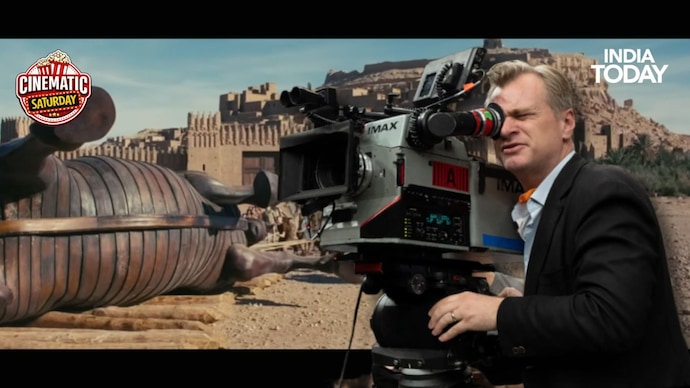
Christopher Nolan, a director who's become almost synonymous with IMAX itself, landed in India this July to promote The Odyssey, the first feature film in history shot entirely on IMAX. A genuine moment for Indian cinema. Except by the time he'd cleared the airport, the internet had already moved on: memes started circulating about Nolan discovering that the IMAX India queues up for isn't quite the IMAX he built his career on.
IMAX has long been sold as the gold standard of movie experience in India, and audiences have been willing to pay for that promise. Depending on the city, theatre and showtime, a regular IMAX ticket typically costs anywhere between Rs 400 to Rs 1,200, while opening weekend shows for major releases can climb well beyond Rs 2,000, with Christopher Nolan's The Odyssey recently pushing premium seats to Rs 3,400 in Mumbai and Rs 2,500 in Delhi-NCR. When people are paying that kind of money for a cinema ticket, it's only fair to ask a simple question: what exactly makes IMAX different, and are we really getting the same IMAX that Nolan shoots his films for? So what exactly are you buying when your ticket says IMAX?
Grab a tea, this one needs a bit of unpacking, but we promise, by the end, you'll be the one explaining it to your friends at the multiplex.
What actually is IMAX?
IMAX, short for Image MAXimum, isn't a technology one studio invented and moved on from. It's a standalone, publicly traded company (NYSE: IMAX), founded all the way back in 1967 in Montreal by a group of filmmakers inspired by the giant multi-screen displays at Expo 67, who then spent years building a single-projector system that could do the same job better. Today it's run by long-time CEO Richard Gelfond, and it doesn't just sell projectors and walk away. IMAX enters long-term partnerships with cinema chains, effectively co-designing the auditorium itself, the screen placement, the acoustics, the whole room, often funding a chunk of the installation in exchange for a cut of ticket sales going forward.
None of that explains what you're actually seeing on screen, though. For that, let's park the company discussion and look at the shape of the picture itself.
Forget the jargon, think of it as a window
Every film has an aspect ratio, simply the shape of the rectangle you're watching it in. Wide and short, or tall and roomy. That's the whole concept people spend YouTube videos over-complicating.
Picture a normal window in your house, waist height, running along the wall. That's an ordinary cinema screen: the 2.39:1 scope ratio that roughly eight in ten films and eight in ten Indian screens are built for, the shape cinema settled on in the 1950s to make theatres feel bigger than the boxy TVs people had at home.
Now picture a mason knocking that window open, upward, both ways: more glass above and below, same width. You haven't moved, but you can now see the treetops and the ground that used to be hidden. That's what an IMAX screen does to a film: not a different picture, just more of the same picture.
Here's the bit almost nobody explains: there isn't one size of taller window. There are two, and the gap between them matters more than most people realise.
- LieMAX (1.90:1): the shape of every commercial IMAX screen in India - the window knocked open by another foot or so, top and bottom. Noticeably taller, still very much a window.
- True IMAX (1.43:1): the format IMAX was actually invented for in 1970. Not a taller window anymore, but an opening nearly as tall as it is wide, close to a full glass wall from knee height to well above your head. Nolan described shooting on it as "letting the screen disappear," an effect like watching 3D without glasses, because the image fills your entire peripheral vision.
That gap, roughly a quarter more picture, top and bottom, is the entire reason that “the Nolan discovers India doesn't have real IMAX”-jokes exist. 1.43:1 is not commercially screened anywhere in the country. More on that below.
Things that decide whether you get true IMAX
Here's the trick nobody tells you when you're booking tickets: IMAX written on your ticket doesn't describe one thing. It's shorthand for three completely separate decisions, made by three completely different people, at three completely different stages of a film's life. Was it shot on an IMAX camera? Was it projected on an IMAX projector? Is the screen actually IMAX shaped? A film can tick just one of those boxes and still legally call itself IMAX.
1. How it was shot
- Never intended for IMAX: Think of a wedding guest standing at the back, zooming in on their phone. No matter how good the phone is, the footage can only do so much. Similarly, these films are shot on ordinary digital cameras and later digitally enlarged for IMAX screens. They still play on a bigger screen, but the image is essentially a blown-up version of the original. This is the overwhelming majority of films shown in IMAX theatres in India. They're perfectly good films, just not made for the format. No extra picture. No extra detail. Just a regular film on a bigger wall.
- IMAX-certified digital: Now think of the guest who's been filming the wedding, standing in the front row and framing everything properly from the start, but still on his phone. Similarly, these films are shot on IMAX-certified digital cameras, modified Sony, RED or ARRI systems, so they're composed for IMAX from the first take instead of being enlarged later. Films like Avengers: Infinity War, Endgame, Spider-Man: No Way Home, Dune: Part One and upcoming Indian tent-poles like Namit Malhotra's Ramayana fall into this category.
- True IMAX: This is like the family bringing in a professional with specialised equipment for the ceremony that matters most. Shooting on massive 65/70mm IMAX film cameras using physical celluloid, these cameras capture the full 1.43:1 frame at an estimated resolution of around 18K, compared to under 2K for a home HD screen. Nolan has used them since The Dark Knight (2008), but only for select sequences, because they were too loud and cumbersome to shoot an entire film. The Odyssey changes that, becoming the first feature film shot entirely with these cameras.
Only around eight to twelve of these physical cameras exist on the planet, hand-built, rented out by IMAX itself rather than sold, because nobody else can service them. That scarcity is the whole ballgame.
2. How it was shown to you
This is where most Indian cinemagoers lose picture quality without realising it. There's entry-level digital (2K xenon, stuck at 1.90:1), mid-tier digital (sharper 4K laser, still 1.90:1), and the real deal: a dual-laser GT projector or an actual 15/70mm film projector, both capable of the full 1.43:1 image.
India doesn't have a single top-tier projector or film, running commercially anywhere. All roughly 30 IMAX-branded screens in the country, from Mumbai to Delhi to Bengaluru to Chennai to Coimbatore and Kolkata, use the smaller 1.90:1 shape. Still a good cinema. Just not the format Nolan built The Odyssey around.
3. How big is the wall
This is the part people notice most. A genuine true-IMAX auditorium isn't a bigger version of a normal hall, it's built from scratch as a steep, stadium-style room where even front-row viewers look almost straight up at a screen that curves around them. India's one true example, at Gujarat Science City in Ahmedabad, runs close to 95 feet wide and 66 feet tall. Most commercial IMAX halls in India, by contrast, are ordinary auditoriums with the front wall knocked down and a somewhat bigger 1.90:1 screen pushed forward a few feet: same floor, same seats, same room.
Even India's largest digital IMAX screen, at Miraj Cinemas in Wadala, Mumbai, tops out around 72 feet wide, respectable, but nowhere near true scale, and built inside a retrofit rather than designed for it. Gujarat Science City's screen is reserved for documentaries, so it isn't really an option for anyone wanting to watch a feature film.
That's why simply upgrading the projector can't fix an old multiplex hall: the room itself isn't tall, steep, or close enough. Getting there means building from scratch, which is exactly the expensive problem keeping true IMAX out of India's malls.
Was this always the case?
Prasad's Multiplex in Hyderabad opened a genuine 70mm IMAX auditorium in 2003, briefly one of the biggest screens on Earth, and in 2014 the last place in India to watch Interstellar in its full, intended glory (roughly 75,000 people packed the 600-seat hall in a single month). But flying physical film reels from the US, and the rising cost of a dying format, made it unsustainable; by late 2014 the projector was gone. Two more true IMAX auditoriums, in Ghaziabad and Kolkata, closed around the same time.
There's a twist, though: Indian director S.S. Rajamouli is reportedly shooting his upcoming epic Varanasi natively in 1.43:1, something no Indian film has attempted, and has been vocal about wanting a true IMAX screen ready in Hyderabad by release. So the story isn't necessarily that India never gets a real IMAX. It's not yet.
The business of IMAX
Part of this also comes down to how IMAX makes its money. Getting a film onto an IMAX screen isn't purely a technical decision; it's a commercial one. Filmmakers typically have two routes. They can join the Filmed for IMAX programme, planning the taller IMAX frame from the outset using IMAX-certified cameras, or they can finish the film conventionally and later put it through Digital Media Remastering (DMR), IMAX's proprietary post-production process that enhances the picture and remixes the sound for IMAX exhibition. Either way, IMAX earns a share of the film's IMAX box office, making the format as much a business model as a filmmaking standard.
The financial commitment, however, differs significantly. Filmed for IMAX doesn't require an upfront licensing fee to IMAX, but productions must rent approved camera systems and share a percentage of their IMAX box office revenue. DMR, on the other hand, is a paid post-production service that reportedly costs around $1 million to $1.5 million for a major feature, although large studios sometimes negotiate different commercial terms. That's why many films carrying the IMAX logo were never actually shot in IMAX. With that in mind, let's look at the three decisions that ultimately determine the IMAX experience.
The takeaway, for the next time you're booking a ticket
You don't need to feel conned buying an IMAX ticket in India: you're still getting a genuinely bigger screen, sharper projection, and better sound than your neighbourhood's single screen, and for most films that's a real upgrade. What's worth knowing is that IMAX is doing three different jobs at once, and in India today, two of those three, the projector and the screen, are capped in a smaller shape. Only the camera occasionally reaches the top tier, in the handful of scenes Nolan or Rajamouli shoot that way.
So next time a film advertises an IMAX experience, ask yourself which of the three you're actually getting. Chances are, it's a very good window, just not quite the full wall Nolan knocked down to build his.
Christopher Nolan, a director who's become almost synonymous with IMAX itself, landed in India this July to promote The Odyssey, the first feature film in history shot entirely on IMAX. A genuine moment for Indian cinema. Except by the time he'd cleared the airport, the internet had already moved on: memes started circulating about Nolan discovering that the IMAX India queues up for isn't quite the IMAX he built his career on.
IMAX has long been sold as the gold standard of movie experience in India, and audiences have been willing to pay for that promise. Depending on the city, theatre and showtime, a regular IMAX ticket typically costs anywhere between Rs 400 to Rs 1,200, while opening weekend shows for major releases can climb well beyond Rs 2,000, with Christopher Nolan's The Odyssey recently pushing premium seats to Rs 3,400 in Mumbai and Rs 2,500 in Delhi-NCR. When people are paying that kind of money for a cinema ticket, it's only fair to ask a simple question: what exactly makes IMAX different, and are we really getting the same IMAX that Nolan shoots his films for? So what exactly are you buying when your ticket says IMAX?
Grab a tea, this one needs a bit of unpacking, but we promise, by the end, you'll be the one explaining it to your friends at the multiplex.
What actually is IMAX?
IMAX, short for Image MAXimum, isn't a technology one studio invented and moved on from. It's a standalone, publicly traded company (NYSE: IMAX), founded all the way back in 1967 in Montreal by a group of filmmakers inspired by the giant multi-screen displays at Expo 67, who then spent years building a single-projector system that could do the same job better. Today it's run by long-time CEO Richard Gelfond, and it doesn't just sell projectors and walk away. IMAX enters long-term partnerships with cinema chains, effectively co-designing the auditorium itself, the screen placement, the acoustics, the whole room, often funding a chunk of the installation in exchange for a cut of ticket sales going forward.
None of that explains what you're actually seeing on screen, though. For that, let's park the company discussion and look at the shape of the picture itself.
Forget the jargon, think of it as a window
Every film has an aspect ratio, simply the shape of the rectangle you're watching it in. Wide and short, or tall and roomy. That's the whole concept people spend YouTube videos over-complicating.
Picture a normal window in your house, waist height, running along the wall. That's an ordinary cinema screen: the 2.39:1 scope ratio that roughly eight in ten films and eight in ten Indian screens are built for, the shape cinema settled on in the 1950s to make theatres feel bigger than the boxy TVs people had at home.
Now picture a mason knocking that window open, upward, both ways: more glass above and below, same width. You haven't moved, but you can now see the treetops and the ground that used to be hidden. That's what an IMAX screen does to a film: not a different picture, just more of the same picture.
Here's the bit almost nobody explains: there isn't one size of taller window. There are two, and the gap between them matters more than most people realise.
- LieMAX (1.90:1): the shape of every commercial IMAX screen in India - the window knocked open by another foot or so, top and bottom. Noticeably taller, still very much a window.
- True IMAX (1.43:1): the format IMAX was actually invented for in 1970. Not a taller window anymore, but an opening nearly as tall as it is wide, close to a full glass wall from knee height to well above your head. Nolan described shooting on it as "letting the screen disappear," an effect like watching 3D without glasses, because the image fills your entire peripheral vision.
That gap, roughly a quarter more picture, top and bottom, is the entire reason that “the Nolan discovers India doesn't have real IMAX”-jokes exist. 1.43:1 is not commercially screened anywhere in the country. More on that below.
Things that decide whether you get true IMAX
Here's the trick nobody tells you when you're booking tickets: IMAX written on your ticket doesn't describe one thing. It's shorthand for three completely separate decisions, made by three completely different people, at three completely different stages of a film's life. Was it shot on an IMAX camera? Was it projected on an IMAX projector? Is the screen actually IMAX shaped? A film can tick just one of those boxes and still legally call itself IMAX.
1. How it was shot
- Never intended for IMAX: Think of a wedding guest standing at the back, zooming in on their phone. No matter how good the phone is, the footage can only do so much. Similarly, these films are shot on ordinary digital cameras and later digitally enlarged for IMAX screens. They still play on a bigger screen, but the image is essentially a blown-up version of the original. This is the overwhelming majority of films shown in IMAX theatres in India. They're perfectly good films, just not made for the format. No extra picture. No extra detail. Just a regular film on a bigger wall.
- IMAX-certified digital: Now think of the guest who's been filming the wedding, standing in the front row and framing everything properly from the start, but still on his phone. Similarly, these films are shot on IMAX-certified digital cameras, modified Sony, RED or ARRI systems, so they're composed for IMAX from the first take instead of being enlarged later. Films like Avengers: Infinity War, Endgame, Spider-Man: No Way Home, Dune: Part One and upcoming Indian tent-poles like Namit Malhotra's Ramayana fall into this category.
- True IMAX: This is like the family bringing in a professional with specialised equipment for the ceremony that matters most. Shooting on massive 65/70mm IMAX film cameras using physical celluloid, these cameras capture the full 1.43:1 frame at an estimated resolution of around 18K, compared to under 2K for a home HD screen. Nolan has used them since The Dark Knight (2008), but only for select sequences, because they were too loud and cumbersome to shoot an entire film. The Odyssey changes that, becoming the first feature film shot entirely with these cameras.
Only around eight to twelve of these physical cameras exist on the planet, hand-built, rented out by IMAX itself rather than sold, because nobody else can service them. That scarcity is the whole ballgame.
2. How it was shown to you
This is where most Indian cinemagoers lose picture quality without realising it. There's entry-level digital (2K xenon, stuck at 1.90:1), mid-tier digital (sharper 4K laser, still 1.90:1), and the real deal: a dual-laser GT projector or an actual 15/70mm film projector, both capable of the full 1.43:1 image.
India doesn't have a single top-tier projector or film, running commercially anywhere. All roughly 30 IMAX-branded screens in the country, from Mumbai to Delhi to Bengaluru to Chennai to Coimbatore and Kolkata, use the smaller 1.90:1 shape. Still a good cinema. Just not the format Nolan built The Odyssey around.
3. How big is the wall
This is the part people notice most. A genuine true-IMAX auditorium isn't a bigger version of a normal hall, it's built from scratch as a steep, stadium-style room where even front-row viewers look almost straight up at a screen that curves around them. India's one true example, at Gujarat Science City in Ahmedabad, runs close to 95 feet wide and 66 feet tall. Most commercial IMAX halls in India, by contrast, are ordinary auditoriums with the front wall knocked down and a somewhat bigger 1.90:1 screen pushed forward a few feet: same floor, same seats, same room.
Even India's largest digital IMAX screen, at Miraj Cinemas in Wadala, Mumbai, tops out around 72 feet wide, respectable, but nowhere near true scale, and built inside a retrofit rather than designed for it. Gujarat Science City's screen is reserved for documentaries, so it isn't really an option for anyone wanting to watch a feature film.
That's why simply upgrading the projector can't fix an old multiplex hall: the room itself isn't tall, steep, or close enough. Getting there means building from scratch, which is exactly the expensive problem keeping true IMAX out of India's malls.
Was this always the case?
Prasad's Multiplex in Hyderabad opened a genuine 70mm IMAX auditorium in 2003, briefly one of the biggest screens on Earth, and in 2014 the last place in India to watch Interstellar in its full, intended glory (roughly 75,000 people packed the 600-seat hall in a single month). But flying physical film reels from the US, and the rising cost of a dying format, made it unsustainable; by late 2014 the projector was gone. Two more true IMAX auditoriums, in Ghaziabad and Kolkata, closed around the same time.
There's a twist, though: Indian director S.S. Rajamouli is reportedly shooting his upcoming epic Varanasi natively in 1.43:1, something no Indian film has attempted, and has been vocal about wanting a true IMAX screen ready in Hyderabad by release. So the story isn't necessarily that India never gets a real IMAX. It's not yet.
The business of IMAX
Part of this also comes down to how IMAX makes its money. Getting a film onto an IMAX screen isn't purely a technical decision; it's a commercial one. Filmmakers typically have two routes. They can join the Filmed for IMAX programme, planning the taller IMAX frame from the outset using IMAX-certified cameras, or they can finish the film conventionally and later put it through Digital Media Remastering (DMR), IMAX's proprietary post-production process that enhances the picture and remixes the sound for IMAX exhibition. Either way, IMAX earns a share of the film's IMAX box office, making the format as much a business model as a filmmaking standard.
The financial commitment, however, differs significantly. Filmed for IMAX doesn't require an upfront licensing fee to IMAX, but productions must rent approved camera systems and share a percentage of their IMAX box office revenue. DMR, on the other hand, is a paid post-production service that reportedly costs around $1 million to $1.5 million for a major feature, although large studios sometimes negotiate different commercial terms. That's why many films carrying the IMAX logo were never actually shot in IMAX. With that in mind, let's look at the three decisions that ultimately determine the IMAX experience.
The takeaway, for the next time you're booking a ticket
You don't need to feel conned buying an IMAX ticket in India: you're still getting a genuinely bigger screen, sharper projection, and better sound than your neighbourhood's single screen, and for most films that's a real upgrade. What's worth knowing is that IMAX is doing three different jobs at once, and in India today, two of those three, the projector and the screen, are capped in a smaller shape. Only the camera occasionally reaches the top tier, in the handful of scenes Nolan or Rajamouli shoot that way.
So next time a film advertises an IMAX experience, ask yourself which of the three you're actually getting. Chances are, it's a very good window, just not quite the full wall Nolan knocked down to build his.
Christopher Nolan, a director who's become almost synonymous with IMAX itself, landed in India this July to promote The Odyssey, the first feature film in history shot entirely on IMAX. A genuine moment for Indian cinema. Except by the time he'd cleared the airport, the internet had already moved on: memes started circulating about Nolan discovering that the IMAX India queues up for isn't quite the IMAX he built his career on.
IMAX has long been sold as the gold standard of movie experience in India, and audiences have been willing to pay for that promise. Depending on the city, theatre and showtime, a regular IMAX ticket typically costs anywhere between Rs 400 to Rs 1,200, while opening weekend shows for major releases can climb well beyond Rs 2,000, with Christopher Nolan's The Odyssey recently pushing premium seats to Rs 3,400 in Mumbai and Rs 2,500 in Delhi-NCR. When people are paying that kind of money for a cinema ticket, it's only fair to ask a simple question: what exactly makes IMAX different, and are we really getting the same IMAX that Nolan shoots his films for? So what exactly are you buying when your ticket says IMAX?
Grab a tea, this one needs a bit of unpacking, but we promise, by the end, you'll be the one explaining it to your friends at the multiplex.
What actually is IMAX?
IMAX, short for Image MAXimum, isn't a technology one studio invented and moved on from. It's a standalone, publicly traded company (NYSE: IMAX), founded all the way back in 1967 in Montreal by a group of filmmakers inspired by the giant multi-screen displays at Expo 67, who then spent years building a single-projector system that could do the same job better. Today it's run by long-time CEO Richard Gelfond, and it doesn't just sell projectors and walk away. IMAX enters long-term partnerships with cinema chains, effectively co-designing the auditorium itself, the screen placement, the acoustics, the whole room, often funding a chunk of the installation in exchange for a cut of ticket sales going forward.
None of that explains what you're actually seeing on screen, though. For that, let's park the company discussion and look at the shape of the picture itself.
Forget the jargon, think of it as a window
Every film has an aspect ratio, simply the shape of the rectangle you're watching it in. Wide and short, or tall and roomy. That's the whole concept people spend YouTube videos over-complicating.
Picture a normal window in your house, waist height, running along the wall. That's an ordinary cinema screen: the 2.39:1 scope ratio that roughly eight in ten films and eight in ten Indian screens are built for, the shape cinema settled on in the 1950s to make theatres feel bigger than the boxy TVs people had at home.
Now picture a mason knocking that window open, upward, both ways: more glass above and below, same width. You haven't moved, but you can now see the treetops and the ground that used to be hidden. That's what an IMAX screen does to a film: not a different picture, just more of the same picture.
Here's the bit almost nobody explains: there isn't one size of taller window. There are two, and the gap between them matters more than most people realise.
- LieMAX (1.90:1): the shape of every commercial IMAX screen in India - the window knocked open by another foot or so, top and bottom. Noticeably taller, still very much a window.
- True IMAX (1.43:1): the format IMAX was actually invented for in 1970. Not a taller window anymore, but an opening nearly as tall as it is wide, close to a full glass wall from knee height to well above your head. Nolan described shooting on it as "letting the screen disappear," an effect like watching 3D without glasses, because the image fills your entire peripheral vision.
That gap, roughly a quarter more picture, top and bottom, is the entire reason that “the Nolan discovers India doesn't have real IMAX”-jokes exist. 1.43:1 is not commercially screened anywhere in the country. More on that below.
Things that decide whether you get true IMAX
Here's the trick nobody tells you when you're booking tickets: IMAX written on your ticket doesn't describe one thing. It's shorthand for three completely separate decisions, made by three completely different people, at three completely different stages of a film's life. Was it shot on an IMAX camera? Was it projected on an IMAX projector? Is the screen actually IMAX shaped? A film can tick just one of those boxes and still legally call itself IMAX.
1. How it was shot
- Never intended for IMAX: Think of a wedding guest standing at the back, zooming in on their phone. No matter how good the phone is, the footage can only do so much. Similarly, these films are shot on ordinary digital cameras and later digitally enlarged for IMAX screens. They still play on a bigger screen, but the image is essentially a blown-up version of the original. This is the overwhelming majority of films shown in IMAX theatres in India. They're perfectly good films, just not made for the format. No extra picture. No extra detail. Just a regular film on a bigger wall.
- IMAX-certified digital: Now think of the guest who's been filming the wedding, standing in the front row and framing everything properly from the start, but still on his phone. Similarly, these films are shot on IMAX-certified digital cameras, modified Sony, RED or ARRI systems, so they're composed for IMAX from the first take instead of being enlarged later. Films like Avengers: Infinity War, Endgame, Spider-Man: No Way Home, Dune: Part One and upcoming Indian tent-poles like Namit Malhotra's Ramayana fall into this category.
- True IMAX: This is like the family bringing in a professional with specialised equipment for the ceremony that matters most. Shooting on massive 65/70mm IMAX film cameras using physical celluloid, these cameras capture the full 1.43:1 frame at an estimated resolution of around 18K, compared to under 2K for a home HD screen. Nolan has used them since The Dark Knight (2008), but only for select sequences, because they were too loud and cumbersome to shoot an entire film. The Odyssey changes that, becoming the first feature film shot entirely with these cameras.
Only around eight to twelve of these physical cameras exist on the planet, hand-built, rented out by IMAX itself rather than sold, because nobody else can service them. That scarcity is the whole ballgame.
2. How it was shown to you
This is where most Indian cinemagoers lose picture quality without realising it. There's entry-level digital (2K xenon, stuck at 1.90:1), mid-tier digital (sharper 4K laser, still 1.90:1), and the real deal: a dual-laser GT projector or an actual 15/70mm film projector, both capable of the full 1.43:1 image.
India doesn't have a single top-tier projector or film, running commercially anywhere. All roughly 30 IMAX-branded screens in the country, from Mumbai to Delhi to Bengaluru to Chennai to Coimbatore and Kolkata, use the smaller 1.90:1 shape. Still a good cinema. Just not the format Nolan built The Odyssey around.
3. How big is the wall
This is the part people notice most. A genuine true-IMAX auditorium isn't a bigger version of a normal hall, it's built from scratch as a steep, stadium-style room where even front-row viewers look almost straight up at a screen that curves around them. India's one true example, at Gujarat Science City in Ahmedabad, runs close to 95 feet wide and 66 feet tall. Most commercial IMAX halls in India, by contrast, are ordinary auditoriums with the front wall knocked down and a somewhat bigger 1.90:1 screen pushed forward a few feet: same floor, same seats, same room.
Even India's largest digital IMAX screen, at Miraj Cinemas in Wadala, Mumbai, tops out around 72 feet wide, respectable, but nowhere near true scale, and built inside a retrofit rather than designed for it. Gujarat Science City's screen is reserved for documentaries, so it isn't really an option for anyone wanting to watch a feature film.
That's why simply upgrading the projector can't fix an old multiplex hall: the room itself isn't tall, steep, or close enough. Getting there means building from scratch, which is exactly the expensive problem keeping true IMAX out of India's malls.
Was this always the case?
Prasad's Multiplex in Hyderabad opened a genuine 70mm IMAX auditorium in 2003, briefly one of the biggest screens on Earth, and in 2014 the last place in India to watch Interstellar in its full, intended glory (roughly 75,000 people packed the 600-seat hall in a single month). But flying physical film reels from the US, and the rising cost of a dying format, made it unsustainable; by late 2014 the projector was gone. Two more true IMAX auditoriums, in Ghaziabad and Kolkata, closed around the same time.
There's a twist, though: Indian director S.S. Rajamouli is reportedly shooting his upcoming epic Varanasi natively in 1.43:1, something no Indian film has attempted, and has been vocal about wanting a true IMAX screen ready in Hyderabad by release. So the story isn't necessarily that India never gets a real IMAX. It's not yet.
The business of IMAX
Part of this also comes down to how IMAX makes its money. Getting a film onto an IMAX screen isn't purely a technical decision; it's a commercial one. Filmmakers typically have two routes. They can join the Filmed for IMAX programme, planning the taller IMAX frame from the outset using IMAX-certified cameras, or they can finish the film conventionally and later put it through Digital Media Remastering (DMR), IMAX's proprietary post-production process that enhances the picture and remixes the sound for IMAX exhibition. Either way, IMAX earns a share of the film's IMAX box office, making the format as much a business model as a filmmaking standard.
The financial commitment, however, differs significantly. Filmed for IMAX doesn't require an upfront licensing fee to IMAX, but productions must rent approved camera systems and share a percentage of their IMAX box office revenue. DMR, on the other hand, is a paid post-production service that reportedly costs around $1 million to $1.5 million for a major feature, although large studios sometimes negotiate different commercial terms. That's why many films carrying the IMAX logo were never actually shot in IMAX. With that in mind, let's look at the three decisions that ultimately determine the IMAX experience.
The takeaway, for the next time you're booking a ticket
You don't need to feel conned buying an IMAX ticket in India: you're still getting a genuinely bigger screen, sharper projection, and better sound than your neighbourhood's single screen, and for most films that's a real upgrade. What's worth knowing is that IMAX is doing three different jobs at once, and in India today, two of those three, the projector and the screen, are capped in a smaller shape. Only the camera occasionally reaches the top tier, in the handful of scenes Nolan or Rajamouli shoot that way.
So next time a film advertises an IMAX experience, ask yourself which of the three you're actually getting. Chances are, it's a very good window, just not quite the full wall Nolan knocked down to build his.

