The politics of Dhanush's films: A groundwork for his possible political entry?
A viral speech has put Dhanush's political ambitions back in the spotlight. But long before the rumours, his films had already begun speaking the language of politics. From Asuran to Captain Miller, here's how his cinema may have already laid the groundwork for a political future.
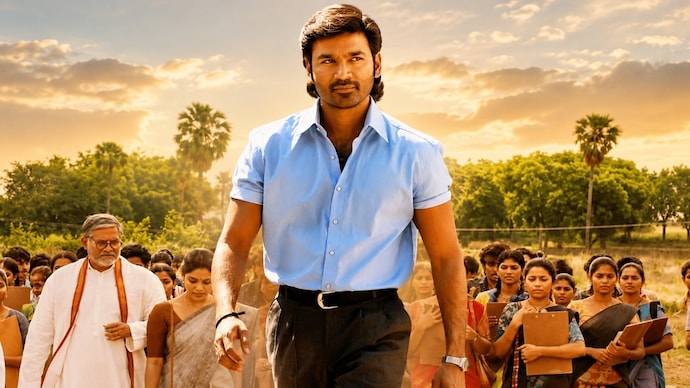
A viral speech in Tiruvallur, a new fan-club flag, and no denial from the man himself - that's all it has taken for "Is Dhanush entering politics?" to become Kollywood's biggest question this week. Nothing has been confirmed. But in a state where Vijay's Tamilaga Vettri Kazhagam (TVK) has gone from zero to becoming the single largest party in the 2026 Assembly elections, every gesture from a star with Dhanush's fan base is bound to be read as a political signal.
While the buzz continues, it is worth noting that, much like Vijay, much of the groundwork in Dhanush's case also appears to have already been laid. But before we explain why, it is important to understand how the latest round of speculation began.
Rumours about Dhanush's political entry have been around for months. However, during a public event in Tamil Nadu on Sunday, the actor urged his followers to unite for a purpose, remarks that many interpreted as a hint towards a possible political debut. The speech immediately fuelled fresh speculation, with many questioning the intent and timing behind his words.
And if Dhanush does eventually take the political plunge, remember you read it here first. His filmography has arguably been laying the foundation for years. Over nearly two decades, the 42-year-old has consistently portrayed characters shaped by the very fault lines that have defined Tamil Nadu's politics – caste oppression, land rights, policing, education and unemployment.
Caste and land: Asuran, Captain Miller
If Dhanush were to enter politics tomorrow, caste and land rights would already be familiar terrain for his audience. Long before the rumours of a political plunge, his cinema had repeatedly placed him at the centre of these battles, not as an observer, but as the man leading the resistance.
Asuran (2019), Vetri Maaran's adaptation of Poomani's novel Vekkai, is the clearest example. Dhanush's Sivasamy is a farmer from an oppressed community whose three-acre plot sits in the way of a dominant-caste landlord's factory. The film doesn't dress up its politics, it's built around the everyday machinery of land grabbing, and the violence a community faces for simply refusing to hand over what little it owns. Sivasamy, here, is the face of a community's fight against structural oppression, a role that closely mirrors the image many political leaders seek to cultivate.
Captain Miller (2024) takes the same caste-and-land grievance and pushes it back a century into British-era Tamil Nadu. Dhanush's Eesa, barred from a temple for his caste, joins the British Indian Army chasing the dignity his own society denies him, only to be sent back to crush his own people's land and resistance. The film centres its politics on land, caste hierarchy, and who gets to belong where. Once again, Dhanush isn't merely playing a character. He is cast as the man who ultimately confronts an unjust system.
Caste and police brutality: Karnan
If Asuran made Dhanush the defender of land rights, Karnan (2021) transformed him into the face of resistance against state power.
Mari Selvaraj's Karnan is Dhanush's clearest film on caste and policing. It follows an oppressed village denied even a bus stop of its own, forced to flag down buses on a highway while a neighbouring dominant-caste village receives full public services. When the villagers finally protest, the state's response isn't negotiation.
It is a police force that descends on the village and brutalises its residents, men, women, and children alike, in a sequence that draws directly on the real 1995 Kodiyankulam incident, where Tamil Nadu police entered a Dalit village and assaulted its residents en masse after a caste clash.
Dhanush's Karnan doesn't fight a landlord or a rival gang here; he fights the state's own enforcement machinery, making it possibly the bluntest political statement in his entire filmography. More importantly, the film casts him as the moral voice of an entire marginalised community, a recurring image that has followed Dhanush across many of his biggest films.
Police, gangs, and the politicians who run both: Vada Chennai, Kodi
The politics in Dhanush's films also extends beyond caste. Several of his most acclaimed performances explore how power itself operates through the nexus of politicians, police and local strongmen.
Vada Chennai (2018) is Dhanush and Vetri Maaran's gangster epic, but its real subject is the alliance between slum landlords, gang bosses, corrupt police, and party workers who take the people for granted. Anbu, a carrom player dragged into a gang war, gradually discovers that the violence around him serves a larger political and commercial agenda. A road contractor wants residents evicted, while local gang leaders and politicians broker the "relocation."
What begins as a gangster story slowly reveals itself as a critique of political power, with Dhanush once again playing the ordinary man forced to expose a broken system. It's less a film about gangsters killing each other for pride than about how North Chennai's poor keep getting sold out by the very networks — police, party, gang — that claim to protect them.
Kodi (2016) goes one step further by placing electoral politics at the centre of its story. Dhanush plays twin brothers: one raised to inherit his father's political legacy, the other as an apolitical college lecturer. The father's defining act is self-immolation in protest against a mercury-processing factory poisoning the local water. It's a masala political thriller first, but it's also one of the only mainstream Dhanush films to put an environmental-poisoning protest at its emotional core.
Unlike many commercial entertainers that merely feature politicians, Kodi asks what politics should stand for, with Dhanush embodying both political idealism and public accountability.
Education and unemployment: Vaathi, Velaiyilla Pattadhari
Yet the strongest indicator of how Dhanush's cinema mirrors political messaging is the range of everyday issues it chooses to champion. Education and unemployment are not secondary elements to drive the narratives, they are treated as public causes requiring someone to fight for them.
Vaathi (2023) is Dhanush's most direct statement on education inequality. A teacher deputed to a government school finds it emptied out because a rival private tuition-centre owner deliberately keeps public education broken to profit from paid coaching. The film explicitly references the 1990s privatisation push that hollowed out government schools in favour of a paid tuition culture.
Once again, Dhanush occupies the role of the reformer who challenges an entrenched system on behalf of ordinary people.
Velaiyilla Pattadhari (2014) tackles unemployment. Dhanush's Raghuvaran is a civil engineering graduate who remains jobless for four years and is ridiculed by his own father for refusing to "settle." Cinematographer Velraj, directing his debut, has described the film as "a message to the youth" about rising unemployment and the frustration of graduates who did everything right and still can't find work. A decade later, it's aged into something closer to documentary than comedy-drama, given how familiar that frustration still sounds.
Viewed together, these films reveal a striking pattern. For two decades, Dhanush has kept choosing roles built around the very things a campaign would run on — land, caste, police violence, and the gap between what the state promises its youth and what it delivers. That is precisely the image Tamil cinema has historically helped build for several actors before they entered politics. Whether intentional or not, his filmography has steadily created a political vocabulary that audiences already associate with him. That's likely reason enough for fans to keep reading his speeches closely, confirmation or not.
A viral speech in Tiruvallur, a new fan-club flag, and no denial from the man himself - that's all it has taken for "Is Dhanush entering politics?" to become Kollywood's biggest question this week. Nothing has been confirmed. But in a state where Vijay's Tamilaga Vettri Kazhagam (TVK) has gone from zero to becoming the single largest party in the 2026 Assembly elections, every gesture from a star with Dhanush's fan base is bound to be read as a political signal.
While the buzz continues, it is worth noting that, much like Vijay, much of the groundwork in Dhanush's case also appears to have already been laid. But before we explain why, it is important to understand how the latest round of speculation began.
Rumours about Dhanush's political entry have been around for months. However, during a public event in Tamil Nadu on Sunday, the actor urged his followers to unite for a purpose, remarks that many interpreted as a hint towards a possible political debut. The speech immediately fuelled fresh speculation, with many questioning the intent and timing behind his words.
And if Dhanush does eventually take the political plunge, remember you read it here first. His filmography has arguably been laying the foundation for years. Over nearly two decades, the 42-year-old has consistently portrayed characters shaped by the very fault lines that have defined Tamil Nadu's politics – caste oppression, land rights, policing, education and unemployment.
Caste and land: Asuran, Captain Miller
If Dhanush were to enter politics tomorrow, caste and land rights would already be familiar terrain for his audience. Long before the rumours of a political plunge, his cinema had repeatedly placed him at the centre of these battles, not as an observer, but as the man leading the resistance.
Asuran (2019), Vetri Maaran's adaptation of Poomani's novel Vekkai, is the clearest example. Dhanush's Sivasamy is a farmer from an oppressed community whose three-acre plot sits in the way of a dominant-caste landlord's factory. The film doesn't dress up its politics, it's built around the everyday machinery of land grabbing, and the violence a community faces for simply refusing to hand over what little it owns. Sivasamy, here, is the face of a community's fight against structural oppression, a role that closely mirrors the image many political leaders seek to cultivate.
Captain Miller (2024) takes the same caste-and-land grievance and pushes it back a century into British-era Tamil Nadu. Dhanush's Eesa, barred from a temple for his caste, joins the British Indian Army chasing the dignity his own society denies him, only to be sent back to crush his own people's land and resistance. The film centres its politics on land, caste hierarchy, and who gets to belong where. Once again, Dhanush isn't merely playing a character. He is cast as the man who ultimately confronts an unjust system.
Caste and police brutality: Karnan
If Asuran made Dhanush the defender of land rights, Karnan (2021) transformed him into the face of resistance against state power.
Mari Selvaraj's Karnan is Dhanush's clearest film on caste and policing. It follows an oppressed village denied even a bus stop of its own, forced to flag down buses on a highway while a neighbouring dominant-caste village receives full public services. When the villagers finally protest, the state's response isn't negotiation.
It is a police force that descends on the village and brutalises its residents, men, women, and children alike, in a sequence that draws directly on the real 1995 Kodiyankulam incident, where Tamil Nadu police entered a Dalit village and assaulted its residents en masse after a caste clash.
Dhanush's Karnan doesn't fight a landlord or a rival gang here; he fights the state's own enforcement machinery, making it possibly the bluntest political statement in his entire filmography. More importantly, the film casts him as the moral voice of an entire marginalised community, a recurring image that has followed Dhanush across many of his biggest films.
Police, gangs, and the politicians who run both: Vada Chennai, Kodi
The politics in Dhanush's films also extends beyond caste. Several of his most acclaimed performances explore how power itself operates through the nexus of politicians, police and local strongmen.
Vada Chennai (2018) is Dhanush and Vetri Maaran's gangster epic, but its real subject is the alliance between slum landlords, gang bosses, corrupt police, and party workers who take the people for granted. Anbu, a carrom player dragged into a gang war, gradually discovers that the violence around him serves a larger political and commercial agenda. A road contractor wants residents evicted, while local gang leaders and politicians broker the "relocation."
What begins as a gangster story slowly reveals itself as a critique of political power, with Dhanush once again playing the ordinary man forced to expose a broken system. It's less a film about gangsters killing each other for pride than about how North Chennai's poor keep getting sold out by the very networks — police, party, gang — that claim to protect them.
Kodi (2016) goes one step further by placing electoral politics at the centre of its story. Dhanush plays twin brothers: one raised to inherit his father's political legacy, the other as an apolitical college lecturer. The father's defining act is self-immolation in protest against a mercury-processing factory poisoning the local water. It's a masala political thriller first, but it's also one of the only mainstream Dhanush films to put an environmental-poisoning protest at its emotional core.
Unlike many commercial entertainers that merely feature politicians, Kodi asks what politics should stand for, with Dhanush embodying both political idealism and public accountability.
Education and unemployment: Vaathi, Velaiyilla Pattadhari
Yet the strongest indicator of how Dhanush's cinema mirrors political messaging is the range of everyday issues it chooses to champion. Education and unemployment are not secondary elements to drive the narratives, they are treated as public causes requiring someone to fight for them.
Vaathi (2023) is Dhanush's most direct statement on education inequality. A teacher deputed to a government school finds it emptied out because a rival private tuition-centre owner deliberately keeps public education broken to profit from paid coaching. The film explicitly references the 1990s privatisation push that hollowed out government schools in favour of a paid tuition culture.
Once again, Dhanush occupies the role of the reformer who challenges an entrenched system on behalf of ordinary people.
Velaiyilla Pattadhari (2014) tackles unemployment. Dhanush's Raghuvaran is a civil engineering graduate who remains jobless for four years and is ridiculed by his own father for refusing to "settle." Cinematographer Velraj, directing his debut, has described the film as "a message to the youth" about rising unemployment and the frustration of graduates who did everything right and still can't find work. A decade later, it's aged into something closer to documentary than comedy-drama, given how familiar that frustration still sounds.
Viewed together, these films reveal a striking pattern. For two decades, Dhanush has kept choosing roles built around the very things a campaign would run on — land, caste, police violence, and the gap between what the state promises its youth and what it delivers. That is precisely the image Tamil cinema has historically helped build for several actors before they entered politics. Whether intentional or not, his filmography has steadily created a political vocabulary that audiences already associate with him. That's likely reason enough for fans to keep reading his speeches closely, confirmation or not.
A viral speech in Tiruvallur, a new fan-club flag, and no denial from the man himself - that's all it has taken for "Is Dhanush entering politics?" to become Kollywood's biggest question this week. Nothing has been confirmed. But in a state where Vijay's Tamilaga Vettri Kazhagam (TVK) has gone from zero to becoming the single largest party in the 2026 Assembly elections, every gesture from a star with Dhanush's fan base is bound to be read as a political signal.
While the buzz continues, it is worth noting that, much like Vijay, much of the groundwork in Dhanush's case also appears to have already been laid. But before we explain why, it is important to understand how the latest round of speculation began.
Rumours about Dhanush's political entry have been around for months. However, during a public event in Tamil Nadu on Sunday, the actor urged his followers to unite for a purpose, remarks that many interpreted as a hint towards a possible political debut. The speech immediately fuelled fresh speculation, with many questioning the intent and timing behind his words.
And if Dhanush does eventually take the political plunge, remember you read it here first. His filmography has arguably been laying the foundation for years. Over nearly two decades, the 42-year-old has consistently portrayed characters shaped by the very fault lines that have defined Tamil Nadu's politics – caste oppression, land rights, policing, education and unemployment.
Caste and land: Asuran, Captain Miller
If Dhanush were to enter politics tomorrow, caste and land rights would already be familiar terrain for his audience. Long before the rumours of a political plunge, his cinema had repeatedly placed him at the centre of these battles, not as an observer, but as the man leading the resistance.
Asuran (2019), Vetri Maaran's adaptation of Poomani's novel Vekkai, is the clearest example. Dhanush's Sivasamy is a farmer from an oppressed community whose three-acre plot sits in the way of a dominant-caste landlord's factory. The film doesn't dress up its politics, it's built around the everyday machinery of land grabbing, and the violence a community faces for simply refusing to hand over what little it owns. Sivasamy, here, is the face of a community's fight against structural oppression, a role that closely mirrors the image many political leaders seek to cultivate.
Captain Miller (2024) takes the same caste-and-land grievance and pushes it back a century into British-era Tamil Nadu. Dhanush's Eesa, barred from a temple for his caste, joins the British Indian Army chasing the dignity his own society denies him, only to be sent back to crush his own people's land and resistance. The film centres its politics on land, caste hierarchy, and who gets to belong where. Once again, Dhanush isn't merely playing a character. He is cast as the man who ultimately confronts an unjust system.
Caste and police brutality: Karnan
If Asuran made Dhanush the defender of land rights, Karnan (2021) transformed him into the face of resistance against state power.
Mari Selvaraj's Karnan is Dhanush's clearest film on caste and policing. It follows an oppressed village denied even a bus stop of its own, forced to flag down buses on a highway while a neighbouring dominant-caste village receives full public services. When the villagers finally protest, the state's response isn't negotiation.
It is a police force that descends on the village and brutalises its residents, men, women, and children alike, in a sequence that draws directly on the real 1995 Kodiyankulam incident, where Tamil Nadu police entered a Dalit village and assaulted its residents en masse after a caste clash.
Dhanush's Karnan doesn't fight a landlord or a rival gang here; he fights the state's own enforcement machinery, making it possibly the bluntest political statement in his entire filmography. More importantly, the film casts him as the moral voice of an entire marginalised community, a recurring image that has followed Dhanush across many of his biggest films.
Police, gangs, and the politicians who run both: Vada Chennai, Kodi
The politics in Dhanush's films also extends beyond caste. Several of his most acclaimed performances explore how power itself operates through the nexus of politicians, police and local strongmen.
Vada Chennai (2018) is Dhanush and Vetri Maaran's gangster epic, but its real subject is the alliance between slum landlords, gang bosses, corrupt police, and party workers who take the people for granted. Anbu, a carrom player dragged into a gang war, gradually discovers that the violence around him serves a larger political and commercial agenda. A road contractor wants residents evicted, while local gang leaders and politicians broker the "relocation."
What begins as a gangster story slowly reveals itself as a critique of political power, with Dhanush once again playing the ordinary man forced to expose a broken system. It's less a film about gangsters killing each other for pride than about how North Chennai's poor keep getting sold out by the very networks — police, party, gang — that claim to protect them.
Kodi (2016) goes one step further by placing electoral politics at the centre of its story. Dhanush plays twin brothers: one raised to inherit his father's political legacy, the other as an apolitical college lecturer. The father's defining act is self-immolation in protest against a mercury-processing factory poisoning the local water. It's a masala political thriller first, but it's also one of the only mainstream Dhanush films to put an environmental-poisoning protest at its emotional core.
Unlike many commercial entertainers that merely feature politicians, Kodi asks what politics should stand for, with Dhanush embodying both political idealism and public accountability.
Education and unemployment: Vaathi, Velaiyilla Pattadhari
Yet the strongest indicator of how Dhanush's cinema mirrors political messaging is the range of everyday issues it chooses to champion. Education and unemployment are not secondary elements to drive the narratives, they are treated as public causes requiring someone to fight for them.
Vaathi (2023) is Dhanush's most direct statement on education inequality. A teacher deputed to a government school finds it emptied out because a rival private tuition-centre owner deliberately keeps public education broken to profit from paid coaching. The film explicitly references the 1990s privatisation push that hollowed out government schools in favour of a paid tuition culture.
Once again, Dhanush occupies the role of the reformer who challenges an entrenched system on behalf of ordinary people.
Velaiyilla Pattadhari (2014) tackles unemployment. Dhanush's Raghuvaran is a civil engineering graduate who remains jobless for four years and is ridiculed by his own father for refusing to "settle." Cinematographer Velraj, directing his debut, has described the film as "a message to the youth" about rising unemployment and the frustration of graduates who did everything right and still can't find work. A decade later, it's aged into something closer to documentary than comedy-drama, given how familiar that frustration still sounds.
Viewed together, these films reveal a striking pattern. For two decades, Dhanush has kept choosing roles built around the very things a campaign would run on — land, caste, police violence, and the gap between what the state promises its youth and what it delivers. That is precisely the image Tamil cinema has historically helped build for several actors before they entered politics. Whether intentional or not, his filmography has steadily created a political vocabulary that audiences already associate with him. That's likely reason enough for fans to keep reading his speeches closely, confirmation or not.

