Monsoon loses temper: Gujarat gets as much rain in a day as Delhi gets in a year
One corner of Gujarat has recorded an astonishing weather feat that puts India's monsoon into perspective. The numbers are staggering, and the impact is being felt far beyond the rainfall charts.
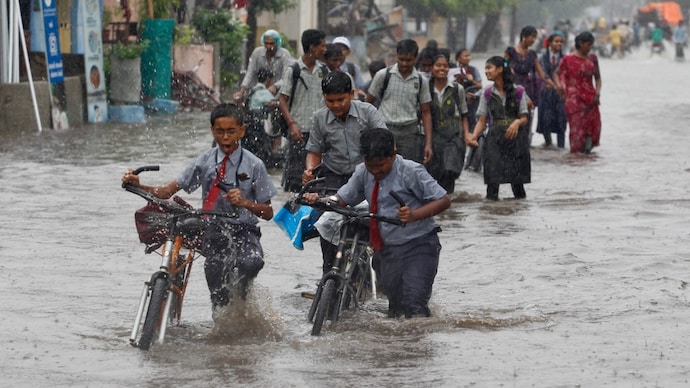
Gujarat has witnessed one of its most intense monsoon spells in recent years, with parts of Valsad district receiving nearly as much rain in 24 hours as Delhi typically gets in an entire year.
According to the State Emergency Operation Centre (SEOC), Umbergaon in Valsad recorded 906 mm of rainfall between 6 am on July 22 and 6 am on July 23.
Delhi's long-term annual average rainfall is about 700-800 mm, meaning Umbergaon received around 113% of Delhi's yearly rainfall in just one day.
The torrential downpour triggered flash floods across south Gujarat, inundating roads and residential areas, disrupting rail and road traffic, and prompting large-scale rescue operations.
Around 1,200 people were also rescued from flood-hit areas as authorities shifted residents to safer locations.
MONSOON BATTERS GUJARAT
SEOC data show that Valsad and neighbouring districts recorded extraordinary rainfall totals.
After Umbergaon, Kaprada received 731 mm, Nanapondha 643 mm, Dharampur 499 mm, Pardi 448 mm, Vansda 435 mm, Vapi 413 mm, and Valsad town 403 mm in the same 24-hour period.
Several other locations also recorded exceptionally heavy rainfall, including Dolvan (378 mm) in Tapi district and Vaghai (369 mm) in The Dangs.
Rainfall exceeding 204.5 mm in 24 hours is classified by the India Meteorological Department (IMD) as "extremely heavy rainfall."
Many locations in south Gujarat recorded more than double, and in some cases more than four times, that threshold.
WHY IS IT RAINING SO HEAVILY IN GUJARAT?
According to the IMD, an active southwest monsoon, supported by strong moisture-laden southwesterly winds from the Arabian Sea and favourable weather systems over western India, triggered the exceptionally heavy rainfall.
Such weather systems can produce prolonged spells of intense rain over the same region, rapidly overwhelming rivers, streams and urban drainage systems.
This often results in flash floods, where water levels rise within hours after exceptionally heavy rainfall.
The southwest monsoon has remained active over large parts of India in recent days, bringing widespread rain to western, central and northeastern states.
IMD has warned that isolated places in Gujarat may continue to receive heavy to very heavy rainfall over the next couple of days, although the most extreme spell is expected to gradually ease.
Authorities have urged people living in low-lying and flood-prone areas to remain alert, avoid waterlogged roads and follow local advisories as rescue, relief and restoration work continues.
With rivers still running high and soils already saturated, even moderate rainfall could trigger fresh flooding in vulnerable pockets.
Gujarat has witnessed one of its most intense monsoon spells in recent years, with parts of Valsad district receiving nearly as much rain in 24 hours as Delhi typically gets in an entire year.
According to the State Emergency Operation Centre (SEOC), Umbergaon in Valsad recorded 906 mm of rainfall between 6 am on July 22 and 6 am on July 23.
Delhi's long-term annual average rainfall is about 700-800 mm, meaning Umbergaon received around 113% of Delhi's yearly rainfall in just one day.
The torrential downpour triggered flash floods across south Gujarat, inundating roads and residential areas, disrupting rail and road traffic, and prompting large-scale rescue operations.
Around 1,200 people were also rescued from flood-hit areas as authorities shifted residents to safer locations.
MONSOON BATTERS GUJARAT
SEOC data show that Valsad and neighbouring districts recorded extraordinary rainfall totals.
After Umbergaon, Kaprada received 731 mm, Nanapondha 643 mm, Dharampur 499 mm, Pardi 448 mm, Vansda 435 mm, Vapi 413 mm, and Valsad town 403 mm in the same 24-hour period.
Several other locations also recorded exceptionally heavy rainfall, including Dolvan (378 mm) in Tapi district and Vaghai (369 mm) in The Dangs.
Rainfall exceeding 204.5 mm in 24 hours is classified by the India Meteorological Department (IMD) as "extremely heavy rainfall."
Many locations in south Gujarat recorded more than double, and in some cases more than four times, that threshold.
WHY IS IT RAINING SO HEAVILY IN GUJARAT?
According to the IMD, an active southwest monsoon, supported by strong moisture-laden southwesterly winds from the Arabian Sea and favourable weather systems over western India, triggered the exceptionally heavy rainfall.
Such weather systems can produce prolonged spells of intense rain over the same region, rapidly overwhelming rivers, streams and urban drainage systems.
This often results in flash floods, where water levels rise within hours after exceptionally heavy rainfall.
The southwest monsoon has remained active over large parts of India in recent days, bringing widespread rain to western, central and northeastern states.
IMD has warned that isolated places in Gujarat may continue to receive heavy to very heavy rainfall over the next couple of days, although the most extreme spell is expected to gradually ease.
Authorities have urged people living in low-lying and flood-prone areas to remain alert, avoid waterlogged roads and follow local advisories as rescue, relief and restoration work continues.
With rivers still running high and soils already saturated, even moderate rainfall could trigger fresh flooding in vulnerable pockets.
Gujarat has witnessed one of its most intense monsoon spells in recent years, with parts of Valsad district receiving nearly as much rain in 24 hours as Delhi typically gets in an entire year.
According to the State Emergency Operation Centre (SEOC), Umbergaon in Valsad recorded 906 mm of rainfall between 6 am on July 22 and 6 am on July 23.
Delhi's long-term annual average rainfall is about 700-800 mm, meaning Umbergaon received around 113% of Delhi's yearly rainfall in just one day.
The torrential downpour triggered flash floods across south Gujarat, inundating roads and residential areas, disrupting rail and road traffic, and prompting large-scale rescue operations.
Around 1,200 people were also rescued from flood-hit areas as authorities shifted residents to safer locations.
MONSOON BATTERS GUJARAT
SEOC data show that Valsad and neighbouring districts recorded extraordinary rainfall totals.
After Umbergaon, Kaprada received 731 mm, Nanapondha 643 mm, Dharampur 499 mm, Pardi 448 mm, Vansda 435 mm, Vapi 413 mm, and Valsad town 403 mm in the same 24-hour period.
Several other locations also recorded exceptionally heavy rainfall, including Dolvan (378 mm) in Tapi district and Vaghai (369 mm) in The Dangs.
Rainfall exceeding 204.5 mm in 24 hours is classified by the India Meteorological Department (IMD) as "extremely heavy rainfall."
Many locations in south Gujarat recorded more than double, and in some cases more than four times, that threshold.
WHY IS IT RAINING SO HEAVILY IN GUJARAT?
According to the IMD, an active southwest monsoon, supported by strong moisture-laden southwesterly winds from the Arabian Sea and favourable weather systems over western India, triggered the exceptionally heavy rainfall.
Such weather systems can produce prolonged spells of intense rain over the same region, rapidly overwhelming rivers, streams and urban drainage systems.
This often results in flash floods, where water levels rise within hours after exceptionally heavy rainfall.
The southwest monsoon has remained active over large parts of India in recent days, bringing widespread rain to western, central and northeastern states.
IMD has warned that isolated places in Gujarat may continue to receive heavy to very heavy rainfall over the next couple of days, although the most extreme spell is expected to gradually ease.
Authorities have urged people living in low-lying and flood-prone areas to remain alert, avoid waterlogged roads and follow local advisories as rescue, relief and restoration work continues.
With rivers still running high and soils already saturated, even moderate rainfall could trigger fresh flooding in vulnerable pockets.

