Watch: Starship's Super Heavy rocket crashes, explodes after launch
SpaceX's Super Heavy booster was unable to complete its planned splashdown after separating from Starship Flight 13, but still gathered insight that will inform the company's push to develop a fully reusable rocket for future missions.
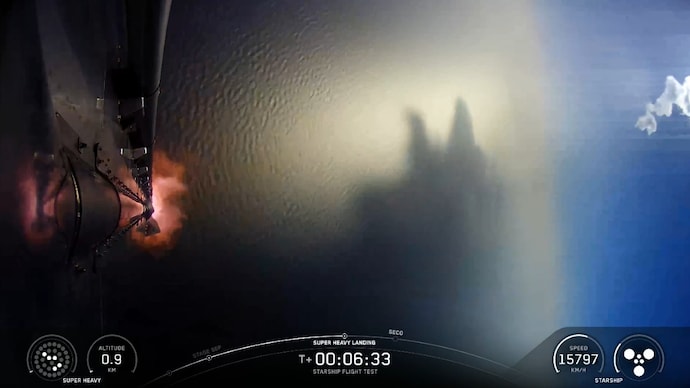
SpaceX's Super Heavy booster completed its planned return after powering Starship Flight 13 into the sky, but wasn't able to perform a successful controlled splashdown as all engines couldn't fire up.
After lifting the world's largest rocket off the launch pad at Starbase in Boca Chica, Texas, the booster separated from the Starship upper stage as planned, allowing the spacecraft to continue its journey on a suborbital trajectory. It was, however, unable to perform a controlled splashdown off the Gulf of Mexico.
Booster 20 encountered a partial engine ignition issue during the landing burn, with not enough Raptors lighting successfully.
This prevented a controlled soft splashdown in the Gulf of Mexico. Despite the booster anomaly, upper stage Ship 40 performed nominally, completing its burns and beginning Starlink deployment.
A PLANNED RETURN
Following stage separation, the Super Heavy booster was supposed to execute a series of carefully choreographed manoeuvres, including a boostback burn, atmospheric descent and a landing burn, before making a controlled splashdown in the Gulf of Mexico.
The sequence unfolded but not as expected, with SpaceX confirming that the booster was unsuccessful in completing its planned flight profile.
Engineers will now analyse data gathered during ascent, engine performance and descent to validate the vehicle's performance and improve future missions.
Although the booster did not execute what was planned, it still provides valuable engineering data that helps SpaceX move closer to routinely reusing the massive first stage.
STARSHIP CARRIES MISSION FORWARD
With the booster back, the Starship upper stage continued on its planned suborbital flight to carry out the mission's other objectives.
It deployed 20 next-generation Starlink Version 3 satellites for an in-flight technology demonstration, attempted an in-space relight of a Raptor engine, and gathered performance data during coast and atmospheric re-entry before a planned splashdown in the Indian Ocean.
The booster flight attempt marks another step in SpaceX's long-term goal of building a fully reusable launch system capable of dramatically reducing the cost of access to space.
The company is expected to review telemetry from every phase of the mission before confirming the timeline for Starship's next test flight.
SpaceX's Super Heavy booster completed its planned return after powering Starship Flight 13 into the sky, but wasn't able to perform a successful controlled splashdown as all engines couldn't fire up.
After lifting the world's largest rocket off the launch pad at Starbase in Boca Chica, Texas, the booster separated from the Starship upper stage as planned, allowing the spacecraft to continue its journey on a suborbital trajectory. It was, however, unable to perform a controlled splashdown off the Gulf of Mexico.
Booster 20 encountered a partial engine ignition issue during the landing burn, with not enough Raptors lighting successfully.
This prevented a controlled soft splashdown in the Gulf of Mexico. Despite the booster anomaly, upper stage Ship 40 performed nominally, completing its burns and beginning Starlink deployment.
A PLANNED RETURN
Following stage separation, the Super Heavy booster was supposed to execute a series of carefully choreographed manoeuvres, including a boostback burn, atmospheric descent and a landing burn, before making a controlled splashdown in the Gulf of Mexico.
The sequence unfolded but not as expected, with SpaceX confirming that the booster was unsuccessful in completing its planned flight profile.
Engineers will now analyse data gathered during ascent, engine performance and descent to validate the vehicle's performance and improve future missions.
Although the booster did not execute what was planned, it still provides valuable engineering data that helps SpaceX move closer to routinely reusing the massive first stage.
STARSHIP CARRIES MISSION FORWARD
With the booster back, the Starship upper stage continued on its planned suborbital flight to carry out the mission's other objectives.
It deployed 20 next-generation Starlink Version 3 satellites for an in-flight technology demonstration, attempted an in-space relight of a Raptor engine, and gathered performance data during coast and atmospheric re-entry before a planned splashdown in the Indian Ocean.
The booster flight attempt marks another step in SpaceX's long-term goal of building a fully reusable launch system capable of dramatically reducing the cost of access to space.
The company is expected to review telemetry from every phase of the mission before confirming the timeline for Starship's next test flight.
SpaceX's Super Heavy booster completed its planned return after powering Starship Flight 13 into the sky, but wasn't able to perform a successful controlled splashdown as all engines couldn't fire up.
After lifting the world's largest rocket off the launch pad at Starbase in Boca Chica, Texas, the booster separated from the Starship upper stage as planned, allowing the spacecraft to continue its journey on a suborbital trajectory. It was, however, unable to perform a controlled splashdown off the Gulf of Mexico.
Booster 20 encountered a partial engine ignition issue during the landing burn, with not enough Raptors lighting successfully.
This prevented a controlled soft splashdown in the Gulf of Mexico. Despite the booster anomaly, upper stage Ship 40 performed nominally, completing its burns and beginning Starlink deployment.
A PLANNED RETURN
Following stage separation, the Super Heavy booster was supposed to execute a series of carefully choreographed manoeuvres, including a boostback burn, atmospheric descent and a landing burn, before making a controlled splashdown in the Gulf of Mexico.
The sequence unfolded but not as expected, with SpaceX confirming that the booster was unsuccessful in completing its planned flight profile.
Engineers will now analyse data gathered during ascent, engine performance and descent to validate the vehicle's performance and improve future missions.
Although the booster did not execute what was planned, it still provides valuable engineering data that helps SpaceX move closer to routinely reusing the massive first stage.
STARSHIP CARRIES MISSION FORWARD
With the booster back, the Starship upper stage continued on its planned suborbital flight to carry out the mission's other objectives.
It deployed 20 next-generation Starlink Version 3 satellites for an in-flight technology demonstration, attempted an in-space relight of a Raptor engine, and gathered performance data during coast and atmospheric re-entry before a planned splashdown in the Indian Ocean.
The booster flight attempt marks another step in SpaceX's long-term goal of building a fully reusable launch system capable of dramatically reducing the cost of access to space.
The company is expected to review telemetry from every phase of the mission before confirming the timeline for Starship's next test flight.

