Nuclear weapons hidden in space? Shoebox-sized satellite could expose them
Scientists have proposed a satellite that could detect hidden nuclear weapons in space by sensing neutrons naturally emitted from uranium. Here's how it could help enforce an important space treaty.
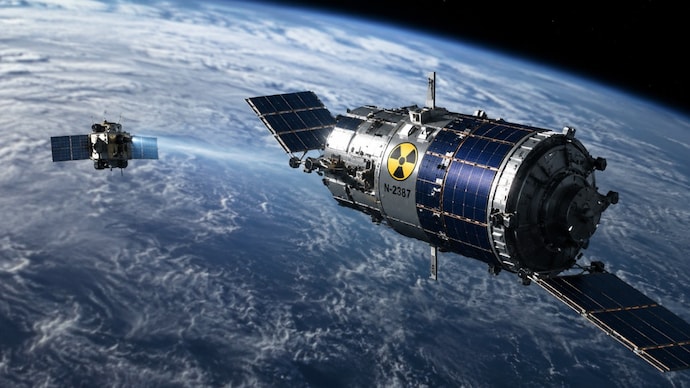
A satellite no bigger than a shoebox could one day help enforce one of the world's most important space treaties by detecting hidden nuclear weapons orbiting Earth.
Scientists, in a new study, have proposed using a small CubeSat to inspect suspicious spacecraft for signs of nuclear weapons.
A CubeSat is a compact, low-cost satellite commonly used for scientific missions.
The idea, published in the journal Nature, comes amid growing concerns over the militarisation of space and the increasing dependence of modern life on satellites for communication, navigation, weather forecasting and banking.
HOW CAN SATELLITE DETECT NUCLEAR WEAPONS?
The proposed system would not rely on cameras or radar.
Instead, it would search for neutrons, which are tiny particles that can be emitted when high-energy cosmic-ray protons naturally strike uranium inside a nuclear weapon.
According to the study, the CubeSat could approach a suspected satellite to within about 4 kilometres and use a neutron detector to look for this distinctive signature.
If a nuclear weapon were present, the detector could identify it after roughly one week of observations. Because the method is passive, the satellite would simply "listen" for naturally produced particles rather than sending out signals that could interfere with other spacecraft.
The researchers said that the concept is still theoretical and would require further testing in space before it could become an operational system for monitoring potential nuclear threats in space.
WILL IT MAKE A DIFFERENCE?
The 1967 Outer Space Treaty, ratified by more than 100 countries, including India, prohibits placing nuclear weapons or other weapons of mass destruction in orbit.
However, the treaty has no practical verification system to check whether countries are complying with it.
Interest in such technology has grown after the United States alleged that Russia is developing a space-based nuclear anti-satellite capability, an accusation Moscow has denied.
Theoretically, a nuclear blast in orbit could cause massive damage and disruption, with massive ripple effects.
A nuclear explosion in orbit would not strike cities directly, but it could generate intense radiation capable of damaging or destroying thousands of satellites, disrupting GPS, communications, weather monitoring and other services that people rely on every day.
Scientists stress that the proposed CubeSat is intended as a verification tool, not a weapon.
By making it easier to detect treaty violations, they argued, such satellites could strengthen international confidence and help discourage the deployment of nuclear weapons in space.
As Earth orbit becomes increasingly crowded with thousands of active satellites, researchers say reliable monitoring technologies will be essential to keeping space peaceful and protecting the infrastructure that underpins modern life.
A satellite no bigger than a shoebox could one day help enforce one of the world's most important space treaties by detecting hidden nuclear weapons orbiting Earth.
Scientists, in a new study, have proposed using a small CubeSat to inspect suspicious spacecraft for signs of nuclear weapons.
A CubeSat is a compact, low-cost satellite commonly used for scientific missions.
The idea, published in the journal Nature, comes amid growing concerns over the militarisation of space and the increasing dependence of modern life on satellites for communication, navigation, weather forecasting and banking.
HOW CAN SATELLITE DETECT NUCLEAR WEAPONS?
The proposed system would not rely on cameras or radar.
Instead, it would search for neutrons, which are tiny particles that can be emitted when high-energy cosmic-ray protons naturally strike uranium inside a nuclear weapon.
According to the study, the CubeSat could approach a suspected satellite to within about 4 kilometres and use a neutron detector to look for this distinctive signature.
If a nuclear weapon were present, the detector could identify it after roughly one week of observations. Because the method is passive, the satellite would simply "listen" for naturally produced particles rather than sending out signals that could interfere with other spacecraft.
The researchers said that the concept is still theoretical and would require further testing in space before it could become an operational system for monitoring potential nuclear threats in space.
WILL IT MAKE A DIFFERENCE?
The 1967 Outer Space Treaty, ratified by more than 100 countries, including India, prohibits placing nuclear weapons or other weapons of mass destruction in orbit.
However, the treaty has no practical verification system to check whether countries are complying with it.
Interest in such technology has grown after the United States alleged that Russia is developing a space-based nuclear anti-satellite capability, an accusation Moscow has denied.
Theoretically, a nuclear blast in orbit could cause massive damage and disruption, with massive ripple effects.
A nuclear explosion in orbit would not strike cities directly, but it could generate intense radiation capable of damaging or destroying thousands of satellites, disrupting GPS, communications, weather monitoring and other services that people rely on every day.
Scientists stress that the proposed CubeSat is intended as a verification tool, not a weapon.
By making it easier to detect treaty violations, they argued, such satellites could strengthen international confidence and help discourage the deployment of nuclear weapons in space.
As Earth orbit becomes increasingly crowded with thousands of active satellites, researchers say reliable monitoring technologies will be essential to keeping space peaceful and protecting the infrastructure that underpins modern life.

