Zverev aims to move beyond tennis' 'third guy' tag, close gap on Sinner and Alcaraz
Wimbledon runner-up Alexander Zverev will return to world No. 2 on Monday, but believes his attacking game has finally brought him closer to Jannik Sinner and Carlos Alcaraz after years of being labelled tennis' "third guy".
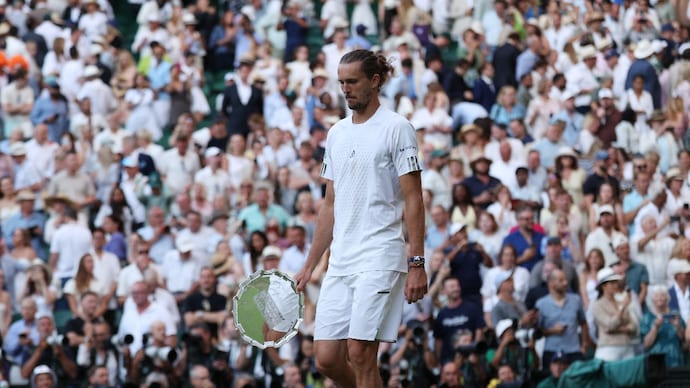
Alexander Zverev believes he is closer than ever to challenging Jannik Sinner and Carlos Alcaraz after reaching his maiden Wimbledon final, with the German convinced his new attacking style has put him in contention to compete consistently for tennis' biggest titles.
The 29-year-old will rise to world No. 2 in the ATP rankings on Monday despite losing 6-7(7), 7-6(2), 6-3, 6-4 to Sinner in Sunday's Wimbledon final. More importantly, the run capped a breakthrough few weeks after Zverev claimed his maiden Grand Slam title at the French Open, marking the most successful spell of his career.
For years, Zverev has been viewed as the player just behind Sinner and Alcaraz. Now, he believes the gap has narrowed significantly.
"There was always this conversation, 'Who will be the third guy?'" Zverev said after the final.
"I've always been the third guy, but I was just far away from those two. I've always been No. 3 in a way. So if I get closer to them, if I can be in the mix competing and winning the big tournaments, it would be great."
NEW ATTACKING STYLE DRIVING SUCCESS
Zverev's transformation has been built around a more aggressive brand of tennis, something he committed to at the start of the season despite mixed results early on.
Instead of relying primarily on his baseline consistency, the German has looked to dictate points with his forehand and take more risks whenever opportunities arise.
"I've said it at the beginning of the year, and I've stuck to it. That's the tennis I want to play. That's the game style I want to play," Zverev said.
Wimbledon 2026 men's singles final Highlights
"There were matches in the beginning of the year where I was struggling a bit more with this style, but I was consistently doing it. The more I do it, the better I'll become.
"I won a Grand Slam for the first time in my career in Paris. I made it to the finals here for the first time in my career. Of course, something has to be working."
The improvement was particularly evident on grass, a surface where Zverev had never progressed beyond the fourth round at Wimbledon before this year. Against Sinner, he landed close to 80 per cent of his first serves for much of the final while repeatedly using his forehand to put the world No. 1 under pressure.
"When I have the opportunity, I hit it," Zverev said.
"Whether I make it or miss it, that depends on the day. But I definitely go for it. That's my goal, that's my aim for this year, that's my aim for hopefully the rest of my career."
CLOSING THE GAP ON SINNER AND ALCARAZ
Although Sunday's defeat extended Zverev's losing streak against Sinner to 10 matches, the German believes the contest showed he can now match the sport's dominant players over five sets.
After winning the opening set, Zverev snapped a run of 14 consecutive sets lost to Sinner and pushed the Italian throughout the contest before momentum shifted in the third set.
"I think I've been pushing those guys. I haven't beaten them this year, but I've pushed them to the limits," Zverev said.
"Alcaraz in Australia, Jannik here. Even though it was four sets, I think it was a very close four sets, which could have gone five as well."
His confidence is backed by his recent results. Zverev pushed Alcaraz to five sets in the Australian Open semi-finals before winning Roland Garros and following it up with his best-ever Wimbledon campaign.
KNEE SLIP PROVED COSTLY IN FINAL
Zverev believes a slip midway through the third set played a decisive role in the outcome of Sunday's final.
The German fell awkwardly while chasing a ball on his only break point of the match and immediately clutched his right knee, with Sinner crossing the net to check on his opponent before helping him back to his feet.
"I over-extended my knee again, similar to two years ago. I was struggling to push off on the serve a little bit. So my serve speed went down," Zverev said.
"But everything else went fine. I was moving fine from the baseline and playing from the baseline fine."
He added: "I think the fall didn't help me in the third set. My level dropped a little bit. But then I picked it up in the fourth again. Overall I thought it was quite high level throughout."
Alexander Zverev believes he is closer than ever to challenging Jannik Sinner and Carlos Alcaraz after reaching his maiden Wimbledon final, with the German convinced his new attacking style has put him in contention to compete consistently for tennis' biggest titles.
The 29-year-old will rise to world No. 2 in the ATP rankings on Monday despite losing 6-7(7), 7-6(2), 6-3, 6-4 to Sinner in Sunday's Wimbledon final. More importantly, the run capped a breakthrough few weeks after Zverev claimed his maiden Grand Slam title at the French Open, marking the most successful spell of his career.
For years, Zverev has been viewed as the player just behind Sinner and Alcaraz. Now, he believes the gap has narrowed significantly.
"There was always this conversation, 'Who will be the third guy?'" Zverev said after the final.
"I've always been the third guy, but I was just far away from those two. I've always been No. 3 in a way. So if I get closer to them, if I can be in the mix competing and winning the big tournaments, it would be great."
NEW ATTACKING STYLE DRIVING SUCCESS
Zverev's transformation has been built around a more aggressive brand of tennis, something he committed to at the start of the season despite mixed results early on.
Instead of relying primarily on his baseline consistency, the German has looked to dictate points with his forehand and take more risks whenever opportunities arise.
"I've said it at the beginning of the year, and I've stuck to it. That's the tennis I want to play. That's the game style I want to play," Zverev said.
Wimbledon 2026 men's singles final Highlights
"There were matches in the beginning of the year where I was struggling a bit more with this style, but I was consistently doing it. The more I do it, the better I'll become.
"I won a Grand Slam for the first time in my career in Paris. I made it to the finals here for the first time in my career. Of course, something has to be working."
The improvement was particularly evident on grass, a surface where Zverev had never progressed beyond the fourth round at Wimbledon before this year. Against Sinner, he landed close to 80 per cent of his first serves for much of the final while repeatedly using his forehand to put the world No. 1 under pressure.
"When I have the opportunity, I hit it," Zverev said.
"Whether I make it or miss it, that depends on the day. But I definitely go for it. That's my goal, that's my aim for this year, that's my aim for hopefully the rest of my career."
CLOSING THE GAP ON SINNER AND ALCARAZ
Although Sunday's defeat extended Zverev's losing streak against Sinner to 10 matches, the German believes the contest showed he can now match the sport's dominant players over five sets.
After winning the opening set, Zverev snapped a run of 14 consecutive sets lost to Sinner and pushed the Italian throughout the contest before momentum shifted in the third set.
"I think I've been pushing those guys. I haven't beaten them this year, but I've pushed them to the limits," Zverev said.
"Alcaraz in Australia, Jannik here. Even though it was four sets, I think it was a very close four sets, which could have gone five as well."
His confidence is backed by his recent results. Zverev pushed Alcaraz to five sets in the Australian Open semi-finals before winning Roland Garros and following it up with his best-ever Wimbledon campaign.
KNEE SLIP PROVED COSTLY IN FINAL
Zverev believes a slip midway through the third set played a decisive role in the outcome of Sunday's final.
The German fell awkwardly while chasing a ball on his only break point of the match and immediately clutched his right knee, with Sinner crossing the net to check on his opponent before helping him back to his feet.
"I over-extended my knee again, similar to two years ago. I was struggling to push off on the serve a little bit. So my serve speed went down," Zverev said.
"But everything else went fine. I was moving fine from the baseline and playing from the baseline fine."
He added: "I think the fall didn't help me in the third set. My level dropped a little bit. But then I picked it up in the fourth again. Overall I thought it was quite high level throughout."

