POK protest leader calls region occupied, rejects Pak's 'Azad Kashmir' narrative
The protests, now in their second month, have expanded beyond shortages of food and medicines to broader demands on governance, inflation and political rights. Protest leaders have accused Pakistan of treating the movement as a security issue while warning that continued restrictions could further escalate public anger.
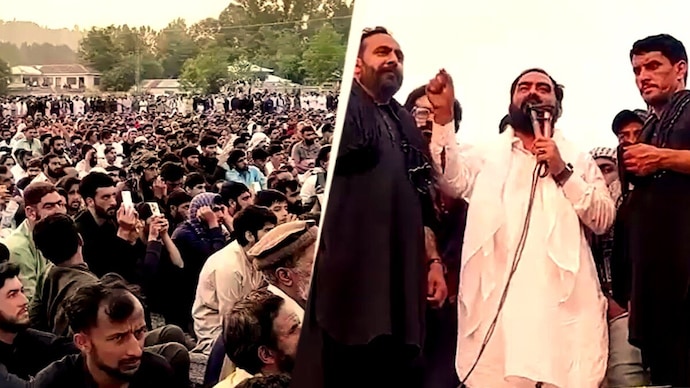


Islamabad's official narrative on Pakistan-occupied Jammu and Kashmir (POK) came under direct challenge as Sardar Aman Khan, one of the leading faces of the public protest movement that has been ongoing for over a month, declared that POK is neither "Azad" (free) nor a "disputed" territory, but an "occupied territory."
Thousands gathered at Rawalakot's Eidgah Ground, where Aman Khan openly rejected Pakistan's long-standing position on the region. The crowd responded with loud cheers and thunderous applause.
"This is not a disputed territory... It is an occupied territory... It has been occupied," he said.
The statement drew loud applause and slogans from the crowd.
Khan's remarks are being seen as a significant rebuke to Islamabad's decades-old narrative that portrays POK as "Azad Kashmir." They come amid a mass protest movement that has continued in Rawalakot for more than 40 days.
Pakistan has not issued any official response to the statement.
Protests in Pakistan-occupied Kashmir intensified earlier this month, with thousands of people gathering near the Line of Control and declaring that POK was not part of Pakistan.
The demonstrators also warned Islamabad that continued curbs on food supplies could push residents towards "other roads", a remark widely read as a signal of closer ties with India.
Addressing the gathering, Sardar Aman Khan said POK did not belong to Pakistan and accused the authorities of worsening conditions in the region.
He had earlier appealed to people across the Line of Control and to India, alleging that Pakistan had blocked the supply of food and medicines to the region for the past three weeks, deepening the humanitarian situation.
During the protest, Khan asked the crowd whether they should march towards the Line of Control. In response, the protesters repeatedly chanted, "Move towards it." He also warned that if the authorities continued to answer the people's demands with bullets, "we also have other paths."
Khan told the crowd, "POK is not a part of Pakistan. We do not need Pakistan; rather, it is Pakistan that desperately needs POK."
The protest gathering came amid rising anger over restrictions on essential supplies and a wider movement against what protest leaders described as long-standing political and economic grievances.
The agitation began after Pakistani authorities blocked the movement of food grains, flour and other daily essentials into parts of POK. Protesters alleged that the restrictions were intended to weaken the movement by creating shortages and raising economic pressure on residents.
According to protest leaders, the campaign is now centred on a 38-point charter of demands that includes inflation, electricity prices, governance, subsidies, unemployment and what they called decades of political discrimination.
They have also said that Pakistani authorities are increasingly treating the protests as a security issue.
The demonstrations near the Line of Control have brought together demands over supplies, prices and governance, while also sharpening political messaging against Pakistan. Protest leaders have linked the worsening shortages of food and medicines to the wider movement, as calls for action continue to grow.
Islamabad's official narrative on Pakistan-occupied Jammu and Kashmir (POK) came under direct challenge as Sardar Aman Khan, one of the leading faces of the public protest movement that has been ongoing for over a month, declared that POK is neither "Azad" (free) nor a "disputed" territory, but an "occupied territory."
Thousands gathered at Rawalakot's Eidgah Ground, where Aman Khan openly rejected Pakistan's long-standing position on the region. The crowd responded with loud cheers and thunderous applause.
"This is not a disputed territory... It is an occupied territory... It has been occupied," he said.
The statement drew loud applause and slogans from the crowd.
Khan's remarks are being seen as a significant rebuke to Islamabad's decades-old narrative that portrays POK as "Azad Kashmir." They come amid a mass protest movement that has continued in Rawalakot for more than 40 days.
Pakistan has not issued any official response to the statement.
Protests in Pakistan-occupied Kashmir intensified earlier this month, with thousands of people gathering near the Line of Control and declaring that POK was not part of Pakistan.
The demonstrators also warned Islamabad that continued curbs on food supplies could push residents towards "other roads", a remark widely read as a signal of closer ties with India.
Addressing the gathering, Sardar Aman Khan said POK did not belong to Pakistan and accused the authorities of worsening conditions in the region.
He had earlier appealed to people across the Line of Control and to India, alleging that Pakistan had blocked the supply of food and medicines to the region for the past three weeks, deepening the humanitarian situation.
During the protest, Khan asked the crowd whether they should march towards the Line of Control. In response, the protesters repeatedly chanted, "Move towards it." He also warned that if the authorities continued to answer the people's demands with bullets, "we also have other paths."
Khan told the crowd, "POK is not a part of Pakistan. We do not need Pakistan; rather, it is Pakistan that desperately needs POK."
The protest gathering came amid rising anger over restrictions on essential supplies and a wider movement against what protest leaders described as long-standing political and economic grievances.
The agitation began after Pakistani authorities blocked the movement of food grains, flour and other daily essentials into parts of POK. Protesters alleged that the restrictions were intended to weaken the movement by creating shortages and raising economic pressure on residents.
According to protest leaders, the campaign is now centred on a 38-point charter of demands that includes inflation, electricity prices, governance, subsidies, unemployment and what they called decades of political discrimination.
They have also said that Pakistani authorities are increasingly treating the protests as a security issue.
The demonstrations near the Line of Control have brought together demands over supplies, prices and governance, while also sharpening political messaging against Pakistan. Protest leaders have linked the worsening shortages of food and medicines to the wider movement, as calls for action continue to grow.

