Video: 3,000 Moroccan migrants enter Spain by sea after overwhelming police
Spain's Guardia Civil said migrants were "massively entering from the sea" through the Tarajal breakwater after overwhelming police deployed in the area. Videos circulating on social media showed groups of migrants swimming around the breakwater using inflatable inner tubes and makeshift flotation devices.
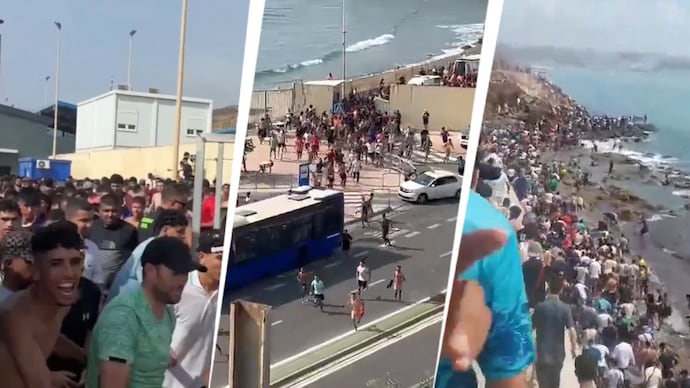
Thousands of migrants crossed into Spain's North African enclave of Ceuta on Thursday after overwhelming security forces at the border. The mass crossing is one of the largest to hit the Spanish territory since the 2021 migration crisis. Spanish authorities did not release an official figure, but state broadcaster TVE estimated that between 2,000 and 3,000 migrants entered Ceuta within hours. Many crossed by sea while others broke through border fencing separating the enclave from Morocco.
The influx overwhelmed police and renewed concerns over migration at the European Union's only land border with Africa. As the number of arrivals mounted, Ceuta's regional government urged Madrid to declare a state of emergency and deploy additional forces.
Spain's Guardia Civil said migrants were "massively entering from the sea" through the Tarajal breakwater after overwhelming police deployed in the area. Videos circulating on social media showed groups of migrants swimming around the breakwater using inflatable inner tubes and makeshift flotation devices.
Others forced open a gate in the border fence before running into Ceuta. Some were heard shouting, "Long live Spain," as they crossed into the enclave.
The scenes echoed the unprecedented migration crisis in May 2021, when around 10,000 migrants from Morocco and sub-Saharan Africa entered Ceuta within days. Ceuta, along with the nearby Spanish enclave of Melilla, is the European Union's only land frontier with Africa and has long been a focal point for migrants seeking to reach Europe.
CEUTA URGES MADRID TO DECLARE EMERGENCY
As the number of arrivals continued to rise, Ceuta leader Juan Jesus Vivas called on Madrid to declare a state of emergency, deploy the army to help restore order and reinforce security, and temporarily close the border with Morocco to prevent further crossings. Spain's Defence Ministry, however, said there were no immediate plans to deploy military personnel.
Prime Minister Pedro Sanchez later responded by saying the government was "fully committed to providing an immediate response" to the unfolding crisis.
"We are mobilising all necessary resources, working with Moroccan and international authorities, and preparing the necessary measures to restore normalcy as soon as possible," Sanchez wrote after speaking with Vivas.
"This is the moment to build solutions, with responsibility and cooperation," he added, without outlining specific measures.
The Interior Ministry said it was coordinating closely with Moroccan authorities and stressed that thousands of attempted illegal crossings had already been prevented in recent days. It also vowed to immediately deport those found to have entered Spain illegally, accusing people-smuggling networks of exploiting the situation.
SUPREME COURT RULING UNDER SCRUTINY
Some officials linked Thursday's surge to a recent Supreme Court ruling that barred authorities from summarily returning migrants intercepted at sea while attempting to reach Ceuta or Melilla under the enclaves' special border-rejection rules. Although the judgment did not grant migrants the right to remain in Spain, officials believe it may have encouraged more people to attempt the dangerous sea crossing.
"It has been a slow trickle since the Supreme Court's ruling, but today has been an explosion," a Guardia Civil spokesperson told news agency Reuters.
The ruling applies specifically to migrants arriving by sea, even if they bypass the land border by swimming around the fences into the Spanish enclaves.
Separately, Spain's programme to regularise the status of around 500,000 undocumented migrants has also become a trouble spot in the country's political debate. While the scheme only applies to migrants already living in Spain before the measure took effect, critics argue it has created the perception that irregular migration could eventually lead to legal residency.
PRESSURE MOUNTS ON SANCHEZ GOVT
The crisis sparked backlash against Sanchez's Socialist government, which has generally adopted a more migrant-friendly approach than many other European administrations. Conservative opposition leader Alberto Nunez Feijoo described the situation as a national security issue.
"The situation in Ceuta is desperate. The government cannot look the other way... because we are facing a national security crisis," he wrote on X.
Meanwhile, migrant rights activist Zakaria Zarroqui said people continued gathering in the Moroccan border city of Fnideq in hopes of reaching Ceuta.
"The situation remains out of control as we speak," Zarroqui said.
With migrants still attempting to reach the enclave, officials now face the immediate challenge of restoring order while preventing further crossings.
Thousands of migrants crossed into Spain's North African enclave of Ceuta on Thursday after overwhelming security forces at the border. The mass crossing is one of the largest to hit the Spanish territory since the 2021 migration crisis. Spanish authorities did not release an official figure, but state broadcaster TVE estimated that between 2,000 and 3,000 migrants entered Ceuta within hours. Many crossed by sea while others broke through border fencing separating the enclave from Morocco.
The influx overwhelmed police and renewed concerns over migration at the European Union's only land border with Africa. As the number of arrivals mounted, Ceuta's regional government urged Madrid to declare a state of emergency and deploy additional forces.
Spain's Guardia Civil said migrants were "massively entering from the sea" through the Tarajal breakwater after overwhelming police deployed in the area. Videos circulating on social media showed groups of migrants swimming around the breakwater using inflatable inner tubes and makeshift flotation devices.
Others forced open a gate in the border fence before running into Ceuta. Some were heard shouting, "Long live Spain," as they crossed into the enclave.
The scenes echoed the unprecedented migration crisis in May 2021, when around 10,000 migrants from Morocco and sub-Saharan Africa entered Ceuta within days. Ceuta, along with the nearby Spanish enclave of Melilla, is the European Union's only land frontier with Africa and has long been a focal point for migrants seeking to reach Europe.
CEUTA URGES MADRID TO DECLARE EMERGENCY
As the number of arrivals continued to rise, Ceuta leader Juan Jesus Vivas called on Madrid to declare a state of emergency, deploy the army to help restore order and reinforce security, and temporarily close the border with Morocco to prevent further crossings. Spain's Defence Ministry, however, said there were no immediate plans to deploy military personnel.
Prime Minister Pedro Sanchez later responded by saying the government was "fully committed to providing an immediate response" to the unfolding crisis.
"We are mobilising all necessary resources, working with Moroccan and international authorities, and preparing the necessary measures to restore normalcy as soon as possible," Sanchez wrote after speaking with Vivas.
"This is the moment to build solutions, with responsibility and cooperation," he added, without outlining specific measures.
The Interior Ministry said it was coordinating closely with Moroccan authorities and stressed that thousands of attempted illegal crossings had already been prevented in recent days. It also vowed to immediately deport those found to have entered Spain illegally, accusing people-smuggling networks of exploiting the situation.
SUPREME COURT RULING UNDER SCRUTINY
Some officials linked Thursday's surge to a recent Supreme Court ruling that barred authorities from summarily returning migrants intercepted at sea while attempting to reach Ceuta or Melilla under the enclaves' special border-rejection rules. Although the judgment did not grant migrants the right to remain in Spain, officials believe it may have encouraged more people to attempt the dangerous sea crossing.
"It has been a slow trickle since the Supreme Court's ruling, but today has been an explosion," a Guardia Civil spokesperson told news agency Reuters.
The ruling applies specifically to migrants arriving by sea, even if they bypass the land border by swimming around the fences into the Spanish enclaves.
Separately, Spain's programme to regularise the status of around 500,000 undocumented migrants has also become a trouble spot in the country's political debate. While the scheme only applies to migrants already living in Spain before the measure took effect, critics argue it has created the perception that irregular migration could eventually lead to legal residency.
PRESSURE MOUNTS ON SANCHEZ GOVT
The crisis sparked backlash against Sanchez's Socialist government, which has generally adopted a more migrant-friendly approach than many other European administrations. Conservative opposition leader Alberto Nunez Feijoo described the situation as a national security issue.
"The situation in Ceuta is desperate. The government cannot look the other way... because we are facing a national security crisis," he wrote on X.
Meanwhile, migrant rights activist Zakaria Zarroqui said people continued gathering in the Moroccan border city of Fnideq in hopes of reaching Ceuta.
"The situation remains out of control as we speak," Zarroqui said.
With migrants still attempting to reach the enclave, officials now face the immediate challenge of restoring order while preventing further crossings.
Thousands of migrants crossed into Spain's North African enclave of Ceuta on Thursday after overwhelming security forces at the border. The mass crossing is one of the largest to hit the Spanish territory since the 2021 migration crisis. Spanish authorities did not release an official figure, but state broadcaster TVE estimated that between 2,000 and 3,000 migrants entered Ceuta within hours. Many crossed by sea while others broke through border fencing separating the enclave from Morocco.
The influx overwhelmed police and renewed concerns over migration at the European Union's only land border with Africa. As the number of arrivals mounted, Ceuta's regional government urged Madrid to declare a state of emergency and deploy additional forces.
Spain's Guardia Civil said migrants were "massively entering from the sea" through the Tarajal breakwater after overwhelming police deployed in the area. Videos circulating on social media showed groups of migrants swimming around the breakwater using inflatable inner tubes and makeshift flotation devices.
Others forced open a gate in the border fence before running into Ceuta. Some were heard shouting, "Long live Spain," as they crossed into the enclave.
The scenes echoed the unprecedented migration crisis in May 2021, when around 10,000 migrants from Morocco and sub-Saharan Africa entered Ceuta within days. Ceuta, along with the nearby Spanish enclave of Melilla, is the European Union's only land frontier with Africa and has long been a focal point for migrants seeking to reach Europe.
CEUTA URGES MADRID TO DECLARE EMERGENCY
As the number of arrivals continued to rise, Ceuta leader Juan Jesus Vivas called on Madrid to declare a state of emergency, deploy the army to help restore order and reinforce security, and temporarily close the border with Morocco to prevent further crossings. Spain's Defence Ministry, however, said there were no immediate plans to deploy military personnel.
Prime Minister Pedro Sanchez later responded by saying the government was "fully committed to providing an immediate response" to the unfolding crisis.
"We are mobilising all necessary resources, working with Moroccan and international authorities, and preparing the necessary measures to restore normalcy as soon as possible," Sanchez wrote after speaking with Vivas.
"This is the moment to build solutions, with responsibility and cooperation," he added, without outlining specific measures.
The Interior Ministry said it was coordinating closely with Moroccan authorities and stressed that thousands of attempted illegal crossings had already been prevented in recent days. It also vowed to immediately deport those found to have entered Spain illegally, accusing people-smuggling networks of exploiting the situation.
SUPREME COURT RULING UNDER SCRUTINY
Some officials linked Thursday's surge to a recent Supreme Court ruling that barred authorities from summarily returning migrants intercepted at sea while attempting to reach Ceuta or Melilla under the enclaves' special border-rejection rules. Although the judgment did not grant migrants the right to remain in Spain, officials believe it may have encouraged more people to attempt the dangerous sea crossing.
"It has been a slow trickle since the Supreme Court's ruling, but today has been an explosion," a Guardia Civil spokesperson told news agency Reuters.
The ruling applies specifically to migrants arriving by sea, even if they bypass the land border by swimming around the fences into the Spanish enclaves.
Separately, Spain's programme to regularise the status of around 500,000 undocumented migrants has also become a trouble spot in the country's political debate. While the scheme only applies to migrants already living in Spain before the measure took effect, critics argue it has created the perception that irregular migration could eventually lead to legal residency.
PRESSURE MOUNTS ON SANCHEZ GOVT
The crisis sparked backlash against Sanchez's Socialist government, which has generally adopted a more migrant-friendly approach than many other European administrations. Conservative opposition leader Alberto Nunez Feijoo described the situation as a national security issue.
"The situation in Ceuta is desperate. The government cannot look the other way... because we are facing a national security crisis," he wrote on X.
Meanwhile, migrant rights activist Zakaria Zarroqui said people continued gathering in the Moroccan border city of Fnideq in hopes of reaching Ceuta.
"The situation remains out of control as we speak," Zarroqui said.
With migrants still attempting to reach the enclave, officials now face the immediate challenge of restoring order while preventing further crossings.

