Iran made poor choice, now they pay: Pete Hegseth after US strikes on Tehran
The United States launched another round of strikes on Iran after a reported attack on a commercial ship in the Strait of Hormuz. The exchange deepened tensions between Washington and Tehran as both sides traded blame over the confrontation.
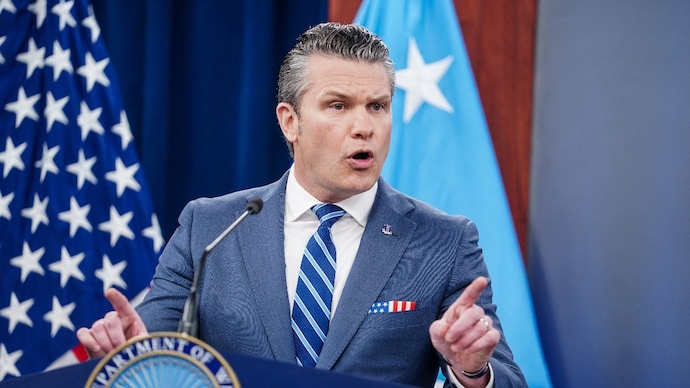
US Defence Secretary Pete Hegseth on Saturday said Iran was "paying the price" for its actions after the United States launched another round of military strikes against the country.
Hegseth made the remarks in a post on X while resharing a statement issued by the US Central Command (CENTCOM), which confirmed the latest military operation. "Iran made a poor choice. Now they pay," he wrote.
According to CENTCOM, the latest operation marked the third wave of US strikes against Iran this week. The military said the action was launched after Iran allegedly targeted a commercial vessel transiting the Strait of Hormuz.
CENTCOM said the strikes began at 7.15 pm ET after forces of Iran's Islamic Revolutionary Guard Corps (IRGC) "blatantly attacked" the Cyprus-flagged container ship M/V GFS Galaxy.
The fresh US strikes came shortly after Iran's IRGC Navy claimed it had intercepted and attacked a container ship attempting to exit the Strait of Hormuz through what it described as an unauthorised route after the vessel allegedly ignored repeated warnings.
The latest exchange marked a further escalation in tensions between Washington and Tehran, with both sides accusing each other of provoking the confrontation in one of the world's most strategically important maritime corridors.
The US military said Iran had been given "yet another opportunity" to comply with the Memorandum of Understanding following previous attacks on commercial shipping but had once again failed to do so.
"In response, the United States is imposing a heavy cost by continuing to degrade Iran’s ability to attack civilian mariners and commercial ships freely transiting the strait," Centcom said.
IRAN CLOSES HORMUZ AGAIN
Soon after the US strikes, Iran announced that the Strait of Hormuz had once again been closed. Tehran said one of its military warning shots hit a vessel navigating what it called an unauthorised route through the strategically vital waterway.
Tehran said that the Strait of Hormuz would remain closed "until further notice" and warned that it could strike "additional enemy bases in the region" if further attacks were launched against it.
"Following this incident... the Strait of Hormuz will be closed until further notice and until the end of American interventions in this region and no vessels will be allowed to pass through," Iran's Revolutionary Guards said in a statement carried by state news agency IRNA.
Iranian state media also reported explosions in the coastal towns of Bandar Abbas and Sirik, located along the Strait of Hormuz, after the US military operation got underway.
US Defence Secretary Pete Hegseth on Saturday said Iran was "paying the price" for its actions after the United States launched another round of military strikes against the country.
Hegseth made the remarks in a post on X while resharing a statement issued by the US Central Command (CENTCOM), which confirmed the latest military operation. "Iran made a poor choice. Now they pay," he wrote.
According to CENTCOM, the latest operation marked the third wave of US strikes against Iran this week. The military said the action was launched after Iran allegedly targeted a commercial vessel transiting the Strait of Hormuz.
CENTCOM said the strikes began at 7.15 pm ET after forces of Iran's Islamic Revolutionary Guard Corps (IRGC) "blatantly attacked" the Cyprus-flagged container ship M/V GFS Galaxy.
The fresh US strikes came shortly after Iran's IRGC Navy claimed it had intercepted and attacked a container ship attempting to exit the Strait of Hormuz through what it described as an unauthorised route after the vessel allegedly ignored repeated warnings.
The latest exchange marked a further escalation in tensions between Washington and Tehran, with both sides accusing each other of provoking the confrontation in one of the world's most strategically important maritime corridors.
The US military said Iran had been given "yet another opportunity" to comply with the Memorandum of Understanding following previous attacks on commercial shipping but had once again failed to do so.
"In response, the United States is imposing a heavy cost by continuing to degrade Iran’s ability to attack civilian mariners and commercial ships freely transiting the strait," Centcom said.
IRAN CLOSES HORMUZ AGAIN
Soon after the US strikes, Iran announced that the Strait of Hormuz had once again been closed. Tehran said one of its military warning shots hit a vessel navigating what it called an unauthorised route through the strategically vital waterway.
Tehran said that the Strait of Hormuz would remain closed "until further notice" and warned that it could strike "additional enemy bases in the region" if further attacks were launched against it.
"Following this incident... the Strait of Hormuz will be closed until further notice and until the end of American interventions in this region and no vessels will be allowed to pass through," Iran's Revolutionary Guards said in a statement carried by state news agency IRNA.
Iranian state media also reported explosions in the coastal towns of Bandar Abbas and Sirik, located along the Strait of Hormuz, after the US military operation got underway.

