
India's Parliament Wasn't Meant to Be Circular: Sobhana Nair Reveals Its Untold History in 'Housing the Republic'

In Booked, Sobhana Nair discusses Housing the Republic and the making of India's old Parliament. The conversation traces contested design choices, colonial politics and the building's layered afterlife.
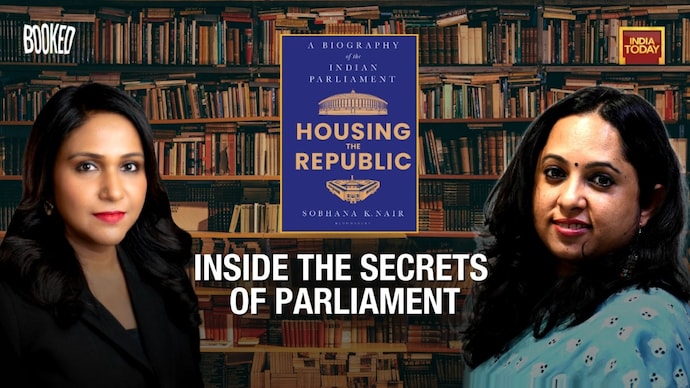

India’s old Parliament building is instantly recognisable by its imposing circular structure. But the building that became one of the defining symbols of Indian democracy was not originally conceived that way.
In the latest edition of Booked, India Today’s Poulomi Saha speaks to journalist and author Sobhana Nair about her latest book, Housing the Republic, which delves into the history, architecture and politics surrounding Parliament.
Nair, who spent around four-and-a-half years researching the book, says the idea came to her around 2022, when the impending shift from the old Parliament building made her confront the history and memories embedded within its corridors.
One of the assumptions she challenges is the overwhelming credit given to architect Edwin Lutyens for the creation of New Delhi. Nair argues that Viceroy Lord Hardinge played a crucial role in shaping the capital, influencing everything from the selection of Raisina Hill to the city’s roads and roundabouts.
The Parliament building itself was designed by Herbert Baker. According to Nair, Baker had initially imagined a three-winged structure with chambers of different shapes. Its now-iconic circular form emerged following architectural disagreements between Baker and Lutyens.
The book also examines the colonial government’s reluctance to describe the building as a “Parliament”. When it was inaugurated in 1927, it was called the Council House, reflecting the British belief that the empire could have only one Parliament — at Westminster.
Several other lesser-known episodes emerge during the conversation. Parliament’s Central Hall, for instance, was originally designed as a library before it became home to the Constituent Assembly. The Federal Court, which preceded the Supreme Court of India, also operated from the Parliament complex.
Perhaps one of the most remarkable episodes came in 1947, when Muhammad Ali Jinnah informally proposed that Pakistan’s Constituent Assembly could meet inside the same complex. The suggestion was initially considered but was ultimately rejected following consultations involving Jawaharlal Nehru, Vallabhbhai Patel and Rajendra Prasad.
Nair also questions whether adequate public and institutional debate preceded the construction of India’s new Parliament building, contrasting the process with decades-long discussions over the future of Britain’s Westminster Palace.
The conversation ends where Nair’s own fascination with the building began — a mysterious stench that once forced the Rajya Sabha to adjourn. Investigating it as a reporter led her to Parliament’s original Herbert Baker blueprints.
For Nair, Parliament is not merely the setting of Housing the Republic. It is the book’s protagonist — a building carrying within its walls more than a century of political history, architectural battles and the evolution of Indian democracy.