
Understanding 'Spiritual Nationalism,' Swami Vivekananda's Idea of India

The great seer's vision is, if anything, even more relevant in today's world. A new book compiles selections from his inspiring writings.
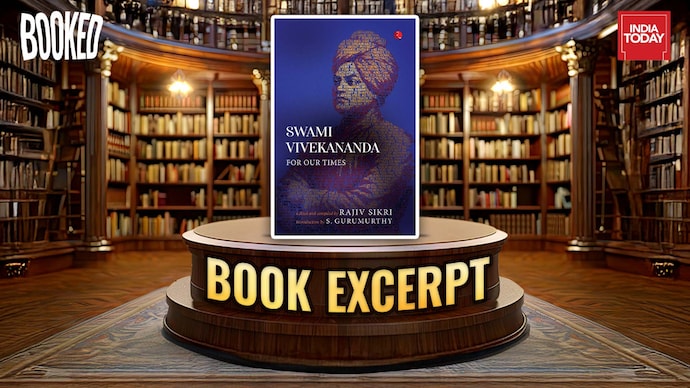

Swami Vivekananda has inspired many to strive towards perfection and compassion. Rajiv Sikri, former diplomat and Vivekananda scholar, has edited and compiled Swami Vivekananda for Our Times (Rupa Publications), presenting a selection of the great seer’s writings. S Gurumurthy, a noted thinker, has written the Introduction to the book, offering an insightful reflection on Swamiji’s enduring influence on India’s moral and cultural fabric.
Here is an excerpt from the Introduction:
Vivekananda’s Idea of India—Spiritual Nationalism
Swami Vivekananda defined the idea of India as ‘a gathering up of its scattered spiritual forces’, declaring that the Indian nation ‘must be a union of those whose hearts beat to the same spiritual tune’. This was his vision of India—an idea he proclaimed with pride before the World Parliament of Religions on 11 September 1893.
His conception of Indian nationalism as Hindu spiritual nationalism clearly inspired Maharishi Aurobindo, Mahatma Gandhi, Jawaharlal Nehru, and even the communist thinker Rajni Palme Dutt—all of whom recognized that the spirit of the Vedas, Sanatana Dharma and India’s sacred pilgrimage centres together defined the civilizational idea of the nation.
‘Sanatana Dharma Is Hindu Nationalism’—Maharishi Aurobindo
In his famous Uttarpara Speech (1909), Maharishi Aurobindo declared:
“I say no longer that nationalism is a creed, a religion, a faith; I say it is the Sanatana Dharma which for us is nationalism. This Hindu nation was born with the Sanatana Dharma, with it moves and with it grows. When the Sanatana Dharma declines, then the nation declines, and if the Sanatana Dharma were capable of perishing, with the Sanatana Dharma it would perish. The Sanatana Dharma, that is nationalism.”
Indian Nationalism as Hindu Cultural Nationalism— Mahatma Gandhi in Hind Swaraj
Mahatma Gandhi, in his treatise Hind Swaraj—about which he later said that not even a comma or full stop required change— wrote:
“The English have taught us that we were not one nation before and that it will require centuries before we become one nation. This is without foundation. We were one nation before they came to India. One thought inspired us. Our mode of life was the same. It was because we were one nation that they were able to establish one kingdom. Subsequently they divided us.”
He went on to explain:
“I do not wish to suggest that because we were one nation we had no differences, but it is submitted that our leading men travelled throughout India either on foot or in bullock carts. They learned one another’s languages and there was no aloofness between them. What do you think could have been the intention of those farseeing ancestors of ours who established Setubandha (Rameshwar) in the South, Jagannath in the East and Hardwar in the North as places of pilgrimage? You will admit they were no fools. They knew that worship of God could have been performed just as well at home. They taught us that those whose hearts were aglow with righteousness had the Ganges in their own homes. But they saw that India was one undivided land so made by nature. They, therefore, argued that it must be one nation. Arguing thus, they established holy places in various parts of India, and fired the people with an idea of nationality in a manner unknown in other parts of the world.
“And we Indians are one as no two Englishmen are.”
When asked whether the principle of Indian nationalism and unity of the ‘pre-Mohammedan period’ could still hold after the advent of Mohammedans, Parsis and Christians—and how India could be one nation—given the fact that ‘Hindu and Mohammedans are old enemies’ and there are irreconcilable differences among them, Mahatma Gandhi replied:
“India cannot cease to be one nation because people belonging to different religions live in it. The introduction of foreigners does not necessarily destroy the nation; they merge in it. A country is one nation only when such a condition obtains in it. That country must have a faculty for assimilation. India has never been such a country. In reality there are as many religions as there are individuals; but those who are conscious of the spirit of nationality do not interfere with one another’s religion. If they do, they are not fit to be considered a nation. If the Hindus believe that India should be peopled only by Hindus, they are living in dreamland. The Hindus, the Mahomedans, the Parsis and the Christians who have made India their country are fellow countrymen, and they will have to live in unity, if only for their own interest. In no part of the world are one nationality and one religion synonymous terms; nor has it ever been so in India.
“[] Should we not remember that many Hindus and Mahomedans own the same ancestors and the same blood runs through their veins? Do people become enemies because they change their religion?”
Gandhi’s secretary, Mahadev Desai, wrote in the Preface to Hind Swaraj that ‘when [Gopal Krishna] Gokhale saw the translation, on his visit to South Africa in 1912, he thought it so crude and hastily conceived that he prophesied that Gandhiji himself would destroy the book after spending a year in India.’ But Gandhiji never changed his view.
In 1938 Gandhi said, ‘[] after the stormy thirty years [] I have seen nothing to make me alter the views expounded in it.’
In 1939 he wrote, ‘Hind Swaraj has undergone many editions and I had the pleasure, therefore, of having to re-read it carefully. The reader may know that I could not revise a single idea.’
In a letter dated 5 October 1945 to Pandit Nehru, he reiterated: ‘I have said that I fully stand by the kind of governance which I have described in Hind Swaraj. It is not just a way of speaking. My experience has confirmed the truth of what I wrote in 1909.’
This is important, for although Gandhi is celebrated in India, his idea of India is not widely known.
The Vedas Give Us the Spirit of Freedom
The colonial rulers of India—and many English intellectuals—used to taunt the leaders of the Indian freedom movement, most of whom were English-educated. They claimed that colonial education had instilled in Indians the spirit of freedom, implying that the freedom movement itself was a gift from the rulers. Without this education, they suggested, Indians would have been content to remain slaves.
Rajni Palme Dutt, founder of the Communist Party of Great Britain, rebutted this claim in his Marxist treatise India Today:
“[I]f the Indian bourgeoisie had been educated only in the Sanscrit Vedas, in monastic seclusion from every other current of thought, they would have assuredly found in the Sanscrit Vedas the inspiring principles and slogans for their struggle.”
Even a communist—who would normally dismiss the past as irrelevant and anti-revolutionary—acknowledged that the Hindu Vedas contained philosophical principles capable of inspiring a revolutionary spirit of freedom.
Vivekananda’s Hindu Nationalism Was Not Against Anyone
Jawaharlal Nehru accepted Vivekananda’s conception of Hindu nationalism as the foundation of India’s identity. In Glimpses of World History, he wrote:
“A famous disciple of Ramakrishna was Swami Vivekananda, who very eloquently and forcibly preached the gospel of nationalism. This was not in any way anti-Muslim or anti-anyone else. Vivekananda’s nationalism was Hindu nationalism, and it had its roots in the Hindu religion and culture.”
He added:
“It was not easy [...] to draw a sharp line between this Hindu nationalism and true nationalism. The two overlapped, as India is the only home of the Hindus and they form a majority there.”
Writing in Foreign Affairs magazine, Nehru observed: ‘Indian background and unity is essentially cultural; not religious in the narrow sense of the word.’
And in his lecture at the Ramakrishna Mission in 1949, he said:
“Our nationalism must not be a narrow nationalism. Swami Vivekananda, though a great nationalist, never preached anything else. His was a kind of nationalism which automatically slipped into Indian nationalism which was part of internationalism.”