
Hunkkaar The Roar review: Fatima, Aneet and Raghubir lift an uneven series

Hunkkaar The Roar series review: Aneet Padda and Fatima Sana Shaikh lead a courtroom drama about power and influence. But Hunkkaar's strong premise gets lost in its scattered writing, says our review.

Hunkkaar The Roar review and ratings.
New Delhi,Sep 25, 2026 08:08 IST Last UpdatedSep 25, 2026 08:08 IST
  Published by
Last UpdatedSep 25, 2026 08:08 IST Published byshweta keshri
Sep 25, 2026 07:45 ISTThere is a scene early in Hunkkaar: The Roar where a 17-year-old girl walks into a police station and names the man who, she says, sexually assaulted her. The reaction around her tells you almost everything about the world she is up against. The accused is not just an influential spiritual leader. He has thousands of followers, a carefully built public image and people in positions of authority who appear reluctant to question him.
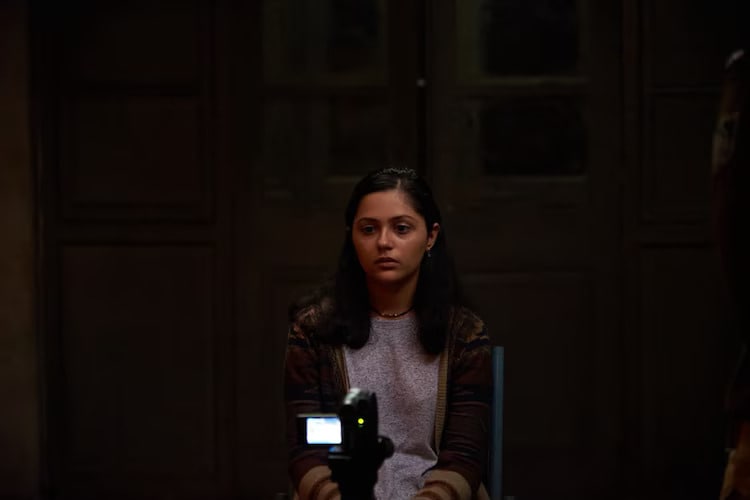
The six-episode JioHotstar series, created by Karan D Kapadia and Nitya Mehra, takes the familiar setting of a powerful godman and turns it into a police and courtroom drama. At the centre is Meenu Rawat (Aneet Padda), whose accusation against Sunil ‘Baapji’ Chakosi (Raghubir Yadav) sets off a chain of events involving the police, lawyers, the media and Baapji’s followers. The series does not take long to establish its conflict. Meenu’s complaint is initially met with hesitancy, while ACP Jasleen Singh Soin (Fatima Sana Shaikh) is assigned to investigate. Jasleen’s approach is different. She listens to Meenu, follows procedure and begins looking beyond the obvious.
That investigation gives the series its initial tension. This is Jasleen’s first case and, as Bhalerao (Mohammed Zeeshan Ayyub) points out, she has almost been set up to fail. She is taking on a case involving someone whose influence extends far beyond his ashram. Baapji’s followers are willing to defend him, lawyers face pressure, witnesses are frightened, and even the police have to work around the crowds gathered in his support. The problem is that while Hunkkaar shows us these pressures, it does not always spend enough time examining what they do to Jasleen or how difficult it is for her to investigate someone with this kind of reach.
Fatima is particularly good as Jasleen because she never turns the police officer into a larger-than-life crusader. There is restraint in her performance, especially in the quieter moments when the case begins to affect her personally. Her scenes with Meenu give the series some of its most effective moments.
Aneet Padda, meanwhile, handles a difficult role with maturity. Meenu is not written as a constantly distressed victim. She is scared, angry, confused and, at times, defiant. Padda gets these shifts right without overplaying them. Her courtroom scenes are among the strongest parts of the show, particularly because they allow Meenu to retain her agency instead of reducing her to the accusation at the centre of the story.
That is also where Hunkkaar’s strongest aspect — its premise — begins to expose the limitations of its writing. We see a sinister Baapji who commands a huge following, but the show does not really explore what makes his devotees follow him so blindly. His power is repeatedly established through crowds, fear and loyalty, but the machinery behind that influence remains largely unexplored. How did he build this following? Why do people continue to defend him when serious allegations are made? What makes it so difficult for those around him to question him? The series raises these questions without digging deeply enough into them.
The show does, however, understand that the fallout of Meenu’s accusation extends beyond the police station and courtroom. Her parents are caught between supporting their daughter and dealing with the fear and consequences that come with taking on someone as powerful as Baapji. Rajesh Sharma and Charu Sharma are convincing in these portions, bringing a grounded quality to the family's predicament.
The courtroom brings another important layer through Bhalerao, the lawyer who takes up Meenu’s case. Mohammed Zeeshan Ayyub gives the legal portions much of their weight, particularly in his exchanges with Ram Kapoor. Bhalerao is not presented as an all-knowing lawyer. He has his own disappointments and personal baggage, which makes his investment in the case feel more human. His observations about the pressures surrounding Jasleen also help establish just how difficult the case is from the beginning.
The series then widens its lens further with Arjun Mathur’s journalist Amitabh Sinha. His track looks at how television news can bring attention to a case while also making things more difficult for the people involved. The media track is not always subtle, but it fits into the show's larger question: what happens when a case becomes bigger than the people at its centre?
That is where the writing falls short of the premise. We see a sinister Baapji who commands a huge following, but the series never really explores what makes his devotees follow him so blindly. His influence extends far beyond the ashram — his followers are willing to defend him, lawyers face pressure, witnesses are frightened, and even the police have to work around crowds gathered in his support. Jasleen is also handling her first major case and, as Bhalerao points out, she has almost been set up to fail. Yet the series doesn't spend enough time with the pressures she faces while investigating someone with this level of influence. The result is that Baapji's power is repeatedly stated and shown, but rarely examined.
The first few episodes are consequently more effective than the later portions. Initially, the tension comes from not knowing what will happen after Meenu makes her accusation. The investigation gradually moves towards the courtroom, widening the story without losing sight of its central conflict. But as more threads enter the narrative, Hunkkaar begins trying to carry too much at once.
The investigation, courtroom battle, media coverage, administration, Baapji’s influence and multiple supporting storylines all have potential. Individually, they add something to the world of the show. Together, however, they make the narrative feel scattered. Just when one track begins to gather momentum, the series shifts its attention elsewhere. The result is that some of its more interesting conflicts never receive the depth they deserve.
Yet the central story remains compelling enough to keep the series moving. Hunkkaar is ultimately less interested in the mystery of whether one man is guilty than in what happens when an accusation is made against someone people have been taught to revere. Its real subject is the collision between faith, fear and influence — and the institutions that are expected to stand between power and the pursuit of justice.
The show occasionally overstates its point, and its writing does not always match the strength of its premise. But the performances keep it grounded. Aneet Padda brings considerable maturity to Meenu, Fatima Sana Shaikh gives Jasleen a quiet strength, Mohammed Zeeshan Ayyub adds weight to the courtroom portions, and Raghubir Yadav makes Baapji suitably unsettling.
Hunkkaar: The Roar may not fully explore the world it creates, but it has enough strong performances and an inherently compelling central conflict to make it worth watching.
Hunkkaar: The Roar premieres on JioHotstar on September 25.
- Ends
