
Someone at Home Shows Stroke Signs: Stroke Emergency First Aid in the Early Minutes

A Bengaluru family sought medical help after Sandhesh showed brief signs of a stroke. His TIA diagnosis underlines why even temporary symptoms require urgent assessment.
Impact Feature
New Delhi,Nov 6, 2026 12:35 IST Last UpdatedNov 6, 2026 12:35 IST
 Published by
Last UpdatedNov 6, 2026 12:35 IST Published byYashika Suri
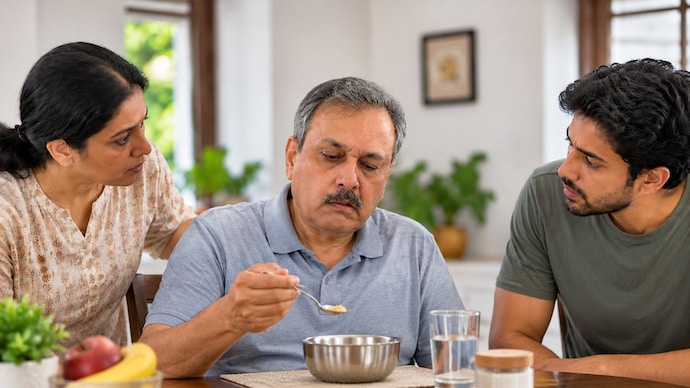
Nov 6, 2026 12:35 ISTA year ago, Sandhesh, 50, was having breakfast when he suddenly couldn't continue his conversation with his family. In front of his startled wife and children, one side of his face began to appear uneven; he wanted to lift his hand, but was too weak. To their relief, moments later, he looked normal.
At first, Sandhesh refused to see a neurologist in Bangalore, but after persuasion, he agreed to a consultation. Doctors found that he had experienced a TIA (transient ischaemic attack), often called a mini-stroke, which is a warning sign that a full stroke may follow. Had he stayed at home, the outcome could have been life-changing. Many people reading this article may never have had a stroke or been with someone who had one.
What Is a Stroke?
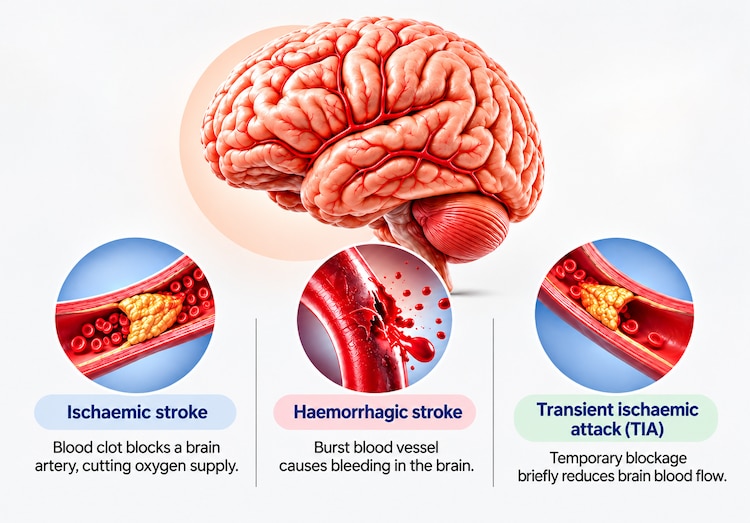
A stroke happens when blood flow to part of the brain is blocked by a clot, or when a blood vessel in or around the brain ruptures. Without oxygen, the affected brain cells stop working and begin to die. The effects can appear within minutes and are sometimes irreversible. A stroke can affect a person's movement, speech, memory, and independence. People often mistake the signs for tiredness, a migraine, low blood sugar, or stress. In some cases, the symptoms go away within a few minutes and then return later as a far more serious stroke. When a stroke happens, what you do in the first few minutes is vital.
Why Each and Every Minute Matters
Stroke management depends on how quickly the doctor can assess the patient.
A brain scan will show the doctors whether the stroke is ischaemic (a clot) or haemorrhagic (a bleed). Even after the 'golden hour' (the first 60 minutes after symptoms begin) has passed, some patients can still benefit from treatment, depending on their clinical picture and brain imaging.
Recognise Stroke Symptoms: Remember BE-FAST
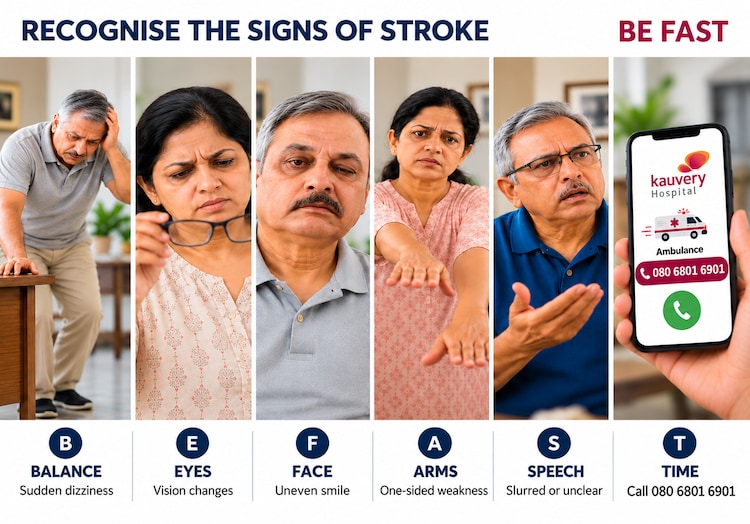
B: Balance: Sudden dizziness, loss of balance, or difficulty walking.
E: Eyes: Sudden blurred, double, or lost vision.
F: Face: Drooping or an uneven smile.
A: Arms: Sudden weakness or numbness, particularly on one side.
S: Speech: Slurring, difficulty finding words, or confusion.
T: Time: Time to call emergency services.
If any stroke warning sign appears suddenly, call for emergency medical help immediately.
Stroke Does Not Always Look Dramatic
A sudden headache with no known cause can be a warning sign of stroke, as can changes in vision, confusion and difficulty with walking. If the symptoms pass after a short time, the person should still urgently, as it could be a TIA (mini-stroke).
The Kauvery 10-Minute Family Protocol: SEE – CALL – NOTE – PROTECT – GO
Step1: SEE the sudden change
Ask the person to smile, raise both arms, and repeat a simple sentence. Watch how easily they can do each one. Do these quick checks and the BE FAST test while someone arranges an ambulance from a stroke-ready hospital in Bangalore. The checks should never delay the call for help.
Step 2: CALL for help
Do not arrange a private vehicle or drive the person yourself. Call emergency services and ask for an ambulance.
Step 3: NOTE essential details
Use a notebook or your phone to record the key points: the time they were last seen normal, their symptoms, their main medical conditions and current medicines, and whether they take any blood thinners. This helps the doctors assess the patient quickly on arrival.
Step 4: PROTECT the person
Keep the patient calm and safe, and don't let them walk around on their own. If they are in tight clothing, then loosen it. Don't give them any food, water, aspirin, or any other medication or home remedy, and don't induce vomiting.
If they vomit, help them lie on their side (if it's safe to do so) to keep their airway clear, and tell the emergency services without delay.
Step 5: GO to stroke-ready care
Follow the emergency team's guidance on transport. Stroke-ready care means rapid assessment, quick access to brain imaging and specialists, and the right treatment. This may include clot-dissolving (thrombolytic) medicine or mechanical thrombectomy, in which the clot is removed through a catheter. Kauvery Hospitals Bengaluru has emergency stroke care with a Hyper Acute Stroke Care Unit and KARES ambulance support. The clinical team will decide which treatments are suitable based on the assessment.
What Happens After Reaching Kauvery?
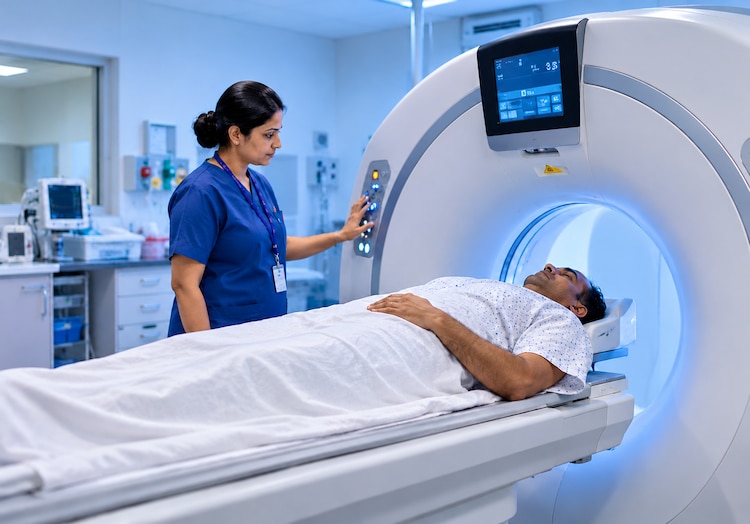
The emergency team will assess the symptoms, stabilize the patient, and arrange urgent brain imaging to find out whether it's an ischaemic stroke (a blocked vessel) or a haemorrhagic stroke (bleeding). Management will depend on the stroke type, time since onset, imaging, and the patient's condition. In some cases, the patient may need surgery and will be referred to the best neurosurgeon in Bangalore.
Recovery Begins With the Right Response
Emergency treatment is only the start. Rehabilitation, medication, follow-up, and support at home are all part of the recovery process. Ask your doctor about your rehabilitation needs, warning signs, risk factors, and next follow-up.
Take Action: Save This Stroke Emergency First Aid Guide
If you notice a sudden change in anyone's smile, speech, arm strength, balance, or vision (even for a few minutes), then call Kauvery Hospital Bengaluru emergency on 080 6801 6901 immediately.
Save this article and pass it on to your family. In a stroke emergency, being prepared is being protected.
Disclaimer: The material, content, and/or information contained within this impact feature are published strictly for advertorial purposes. T.V. Today Network Limited hereby disclaims any and all responsibility, representation, or endorsement with respect to the accuracy, reliability, or quality of the products and/or services featured or promoted herein. Viewers or consumers are strongly advised to conduct their own due diligence and make independent inquiries before relying on or making any decisions based on the information or claims presented in the impact feature. Any reliance placed on such content is strictly at the individual’s own discretion and risk.
- Ends