
How Japan's UNICORN will be Indian Navy's 'ninja power' against China
Tokyo has opened defence technology doors for New Delhi with the move to co-produce its UNICORN naval stealth system
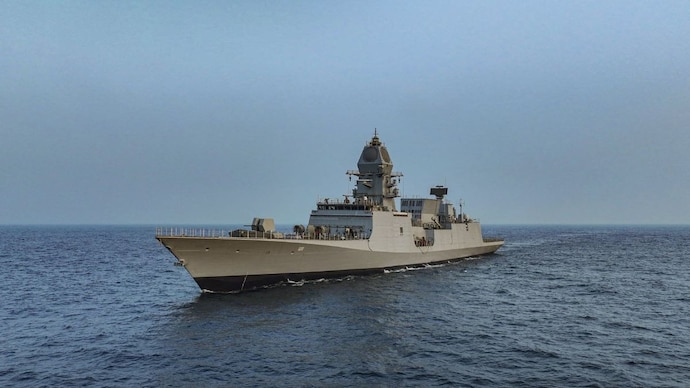

 A landmark shift in Japan’s post-World War defence policy is set to reshape military cooperation with India. Just months after Tokyo approved sweeping changes to its ‘Three Principles on Transfer of Defence Equipment and Technology’, easing decades-old restrictions on the export of defence equipment, New Delhi has moved to harness Japanese military technology through co-production in India.
The momentum culminated on July 2 as the two countries cleared the final hurdles for the joint manufacture of Japan’s UNICORN integrated naval antenna mast, marking a significant milestone in their expanding strategic and defence partnership.
The UNICORN system will be jointly co-produced in India by the defence public sector undertaking Bharat Electronics Limited (BEL). Developed by Japan’s NEC Corporation, Sampa Kogyo and Yokohama Rubber, the integrated antenna mast is currently deployed on the Mogami-class frigates of the Japan Maritime Self-Defence Force and will also be inducted on Indian Navy warships.
The agreement comes as Prime Minister Narendra Modi and his Japanese counterpart, Sanae Takaichi, agreed during talks in New Delhi to deepen maritime security cooperation through more frequent naval exercises, enhanced maritime domain awareness using satellite capabilities, greater collaboration in naval maintenance and expanded defence industrial cooperation, reflecting the growing strategic convergence between the two countries in the Indo-Pacific.
Japan’s Unified Complex Radio Antenna, or UNICORN, is regarded as one of the country’s most sophisticated naval communications and stealth technologies. Despite its prominence, it is neither a radar nor a weapon system. Instead, it is an integrated antenna mast that consolidates multiple communication, navigation, identification and electronic warfare antennas within a single enclosed structure.
Designed to replace the numerous exposed antennas typically found on modern warships, the system improves stealth, reduces electromagnetic interference and simplifies maintenance while creating a cleaner and more efficient topside design.
India and Japan had formalised cooperation on the technology through a Memorandum of Implementation signed in November 2024, paving the way for what has now become the first major joint defence technology development project between the two countries.
Defence experts point out that modern warships carry dozens of separate antennas dedicated to high frequency, very high frequency and ultra-high frequency communications, satellite communications, tactical data links, electronic support measures, Identification Friend or Foe (IFF), Tactical Air Navigation (TACAN) and global positioning systems. The proliferation of these exposed antennas increases radar reflections, creates electromagnetic interference, adds significant weight high above the ship’s centre of gravity and complicates maintenance.
UNICORN addresses these limitations by integrating these diverse functions into a single enclosed mast, reducing external clutter while allowing multiple systems to operate seamlessly.
Although much of the technology remains classified, publicly available information suggests that the system integrates secure multi-band military communications, tactical data links essential for network-centric warfare, TACAN equipment that assists helicopters and fixed-wing aircraft in locating and landing on moving ships, IFF systems for identifying friendly platforms, and sophisticated electronic support measures capable of passively detecting and analysing enemy radar emissions.
These passive electronic warfare capabilities enable a warship to monitor the electromagnetic environment and detect hostile radar activity without actively transmitting signals, thereby improving situational awareness while reducing the likelihood of revealing its own position.
One of UNICORN’s most significant advantages lies in its contribution to stealth. Conventional warships are fitted with numerous exposed antennas, support structures and associated cabling, all of which reflect radar waves and increase a vessel’s radar cross-section. By enclosing these systems within a specially designed composite radome structure, UNICORN presents a cleaner external profile that minimises radar reflections and reduces radar clutter.
While the technology does not make a warship invisible, it lowers detectability, delays identification and tracking by adversary sensors and complicates target acquisition by radar-guided weapons. Japanese media have frequently described the system as “ninja technology” because of its ability to make naval platforms considerably harder to detect.
Already deployed on Japan’s Mogami-class frigates, UNICORN is designed to support modern stealth architecture and network-centric naval operations. For the Indian Navy, the technology aligns with its increasing emphasis on linking warships, submarines, aircraft, helicopters, unmanned systems, satellites and shore-based command centres through secure digital networks capable of sharing operational information in real time. In addition to reducing a vessel’s radar signature, the integrated mast provides a robust communications backbone that strengthens command, control and electronic warfare capabilities.
Operationally, the system is expected to lower the radar cross-section of Indian warships, making them more difficult to detect, classify and track during maritime operations. Its integrated communications architecture facilitates seamless information sharing among multiple naval platforms, enabling one platform to detect a target, another to engage it, while others provide command, surveillance or electronic warfare support. Such coordinated operations are becoming central to modern naval doctrine, particularly in contested maritime environments where information superiority can determine operational success.
UNICORN also enhances survivability by strengthening a ship’s electronic warfare capabilities. Its electronic support measures can passively detect hostile radar emissions, helping identify enemy ships, aircraft and incoming missile seekers while maintaining electromagnetic silence. This provides commanders with valuable early warning and additional reaction time against radar-guided threats without compromising the ship’s own position.
Beyond its operational advantages, the integrated mast offers significant logistical and engineering benefits. Consolidating numerous antennas into a single structure reduces wiring complexity, simplifies maintenance, lowers long-term support requirements, decreases top-side weight and frees valuable space for future upgrades and additional equipment. The design also offers greater flexibility for incorporating emerging technologies over the service life of the platform.
Although the Indian government has not officially identified the classes of warships that will receive the system, analysts believe UNICORN is likely to be integrated into future frigates, destroyers and next-generation stealth surface combatants. Beyond its technological value, the project is strategically important because it represents one of Japan’s most significant defence technology collaborations with India following the relaxation of Tokyo’s export restrictions. It also aligns with India’s Make in India initiative by promoting domestic manufacturing, technology absorption, system integration and long-term maintenance within the country.
While UNICORN is not a replacement for a warship’s primary radar, missile defence systems or weapons, its ability to integrate communications, navigation, identification and electronic warfare functions into a single low-observable structure makes it a force multiplier. By improving stealth, enhancing survivability, simplifying maintenance and strengthening network-centric operations, the system is expected to significantly augment the overall combat effectiveness of future Indian naval warships while deepening one of the fastest-growing defence partnerships in the Indo-Pacific.
Defence analysts believe the induction of UNICORN will significantly enhance the Indian Navy’s ability to counter the expanding footprint of the Chinese People’s Liberation Army Navy (PLAN) in the Indian Ocean Region. As Beijing sustains near-continuous deployments of destroyers, submarines, intelligence-gathering vessels and increasingly aircraft carrier strike groups far from its shores, the ability to operate with a lower radar signature, stronger electronic warfare capabilities and secure, high-speed communications is becoming a decisive operational advantage. By making Indian warships harder to detect, identify and track, UNICORN is expected to complicate Chinese surveillance and targeting efforts while enhancing the survivability of frontline naval platforms.
Military experts say the system’s real strength lies in transforming individual warships into nodes of a fully networked combat force. By seamlessly linking ships, maritime patrol aircraft, helicopters, unmanned platforms, satellites and shore-based command centres, UNICORN enables the rapid exchange of intelligence and targeting data across the battlespace. This allows Indian naval commanders to detect, classify and respond to threats faster than an adversary, compressing the sensor-to-shooter cycle and strengthening maritime domain awareness across critical sea lanes stretching from the Arabian Sea to the eastern Indian Ocean.
Subscribe to India Today Magazine