
How Swaminarayan sect BAPS's request to remove women for Eiffel Tower visit backfired

Furore and a protest shutdown of Eiffel Tower followed BAPS spiritual leader Mahant Swami Maharaj's tour, for which women staff was made to 'go invisible'
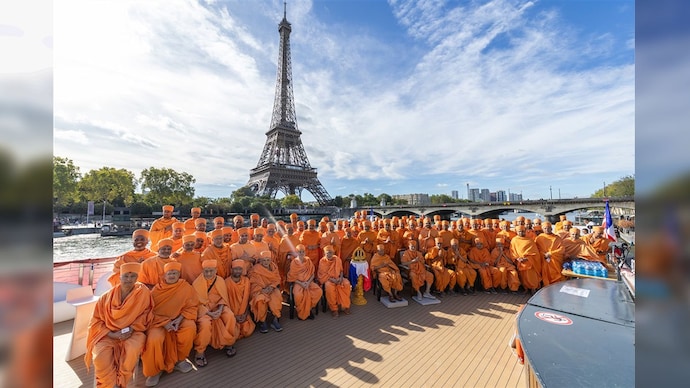

 The Eiffel Tower in Paris, one of the world’s most visited landmarks, reopened on September 8 after a one-day shutdown, capping a 72-hour-long controversy that began when a Gujarat-headquartered Hindu organisation, the Bochasanwasi Akshar Purushottam Swaminarayan Sanstha (BAPS), asked for limiting women’s presence at the tower during a private visit of the sect’s spiritual leader.
Around 100 members of BAPS had toured Eiffel Tower on September 5, led by the sect’s Mahant Swami Maharaj. Two days before, he had inaugurated France’s first traditional Hindu temple in Bussy-Saint-Georges near Paris.
For Mahant Swami Maharaj’s visit, women staff at the Eiffel Tower were told to leave their posts, withdraw to other areas or avoid crossing certain zones while the delegation passed through. In some positions, men had replaced them.
The tower’s operating company, SETE, has confirmed that the BAPS delegation asked to “limit interactions with women”. SETE also said “these conditions should not have been accepted”.
Eiffel Tower staff walked out in protest on September 8. The Confdration Gnrale du Travail (CGT), France’s largest trade union confederation and representing them, condemned “workplace instructions that led to female employees being sidelined, replaced and rendered invisible on the basis of their gender”.
“As the delegation passed through, women were asked to leave their work stations so that men could take their places,” news agency Reuters quoted CGT representative Diane Davoine as saying.
“Tensions mounted over the weekend; so this morning, the employees decided to meet—first, to open a dialogue with the management, and second, to ensure that women are never treated this way at the company again,” Davoine said.
BAPS apologised without fully conceding to the CGT’s account. In a statement, it said: “Given the size of the group, this visit was coordinated in advance with the Eiffel Tower’s management team, and was scheduled at the start of normal operating hours specifically to minimise any disruption to staff, other visitors, and the site’s regular functioning. It was never, at any point, intended as a request rooted in gender, and any suggestion to the contrary does not reflect the spirit or values of our fellowship or the delegation. To our knowledge, no visitor or member of staff was denied access to the monument at any point during our visit.”
Nevertheless, the condemnation was widespread. Paris mayor Emmanuel Grgoire called the arrangement “unacceptable” and pledged an investigation.
SETE president Ariel Weil said: “We are going to shed light on what happened, and we will draw the necessary conclusions.”
France’s equality minister Aurore Berg posted on social media: “In France, we do not ask women to erase themselves.”
But none of the three reviews announced so far is a criminal or judicial one. No labour inspectorate case or formal discrimination complaint had been filed as of September 8.
French labour lawyers, however, have flagged the incident’s exposure under the Code du travail (France’s labour code). Article L.1132-1 bars sidelining, sanctioning or subjecting an employee to discriminatory treatment because of sex, explicitly covering job assignment. Article L.1142-1 bars sex from being a factor in assignment or classification decisions.
Legal commentary on the case argues that an employer cannot convert a client’s discriminatory request into a lawful “professional instruction” by folding it into a shift plan, meaning SETE’s own admission that it accommodated the request could itself be the liability, separate from BAPS’s intent.
The Swaminarayan Sampraday is a Vaishnavite movement that originated in the early 18th century, reaffirming the values of the Hindu Sanatan Dharma. BAPS is one of the six sects under the Swaminarayan umbrella.
For BAPS, while the deity in the temple is Lord Swaminarayan, the belief is that the divine presence survives through the spiritual successor of the Sampraday. Hence, the head of the sect is considered very powerful and is seen to have an iron-like grip over its one million-plus followers. Mahant Swami Maharaj, 92, is the sixth and current head of the Sampraday.
Despite its global reckoning, BAPS’s relationship with women follows a distinct doctrinal logic. Its more than 800 saints worldwide are not merely ascetics: they avoid any interaction with women, even at a distance or through channels as remote as email. “This is one of the core tenets of Swaminarayan Sampraday. The lord said Kanchan and Kamini (money and women) are a hindrance to karma,” says a senior office-bearer of BAPS.
BAPS was established in 1907 by Shastriji Maharaj, based on the principles of Vedas and the pillars of practical spirituality. It claims to have more than one million global members, 80,000 volunteers, a network of over 1,550 mandirs, 5,025 centres and 17,000 weekly assemblies. Some of the popular BAPS temples are the Akshardham in Robbinsville (New Jersey), New Delhi, Gandhinagar, London, Houston, Chicago, Atlanta, Toronto, Los Angeles, Abu Dhabi and Nairobi. Mandirs in Sydney and Johannesburg are in the pipeline.
In 2021, the Federal Bureau of Investigation (FBI) had raided BAPS’s New Jersey temple construction site after workers—mostly Dalit labour from India—alleged they were confined to a guarded compound, had their passports confiscated and were grossly underpaid.
BAPS has been known to command the unyielding loyalty of its followers worldwide, stemming from its financial muscle and reckoning in global power corridors. For several decades now, in Gujarat at least, politicians across party lines have sought the blessings of the local Swaminarayan sect. Although BAPS remains apolitical, its propensity to patronise suitable candidates is an open secret. The affluent Patidar community makes up the sect’s largest chunk of followers, though not limited to it.
Subscribe to India Today Magazine