BRICS challenges dollar dominance, pushes for new global order: Vinay Sahasrabuddhe

Vinay Sahasrabuddhe said the shift in India-Russia trade from the US dollar to the rupee-ruble mechanism was part of a broader rejection of hegemonic thinking in global relations, with BRICS nations moving away from a single-superpower world order and expanding the use of local currencies in trade.
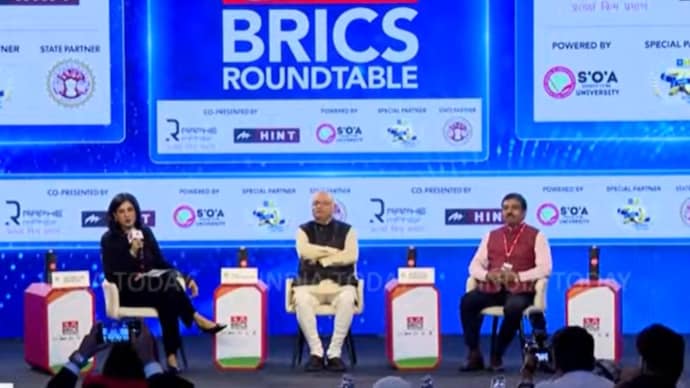

BRICS countries are rejecting the global order dominated by a single superpower and are seeking greater diversity in international trade and economic relations, BJP national executive member and Asiatic Society of Mumbai president Vinay Sahasrabuddhe said, arguing that no one currency should dominate global trade and economic affairs.
Speaking during a discussion at the India Today BRICS Roundtable 2026 alongside former diplomat Muktesh Pardeshi, Sahasrabuddhe said the shift in India-Russia trade from the US dollar to the rupee-ruble mechanism was part of a broader rejection of hegemonic thinking in global relations among BRICS nations.
“What we are witnessing is a rejection of hegemonic thinking in global relations - one becoming the superpower and others listening to them,” Sahasrabuddhe said, adding that BRICS countries were “miles away” from such an approach.
Referring to the growing use of local currencies in bilateral trade, he asked, “Why should one currency be dominating the world trade, economic affairs and order?” He said every country had its own aspirations and wanted to have a voice and be counted in global politics.
His comments come as BRICS seeks to expand its role amid a shifting global order, with Russia’s war in Ukraine, the conflict in West Asia and tensions over trade and tariffs adding to geopolitical uncertainty. Against this backdrop, the discussion focused on the importance of people-to-people ties in strengthening relations between countries and the role of social media in fostering such connections.
During the discussion, Sahasrabuddhe invoked India’s philosophy of Vasudhaiva Kutumbakam, or “the world is one family” and said it could offer a framework for how countries approach social media and cultural exchanges.
He said social media could be used to showcase the cultures, festivals and traditions of different countries, while cautioning against what he described as the “Americanisation” and “global cultural flattening” of societies.
He said the spread of global brands was not a problem in itself, but could become one if it came at the cost of local culinary and cultural traditions.
“I don’t have an issue with it, but if it ends up killing the culinary and cuisine traditions of my country or any other country, then that will be an issue. Global cultural flattening is going to make this world less beautiful,” he said, arguing that social media could instead become a tool to promote cultural diversity, cultural exchange and mutual respect among nations.
The discussion then turned to BRICS’ growing economic and demographic weight. When moderator Anjana Om Kashyap pointed out that BRICS represents nearly 50 per cent of the world’s population, 40 per cent of global GDP and 26 per cent of global trade, Sahasrabuddhe linked the bloc’s growing heft to the broader push against global dominance.
He invoked what he called the “democratisation of cartography”, referring to a United Nations General Assembly-backed resolution seeking a world map that more accurately reflects the relative size of countries. Sahasrabuddhe pointed out that the Mercator projection had historically made the Northern Hemisphere appear larger, while the Southern Hemisphere is, in reality, significantly larger in area.
Meanwhile, Former diplomat Muktesh Pardeshi revealed that BRICS members had also discussed mechanisms to facilitate the return of stolen cultural property and the creation of a permanent database of artworks and artefacts. The database, he said, would initially be developed as a pilot project before being scaled up across BRICS countries.
India’s BRICS presidency comes at a particularly complex geopolitical moment, with the group facing growing challenges from tensions within the global order. US President Donald Trump’s scepticism towards BRICS, coupled with the ongoing conflict in the Middle East, has added another layer of uncertainty. Meanwhile, Iran, the UAE and Saudi Arabia - countries with competing regional interests, including over Tehran’s drone and missile attacks - will find themselves in the same forum on September 12 and 13.