
Vice President says communism's focus on wealth distribution led to its decline

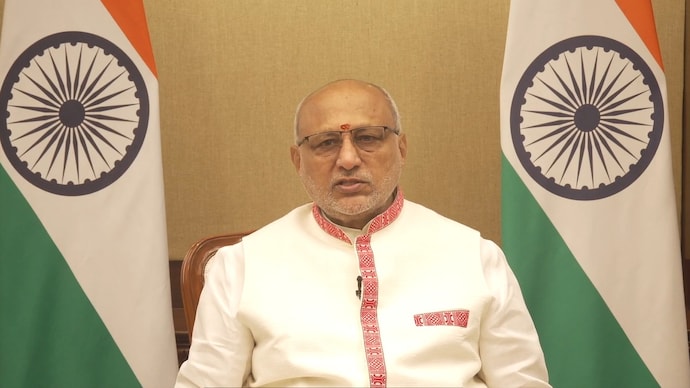
Vice President CP Radhakrishnan said communism's emphasis on wealth distribution over production and productivity contributed to its decline. He argued that economic growth must balance wealth creation with equitable distribution.
 Last UpdatedNov 25, 2026 02:14 IST
 Published by
Vice President CP Radhakrishnan on Tuesday said communism's emphasis on wealth distribution over wealth creation and productivity contributed to its decline, news agency PTI reported.
He said economic progress must combine wealth creation with equitable distribution to improve people's quality of life. He also called for inclusive development across sectors, regions and sections of society to achieve the vision of Viksit Bharat@2047.
Radhakrishnan was addressing a gathering at his official residence in Delhi during the exchange of a Memorandum of Understanding between the London School of Economics and Political Science, the Delhi School of Economics and the Institute of Economic Growth.
The Vice President, who is researching the fall of communism for his doctorate, said the system had failed to place production and economic growth at the centre of its thinking.
“Communism's biggest problem is first a fall in productivity, then the production gets shrunk. They are always talking about distribution. They never worried about production. That is where communism has failed,” he said, according to PTI.
He said declining productivity had led to lower production, shortages of essential commodities and long queues for rationed goods. Attempts to tackle the situation by increasing government employment created further administrative and economic difficulties, he added.
Referring to India's development under Prime Minister Narendra Modi, Radhakrishnan cited achievements in poverty alleviation, housing, rural electrification and tap water connections.
He said economic progress should ultimately improve people's quality of life, with human development, good governance and citizens' welfare remaining central to domestic and global priorities.
Describing the MoU exchange as an important milestone, he said the partnership would combine the academic excellence, research capabilities and policy experience of the three institutions to address pressing economic and social challenges.
The proposed collaboration will facilitate academic exchanges, joint research, training programmes, and exchanges involving students and faculty. The areas identified for collaboration include sustainability, artificial intelligence, public policy, geopolitics and international trade.
Radhakrishnan welcomed the proposal to create a joint research seed fund involving the three institutions. He said it would support young researchers, encourage original scholarship and help generate practical policy recommendations.
He also highlighted the proposed collaboration between the Institute of Economic Growth and the London School of Economics to improve the training of Indian Economic Service officers. International exposure to research and policy practices would strengthen their professional capabilities, he said.
Referring to India's growing role in the Global South, Radhakrishnan said the country's democratic institutions, diversity and development experience had much to offer the international academic community. He added that the experiences of developing countries should also help shape global academic and policy frameworks.
As Chancellor of Delhi University, he said he would personally monitor the initiative's progress and outcomes and provide all necessary support. He also encouraged other universities to draw inspiration from the partnership and pursue similar collaborations.
The ceremony was attended by Institute of Economic Growth President N K Singh, LSE President and Vice-Chancellor Larry Kramer, IEG Chairman Michael Debabrata Patra and Delhi University Vice-Chancellor Yogesh Singh, among others.
The partnership aims to promote academic exchanges, joint research and training while addressing economic and social challenges, as Radhakrishnan stressed the need to balance wealth creation with fair distribution and inclusive development.