Are BJP governments allergic to eggs? Here's the reality with evidence
The BJP government in West Bengal plans to involve ISKCON in preparing Kolkata school midday meals, which might see eggs move out of the menu. Some other BJP states earlier removed eggs from midday meals. Is the BJP allergic to eggs? Here's a detailed analysis with facts.
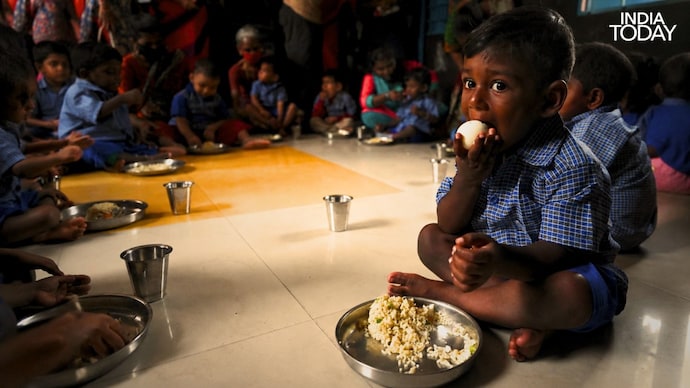
The eggs were introduced in midday meals of school children for the first time in June 1989 in Tamil Nadu. (Image: AFP)

New Delhi,UPDATED: Jun 26, 2026 10:15 IST
"Sunday ho ya Monday, roz khao anday." Few public health campaigns in India are as memorable as the National Egg Coordination Committee's (NECC) iconic jingle urging people to eat eggs every day. The message was simple: eggs are among the most affordable and nutrient-dense foods available. Rich in high-quality protein and almost every essential vitamin except vitamin C, eggs are often described as a superfood. There are many scientific studies that prove this. They are cheaper, easier to procure, and nutritionally superior to many common alternatives.
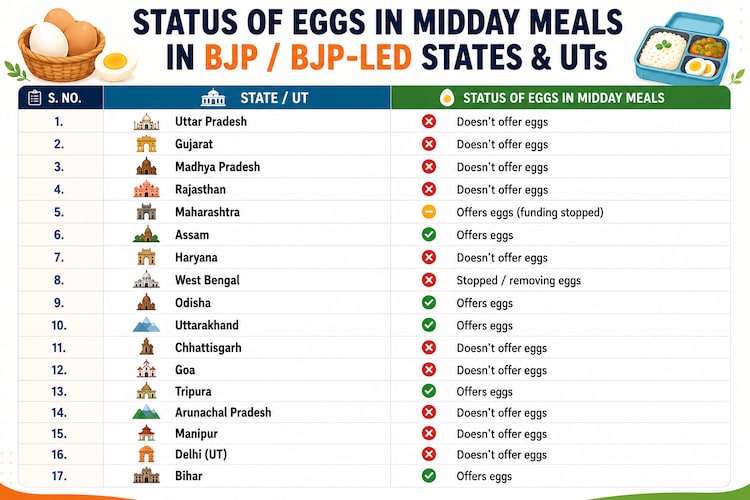
Recognising their value in combating malnutrition, governments introduced eggs into school midday meal programmes across several states. But today, eggs are not being offered in all states in India. Data suggests that a majority of BJP-ruled states do not offer eggs to students under their midday meal schemes.
The latest to join the list is Chief Minister Suvendu Adhikari-led BJP government in West Bengal, which has handed over the preparation of midday meals in Kolkata schools to ISKCON (the International Society for Krishna Consciousness), and will reportedly no longer serve eggs in midday meals.
West Bengal Finance Minister Swapan Dasgupta, while presenting the BJP government's maiden budget on Monday (June 22), said that ISKCON was expected to assist in food preparation and distribution under the midday meal scheme in Kolkata.
The decision to likely remove eggs from the menu has turned into a political slugfest in West Bengal, with Trinamool Congress (TMC) leaders criticising the newly sworn-in government. TMC joint secretary Derek O'Brien on Wednesday alleged in a post on X that the BJP was depriving West Bengal's children of nutrition and was trying to "impose vegetarianism" in the state.
"After the fish-eating tamasha during the election campaign, the Gujarat Gymkhana finally reveals itself. New BJP government at work in Bengal," O'Brien said in a post on X.
"Throw eggs at rivals. But deprive children of nutrition by taking eggs off from midday meals. Imposing vegetarianism. Bengal rejects this," O'Brien added.
West Bengal was among 15 states and Union Territories (UTs) that included eggs as a supplementary nutrition item under the government's midday meal programme.
Today, out of 28 states and eight UTs, eggs feature in midday meals in only 14. A closer look at the states that exclude them shows a dominance of BJP-ruled governments.
ONLY FIVE BJP-RULED STATES CURRENTLY OFFER EGGS IN MIDDAY MEALS
The Maharashtra government in 2025 decided to stop funding eggs in school meals. With that move, Maharashtra was effectively the latest to join the list of BJP-ruled states where eggs were either absent from the midday meal menu or provided only in a limited manner. Now, West Bengal is on the path to being added to that list.
Among the states governed by the BJP, only five states, Assam, Odisha, Uttarakhand, Bihar, and Maharashtra, currently have a consistent state-supported egg programme in school meals.
The BJP currently has 17 chief ministers and 5 CMs of its coalition partners.
Following the uproar, the BJP-ruled Maharashtra government permitted eggs to be served in midday meals, but government funding was withdrawn, and schools were asked to arrange resources on their own if they still wanted to include eggs in school meals.
Most BJP-governed states, particularly in northern and western India, also do not provide eggs through the PM POSHAN scheme. The PM POSHAN scheme, formerly known as the Mid-Day Meal Scheme, is jointly funded by the Centre and states, generally in a 60:40 ratio. Notably, Uttar Pradesh, Gujarat, Madhya Pradesh, Rajasthan, Haryana, Chhattisgarh, Goa, Arunachal Pradesh, Manipur, Delhi, and Tripura also neither provide eggs, nor have any consistent statewide policy supporting them.
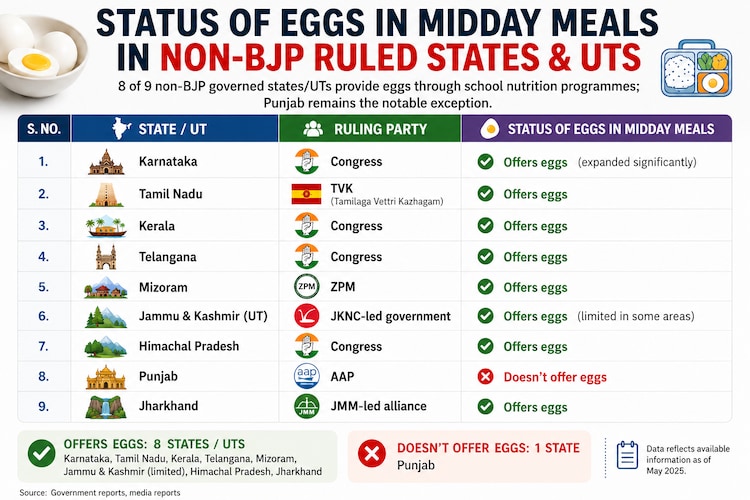
The contrast becomes sharper when compared with non-BJP states: Karnataka, Kerala, Tamil Nadu, Telangana, Himachal Pradesh, Mizoram, and several Union Territories continue to provide eggs through school nutrition programmes.
In many of these states, eggs are viewed not as a political or social issue but as a public health intervention aimed at improving child nutrition.
THREE STATES REMOVED EGGS AFTER A CHANGE IN POLITICAL PRIORITIES
Previously, the saffron party, after coming to power in at least four states, tried to push for a similar policy as it's seemingly attempting to implement in West Bengal.
Chhattisgarh is seemingly the most direct example of such a push. The Congress government, led by Bhupesh Baghel, introduced and expanded the distribution of eggs in schools and Anganwadis in 2019. However, after the BJP returned to power in 2023. Under the chief ministership of Vishnu Deo Sai, the state informed the Union Ministry of Education that it would discontinue eggs and instead focus on millet-based nutrition programmes.
Goa also saw a similar move. The BJP government briefly introduced eggs in school meals in 2022, and withdrew the decision soon after facing backlash from sections of society.
Maharashtra followed a slightly different route. Eggs were limited to only once a week in 2023. However, after the BJP-led Mahayuti government retained power in 2024, state funding for the programme was withdrawn in early 2025. Schools still continue serving eggs, but through independently mobilised funds.
Madhya Pradesh is another state that no longer serves eggs in school meals. The Kamal Nath-led Congress government proposed introducing eggs in midday meals during its brief tenure, but the plan never materialised after the government fell in 2020 and the BJP returned to power.
SOUTHERN STATES REMAIN AN EXCEPTION
While northern and western India reveal a political divide over eggs, southern India narrates a very different story.
Every southern state currently provides eggs in some form through school meals or Anganwadi programmes, irrespective of the political party in power. Karnataka, Tamil Nadu, Kerala, Telangana, and Andhra Pradesh all include eggs as part of their nutrition strategy despite being governed by parties with vastly different ideological positions.
The consistency is particularly notable in Karnataka, which is the only southern state that gives the BJP an opportunity to govern. The BJP government continued to serve eggs in midday meals in 2021 despite criticism from sections of the Lingayat community and opposition from some party leaders. BJP's Tejaswini Ananth Kumar had argued that eggs were not the only source of nutrition and that the policy discriminated against vegetarian students. Nevertheless, the BJP stood by the decision. After the Congress came to power in 2023, the egg allocation was expanded further in Karnataka.
Andhra Pradesh has adopted one of the strongest pro-egg positions in the country. Taking cognisance of recommendations from the National Institute of Nutrition (NIN), the state made eggs mandatory in government-run schools. Authorities directed district education officers to strictly implement the menu and refused to exempt organisations such as Akshaya Patra Foundation or ISKCON from serving eggs on religious grounds. Andhra Pradesh's case is interesting as it also has a midday meal prepared by ISKCON, similar to what Bengal is planning now, but never stopped offering eggs.
Even after Chandrababu Naidu's Telugu Desam Party (TDP) returned to power in alliance with the BJP in 2024, the egg programme has been intact, suggesting that in much of southern India, nutritional considerations have largely trumped ideological disagreements.
EGGS REMAIN A CONTENTIOUS ISSUE DUE TO SOCIAL AND RELIGIOUS CONSIDERATIONS
The debate around eggs has rarely been about nutrition alone, and wholly blaming the BJP would not be an accurate argument.
In Maharashtra, religious organisations had opposed the inclusion of eggs in school meals as early as 2023. Similar objections have surfaced in Karnataka, Goa, and several other states whenever governments have attempted to introduce eggs into publicly funded nutrition programmes.
Supporters of egg distribution argue that the science is unequivocal. Nutritionists, paediatricians, and public health experts have consistently maintained that eggs provide one of the most affordable and effective sources of high-quality protein for children.
According to the National Institute of Nutrition (NIN), protein derived from eggs has a bioavailability of around 94%, which is significantly higher than many plant-based alternatives, such as Bengal gram, which has a protein bioavailability of about 76%, and soybean, at around 54%.
Eggs are also rich in essential amino acids, vitamins, and micronutrients required for child development.
However, the decision on what food items are served is largely left to state governments. As a result, children's access to eggs often depends less on nutritional science and more on where they live and who governs their state. The BJP is not the only party that rejected eggs, but states like Rajasthan, Haryana, and Punjab have also not implemented eggs in midday meals, even when the BJP was not in power in these states.
- Ends