Mekedatu and the Cauvery's unresolved fault line

A revised dam, an unresolved river dispute: Mekedatu is once again testing the fragile Cauvery balance between Karnataka and Tamil Nadu.
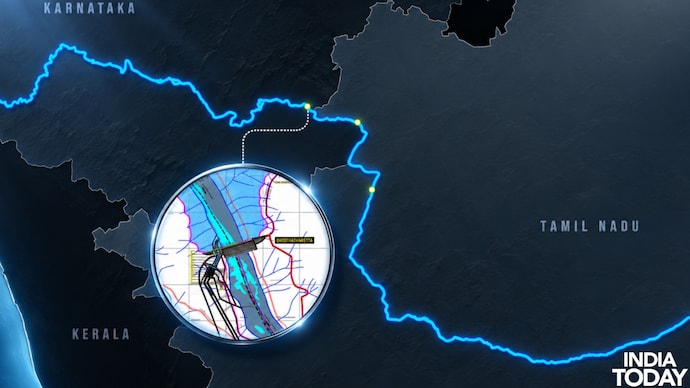

At Mekedatu, the Cauvery squeezes through a rocky gorge before flowing towards Tamil Nadu. Karnataka wants to build a 67.16 TMC reservoir here, upstream of Biligundlu, the point where Cauvery flows entering Tamil Nadu are measured.
That geography is at the heart of the dispute.
Mekedatu does not alter how much Cauvery water Tamil Nadu is legally allocated. What it proposes is another major storage point before that water reaches the interstate gauge.
To examine what that could mean, India Today’s Open Source Intelligence (OSINT) team analysed IMD rainfall records for Karnataka and Tamil Nadu from 2001 to 2024, CGWB groundwater assessments, monthly Cauvery flows recorded at Biligundlu, and official project, court and regulatory documents relating to Mekedatu.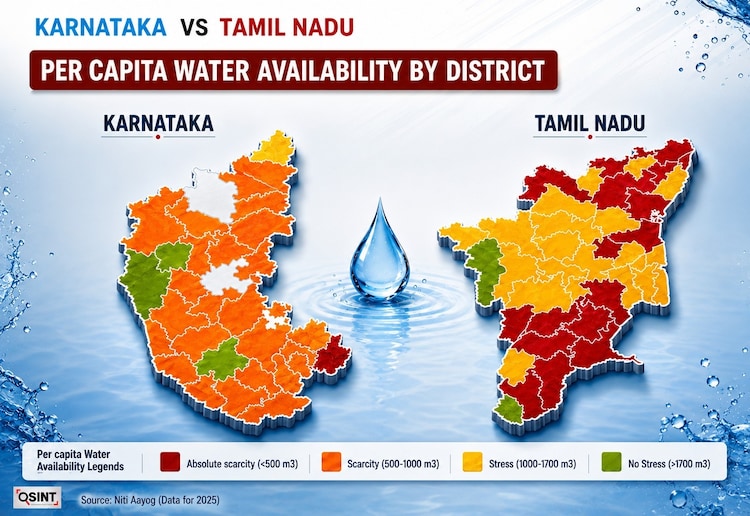
Together, the records point to a question that sits beneath much of the argument over the project: not simply how much Cauvery water eventually reaches Tamil Nadu, but when it gets there.
Mekedatu itself is changing

The project on the table today is not quite the one Karnataka proposed in 2019.
The original Detailed Project Report envisaged 4.75 TMC of consumptive use for Bengaluru and adjoining areas. In April 2026, Karnataka proposed increasing this to 6.95 TMC and added a Shivanasamudra run-of-river power project and diversion weir.
The Central Water Commission returned the 2019 DPR on June 29 and asked Karnataka to submit a revised proposal. Among the issues it flagged were the increased consumptive use and the justification for 59.46 TMC of proposed live storage within the reservoir’s 67.16 TMC gross capacity.
“The basis of determining the above Live Storage Capacity of 59.46 TMC does not seem to be appropriate,” the CWC said in its communication to Karnataka.
Karnataka has since gone back to the Commission with a revised proposal. In an August 21 written reply to the Karnataka Legislative Council, Water Resources Minister N Chaluvarayaswamy said the revised DPR had been uploaded to the CWC’s e-PAMS portal on August 13.
The revised project is now estimated to cost Rs 16,745 crore at 2026–27 prices, up from Rs 9,000 crore in the 2019 DPR.
Scarcity looks different on either side
Water scarcity lies at the centre of arguments made by both states. But statewide indicators do not, by themselves, settle the question of scarcity within the Cauvery basin.
What they do show is that Karnataka and Tamil Nadu face water stress in markedly different ways.
Between 2001 and 2024, Karnataka’s statewide annual rainfall fell more than 20 per cent below normal five times, compared with twice in Tamil Nadu, according to India Today’s analysis of IMD records.
Groundwater reverses the comparison.
The CGWB’s 2024 assessment placed about 58 per cent of Tamil Nadu’s assessment units in the semi-critical, critical or over-exploited categories. The comparable share in Karnataka was about 39 per cent.
Karnataka therefore recorded more severe statewide rainfall-deficit years during this period, while Tamil Nadu carries substantially deeper groundwater stress.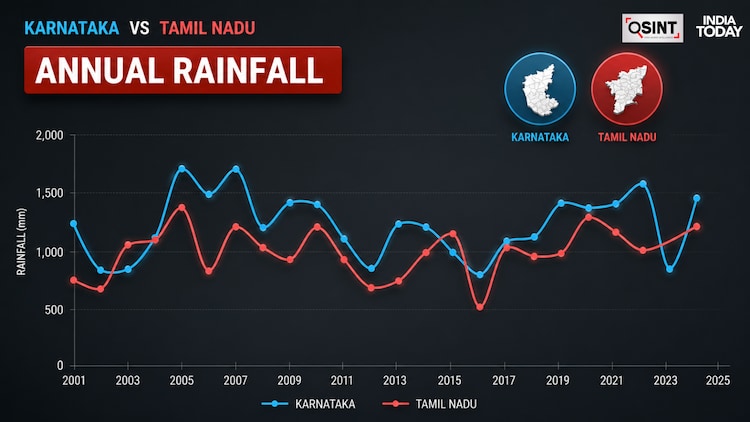
The two states face different forms of water vulnerability.
Karnataka says Mekedatu could help Tamil Nadu
Karnataka argues that additional storage would help rather than hurt its downstream neighbour.
Chief Minister DK Shivakumar recently said, “Every drop of water from the Mekedatu project will help farmers in Tamil Nadu and Puducherry. Help us help you.”
The argument is that a reservoir could store water during periods of high flow and help regulate releases downstream.
But that does not fully settle Tamil Nadu’s concern.
Cauvery records show that the total volume received over a year can tell a very different story from the timing of that water.
In 2020–21, 211.315 TMC was realised at Biligundlu against the normal-year prescribed quantity of 177.25 TMC. That was around 19 per cent more water over the full year.
Yet June recorded only 6.204 TMC against 9.19 TMC, around 32 per cent below schedule.
In July, only 11.346 TMC crossed Biligundlu against 31.24 TMC - a shortfall of nearly 64 per cent.
Higher flows later in the year eventually pushed the annual total comfortably above the prescribed quantity.
The finding is important.
Annual flows above the prescribed quantity can coexist with severe monthly shortfalls.
There is also another gap in the assessment of Mekedatu.
In an August 3 reply to Parliament, the Jal Shakti Ministry said, “No independent hydrological modelling has been carried out by the Central Water Commission.”
It said the CWC instead examines and reviews hydrological studies submitted by the project authority during techno-economic appraisal.
That leaves a critical question resting on studies submitted by the project authority rather than on an independent CWC model: how a reservoir capable of storing 67.16 TMC could affect the timing and pattern of downstream flows.
This does not establish that Mekedatu would create such shortages.
The 2020–21 shortfalls occurred without the proposed reservoir. Nor does the government’s statement mean that downstream timing has not been examined in studies submitted by Karnataka.
What it establishes is narrower: the CWC has not carried out its own independent hydrological modelling of the project.
But the historical record does show why assurances about the total quantity eventually reaching Tamil Nadu do not, by themselves, resolve the argument over upstream storage.
Tamil Nadu’s objection centres on precisely that additional ability to regulate flows.
It argued before the Supreme Court that it was entitled to an “uncontrolled flow of water” and that another upstream dam could adversely affect that flow.
Even if approved, Mekedatu would not give Karnataka unrestricted control over Tamil Nadu’s legal share. Its operation would remain within the Cauvery water-sharing framework overseen by the Cauvery Water Management Authority and the Cauvery Water Regulation Committee, including prescribed flows measured at Biligundlu.
The Supreme Court has also not settled the underlying disagreement.
In November 2025, it called Tamil Nadu’s challenge “premature”, saying the CWC must first examine the DPR along with the views of the CWMA and CWRC.
The Cauvery’s unresolved question
The dispute stretches from the 1892 and 1924 Mysore-Madras agreements to the Cauvery tribunal and the Supreme Court’s 2018 judgment.
Today, Tamil Nadu has 404.25 TMC and Karnataka 284.75 TMC under the allocation framework. At Biligundlu, 177.25 TMC is prescribed in a normal year through a monthly schedule.
Mekedatu does not rewrite those numbers.
What it changes is the geography of storage - where a large volume of Cauvery water could be held before reaching the interstate gauge.
And the flow records show why that matters.
A year in which total flows ultimately exceed the prescribed quantity can still contain months when considerably less water arrives than scheduled.
That is the fault line running through Mekedatu.
For Karnataka, the reservoir is a way to store water during high-flow periods while meeting Bengaluru’s growing water needs.
For Tamil Nadu, the concern is what changes when another large storage structure sits upstream of the point on which its scheduled deliveries depend.
More than a century into the Cauvery dispute, the numbers governing the river are clearer than they once were.
The unresolved question is no longer only how much water crosses the border, but when it gets there.