PM Modi gifts Thirukkural to Putin. There's a fascinating Russian connection

PM Modi gifted Vladimir Putin a Russian edition of the Thirukkural, featuring the Tamil original, transliteration and Naira Mkrtchyan's translation. Presenting the book, PM Modi highlighted its timeless wisdom and expressed hope that it would inspire readers across Russia.
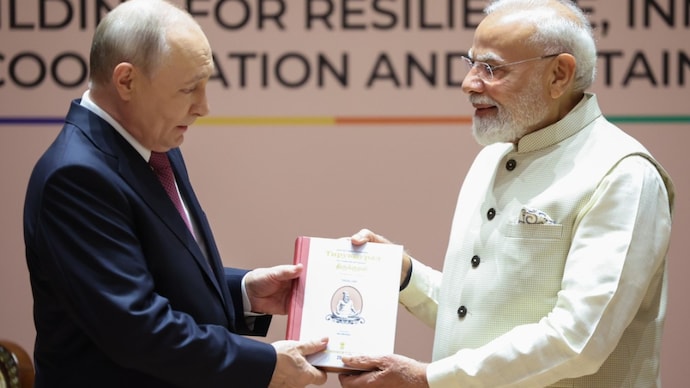

Prime Minister Narendra Modi gifted Russian President Vladimir Putin a Russian translation of the ancient Tamil classic Thirukkural during their meeting on the sidelines of the BRICS Summit in New Delhi.
The gift carried particular significance because of the text’s longstanding, though lesser-known, connection with Russia, where Indian philosophy has influenced writers and intellectuals for centuries.
Published by the Central Institute of Classical Tamil in 2026, the edition includes the original Tamil verses, their transliteration and a Russian translation by Naira Mkrtchyan.
Presenting the book, PM Modi highlighted its timeless wisdom and expressed hope that it would inspire readers across Russia.
“I hope this book helps strengthen our people-to-people connections,” he said.
THIRUKKURAL’S RUSSIAN CONNECTION
Russian interest in Indian philosophy and literature can be traced to at least the 17th century. The Thirukkural later attracted the attention of Russian scholars and literary figures through its translations into European languages.
Leo Tolstoy, one of Russia’s most celebrated writers, is believed to have encountered the Thirukkural through an early translation in the 19th century. Its emphasis on virtue, compassion and non-violence is said to have influenced his philosophical writings.
Accounts also link Tolstoy’s engagement with the text to his correspondence with Mahatma Gandhi in the early 20th century. Some claim that Tolstoy recommended the Thirukkural to Gandhi and that its teachings shaped Gandhi’s ideas on non-violence. However, the extent of this influence has not been conclusively established by historians.
By presenting Putin with a Russian edition, PM Modi placed this old literary connection within the modern India-Russia relationship.
THREE PILLARS OF THIRUKKURAL
Written by Tamil poet-philosopher Thiruvalluvar, the Thirukkural contains 1,330 couplets spread across 133 chapters. Its philosophy is organised around three broad themes.
Aram (Dharma): The first 38 chapters deal with virtue, duty, domestic life and righteous conduct.
Porul (Artha): Chapters 39 to 108 focus on society, economics, statecraft, politics and governance.
Inbam (Kama): The final 25 chapters explore love, affection and relationships.
Interestingly, these three pillars broadly mirror the Hindu concepts of dharma, artha and kama, but leave out moksha, or spiritual liberation.
Believed to have been composed between 300 BCE and 500 CE, the Thirukkural is among the most influential works of classical Tamil literature.
Its reflections on ethics, governance and human relationships have helped it travel far beyond Tamil Nadu through translations into numerous languages, including Russian.
PM MODI'S CONNECTION WITH THIRUKKURAL
PM Modi’s decision to gift the Thirukkural to Putin is part of a broader effort to use the Tamil classic as an instrument of cultural diplomacy.
The Prime Minister has frequently quoted the text in speeches and presented its translations to foreign leaders.
During a visit to Tashkent in August 2026, Modi proposed translating the Thirukkural into Uzbek to introduce its practical and non-sectarian teachings to Central Asia.
In Papua New Guinea in May 2023, Modi and Prime Minister James Marape launched a Tok Pisin translation of the text during the FIPIC Summit. He had similarly unveiled a Thai translation at the “Sawasdee PM Modi” event in Bangkok in 2019 and presented Japanese editions to then Prime Minister Shinz Abe.
The Prime Minister has also invoked the text at significant moments at home.
Addressing soldiers in Leh amid the 2020 border standoff with China, he quoted a couplet describing valour, honour, dignified conduct and trustworthiness as the four foundations of a strong army.
During his 2019 Independence Day address, PM Modi cited Thiruvalluvar’s “Neer indri amayadhu ulagu”, meaning the world cannot exist without water, while announcing the Jal Jeevan Mission.