

 Handcrafted ByOur Editors
 One job, one salary, one identity: Why it's the right time to end career monogamy

For generations, the acceptable work culture involved finding one stable job, staying loyal, climbing the ladder and building your identity around it. But AI, layoffs, changing skills and younger workers, and shaky job security are challenging that model. From skill stacking and personal brands to portfolio careers and multiple income streams, is it time to stop being monogamous with our jobs?

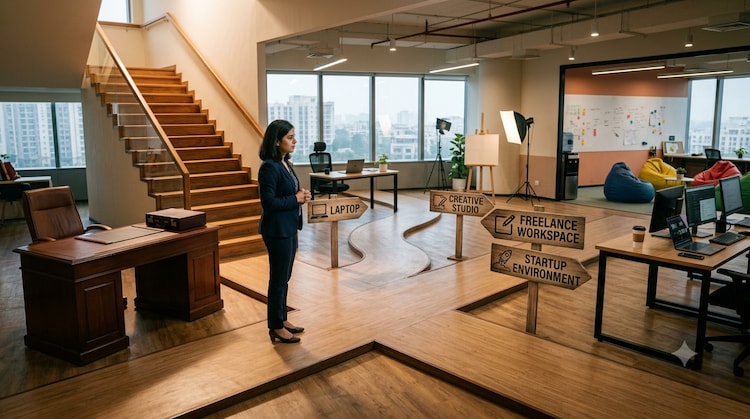
For decades, a good career meant finding one stable job, growing within it and tying much of your identity to it. AI, changing skills, younger workers, and shaky job security are challenging that model. (AI-generated image)

New Delhi,UPDATED: Sep 21, 2026 08:19 IST
Imagine a software engineer who spends weekdays building products, teaches coding on weekends and advises a startup occasionally. Or a designer who works full-time but also sells digital templates and takes on selected freelance projects.
Yet if you ask either person what they do, the answer will probably begin with their full-time job. Everything else is a "side hustle".
Why do we still think a career has to belong to one employer?
For generations, the ideal career was straightforward: study hard, get a stable job, stay loyal, climb the ladder and retire. Beginning and ending your career at a single company was something to be proud of. Your designation became your identity and your years at an organisation became a measure of professional worth.
In today’s world, that bargain is becoming less certain.
The latest Oracle and Adidas layoffs in India are a sharp reminder of why even a "stable" corporate job can no longer be treated as a permanent safety net.
Industries are transforming at breakneck speed, companies are restructuring, skills are becoming outdated faster than ever, and controlling all of these factors like puppets on a string is the ever-looming AI monster.
Younger professionals, including Gen Z, are starting to look beyond the traditional quagmire and asking the most important question -- Why should one employer be the centre of my entire professional life?
Maybe the future of work requires us to become a little less monogamous without workplaces.
THE CAREER MODEL WE INHERITED WAS BUILT FOR A DIFFERENT WORLD
We inherited a work culture built around the idea that one employer could anchor an entire working life. Stability meant staying, loyalty meant longevity, and ambition meant moving steadily up the same ladder.
But professional skills no longer have the same shelf life, and job security seems to come with an expiry date.
The World Economic Forum's Future of Jobs Report 2025 estimates that 39% of workers' existing skill sets could be transformed or become outdated by 2030, while structural changes could create 170 million roles and displace 92 million globally.
That does not mean AI will take everyone's job. But does mean the value of particular skills and roles is being reassessed quickly. You simply cannot count on what you learned at college to take you through to retirement. It probably won’t even buy you 10 years.
Suchita Dutta, Executive Director of the Indian Staffing Federation (ISF), calls diversification "the real career insurance". Depending entirely on one role or competency can become a vulnerability when skills lose relevance.
The alternative to depending on one employer does not have to be constant job-hopping. It can mean diversifying skills, income sources and ways of creating value.
The more unique your skillset mix and personal experience combo, the more value you are likely to have as an individual brand.

THE YOUNGER WORKFORCE IS REWRITING THE DEAL
The Gen Z conversation is often reduced to stereotypes about young people being unwilling to work or stay. But the reality is more complicated.
Deloitte's 2025 Gen Z and Millennial Survey found that only 6% of Gen Z respondents globally considered reaching senior leadership their primary career goal. Work-life balance, learning and career progression featured strongly in what they wanted from work. Career monogamy is not even in their dictionary.
In India, 94% of Gen Z respondents said on-the-job learning was helpful for career growth, while 85% said they participated in learning activities every week.
AI has intensified that need for continuous learning. Deloitte found that 85% of both Gen Z and millennial respondents surveyed in India were using generative AI at work.
The professional identity is therefore shifting from "I am my job title" to something closer to "I am what I know, what I can do and what I am learning."
Shashi Tiwari, CHRO, API Holdings, sees this change clearly. "Younger professionals tend to think about their careers as a portfolio rather than a path," he says. Skills, experiences, exposure and relationships travel with them across roles.
That should not automatically be interpreted as declining loyalty. "What's changed is what they expect in return for it."
Younger professionals increasingly ask whether a move adds to their portfolio faster than staying would. Career identity has shifted "from the badge" of a company to "What can I actually do? What have I built? What am I known for?"

WHAT IF YOUR CAREER IS A PORTFOLIO, NOT A JOB TITLE?
A software engineer who teaches coding, writes about AI and advises startups is not necessarily pursuing three separate careers. Those activities can be different expressions of overlapping skills.
That is where skill stacking -- combining several complementary abilities instead of relying on one core skill -- becomes powerful.
Writing combined with data analysis is different from writing alone. Coding combined with communication creates a different proposition from coding alone. Subject expertise combined with teaching can open opportunities beyond a single job description.
Your employer may own your job. But it does not own the entire combination of things that make you professionally useful or unique.
The same applies to personal branding. In a world where opportunities can come through LinkedIn, freelance platforms, communities or direct networks, being good at something is increasingly only half the equation. People also need to be discoverable for what they can do.
LinkedIn's India data offers a glimpse of this shift. The platform reports a 104% year-on-year increase in members adding "Founder" to their profiles in India. Among Gen Z entrepreneurs in India, 75% report having multiple income streams, compared with 62% of Gen X entrepreneurs.
This is data about entrepreneurs, not all Gen Z workers. But it captures an emerging attitude: a career does not necessarily have to be a single trajectory.
A portfolio career can therefore look very different from the traditional ladder: one primary job, a specialised skill stack, a personal brand, selected freelance work, teaching or a small business, all building on each other rather than existing as unrelated pursuits.
LinkedIn also found that 64% of Gen Z entrepreneurs prioritise freedom and flexibility, ahead of personal growth at 56% and financial wealth at 55%.
What you publish, build, teach or speak about can become evidence of your expertise, strengthening a professional identity that travels with you rather than staying behind when you change jobs.

THE CREATOR ECONOMY SHOWS HOW SIDE SKILLS BECOME CAREERS
The creator economy is one of the clearest examples of this shift.
Skills that professionals once used informally after work are increasingly becoming sources of income, employment and business creation.
Indeed Hiring Lab data shared for this feature shows that creator-related job postings in India grew 919% between 2020 and early 2026.
Saumitra Chand, Career Expert at Indeed, says the bigger shift is towards "portfolio skills rather than simply multiple jobs".
"As AI reshapes roles and accelerates the pace at which skills evolve, professionals are increasingly thinking about building a portfolio of capabilities, rather than depending on one role or one area of expertise," he says.
The future, then, may not be about everyone taking a second job. It may be about developing capabilities that can travel between employment, freelancing, entrepreneurship and creative work.

WHY MOONLIGHTING NEEDS A NEW CONVERSATION
India got an early glimpse of this debate in 2022, when employees taking second jobs or freelance assignments triggered a major corporate discussion around loyalty.
Swiggy's moonlighting policy allowed employees to take up external projects under certain conditions, provided they did not interfere with primary work or create conflicts of interest.
Infosys, meanwhile, warned employees against undisclosed dual employment while allowing some forms of freelance work subject to restrictions.
The question became: can you genuinely belong to one company while working for another?
Perhaps "belonging" is the concept that needs reconsideration.
If someone completes their contracted work, protects confidential information, avoids conflicts and does not use one employer's resources for another, does earning from an additional skill automatically make them disloyal?
The answer depends on contracts, industries and circumstances. Moonlighting can create real problems around confidentiality, intellectual property, competing employment and performance.
And it is not an unstoppable movement. Chand says Indeed's earlier India research in tech found that support for moonlighting had cooled, with the share of IT workers in favour falling from 43% to 36%. Among those open to it, drivers included additional income, fear of job loss and access to freelancing platforms.
"So this isn't really a one-way growth story," he says. "It is evolving with economic pressure, employer policy and worker fatigue."
The future may therefore not be a world where everyone has two jobs. It may be one where legitimate outside work is no longer automatically treated as betrayal.
EMPLOYERS MAY NEED TRUST WITH CLEAR BOUNDARIES
Employers have legitimate concerns. Confidentiality, intellectual property, conflicts of interest, company resources and performance obligations all matter.
But a blanket ban on every form of outside activity may miss the bigger issue.
Chand says the bigger challenge is building workplaces that offer learning, flexibility, trust and purpose, so employees feel less need to seek fulfilment elsewhere.
Shashi Tiwari similarly distinguishes between activities that help someone grow and those that create genuine organisational conflict. His preferred model is "clear principles, transparency and accountability", moving "from a culture of control to one of trust with clear boundaries."
That could mean disclosure rules, defined conflicts of interest, protection of intellectual property and clarity around working hours and performance.
YOUR EMPLOYER CAN MATTER WITHOUT DEFINING YOU
There is also a danger of turning all this into another piece of hustle culture.
The point is not that everyone should work two jobs, become a creator and monetise every spare hour. A portfolio career should not mean having five employers breathing down your neck instead of one.
It could simply mean having more control over how your skills are used, where your income comes from and which opportunities you accept.
India's expanding flexi and gig economy is part of this shift. NITI Aayog has projected that the country's gig workforce could grow from 7.7 million in 2020-21 to 23.5 million by 2029-30. That does not automatically mean better work or greater security, but it shows that a single permanent employer is no longer the only structure through which work is organised.

You can care deeply about your work without believing your job is your worth. You can be proud of your company without assuming it will be part of your life forever.
Tiwari describes today's career as less like a ladder and more like a lattice: people can move up, across, sideways, sometimes out and back.
That may be the real shift beneath moonlighting, side hustles, skill stacking and portfolio careers.
The individual is becoming the unit of the career.
The job becomes one part of the portfolio, skill stacking becomes the engine, and personal brand becomes the bridge between what you can do and who knows you can do it.
Companies, salaries, and stable employment still matter. But the relationship between worker and employer may become less about permanent belonging and more about mutual value.
You bring skills, experience and time. The company brings money, opportunities and learning. When the exchange stops making sense, either side can move on.
So maybe we do not need to break up with the nine-to-five.
We just need to stop asking it to be everything.
Your salary can come from your job. Your confidence can come from your craft. Your next opportunity can come from a skill you are still learning. Your sense of who you are can come from a life that exists well beyond the office.
Career security in the age of AI may not mean finding one employer to stay with forever. It may mean becoming someone who has more than one way to remain valuable.
- Ends