
Bengaluru landlord or software engineer? Highest-paying careers list has a surprise

Bengaluru's highest-paying jobs list is turning the usual career hierarchy upside down. While software engineers chase skills and salary hikes, PG owners, landlords, water tanker operators and brokers are being highlighted for profiting from the city's growing demand for housing and essential services.

Bengaluru's 'highest-paying careers' list has PG owners, landlords ahead of software engineers (AI generated image)

New Delhi,UPDATED: Aug 27, 2026 12:16 IST
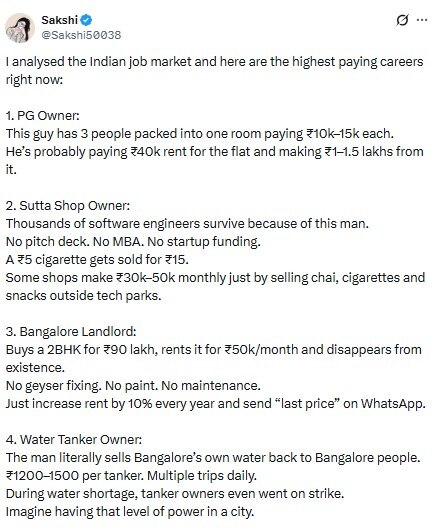
What if you didn't need an IIT degree, a coding job or years of DSA preparation to make serious money? A tongue-in-cheek ranking has posed exactly that question, placing PG owners, Bengaluru landlords, water tanker operators and neighbourhood shopkeepers above software engineers.
Sakshi, a tech and AI commentator, took to X with an unconventional list of India’s highest-paying careers, highlighting the unlikely businesses making money from Bengaluru’s housing crunch, water shortages and growing urban demand.
1. PG OWNER: THE ROOM IS THE BUSINESS
Taking the top spot is the humble PG owner. The calculation, as Sakshi presents it, is simple: "This guy has three people packed into one room paying Rs 10k–15k each." If the owner is paying around Rs 40,000 in rent, she estimates that the setup could bring in Rs 1–1.5 lakh a month.
The figures are clearly part of the joke and can vary significantly depending on rent, occupancy, property size and operating costs. But the underlying observation is familiar in Bengaluru: with thousands of people arriving for work every year, affordable accommodation is always in demand. As Sakshi puts it, the PG owner may be one of the biggest beneficiaries of the city's housing crunch.
2. TEA AND CIGARETTE STALL OWNER: THE UNSUNG TECH ENABLER
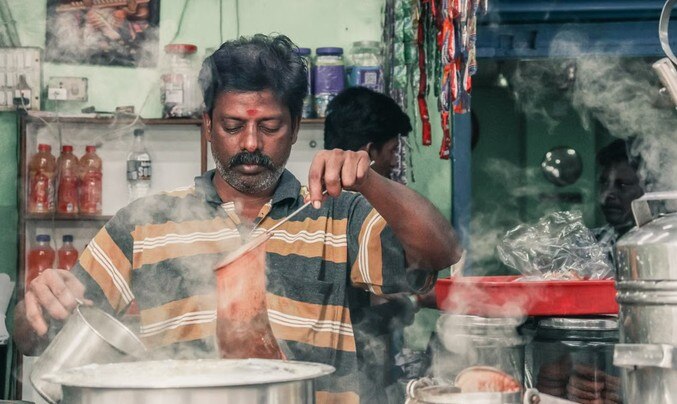
At number two is the neighbourhood sutta-and-chai shop owner, particularly the one strategically located outside a technology park. Sakshi calls him one of the "unsung enablers" of the tech economy, with thousands of software engineers depending on him for their regular chai, cigarettes and snacks.
The business model, as she describes it, is remarkably simple: "A Rs 5 cigarette gets sold for Rs 15." Add chai, snacks and other quick purchases, and some shops can make Rs 30,000–50,000 a month, according to her estimate. "No pitch deck. No MBA. No startup funding." Just a small shop, a steady stream of customers and a location surrounded by tech workers.
3. BENGALURU LANDLORD: BUY, RENT, REPEAT
Coming in at number three is Bengaluru's most recognisable character: the landlord. The formula, as Sakshi jokes, is simple, "Buy a 2BHK for Rs 90 lakh, rent it for Rs 50k/month, increase rents annually" and communicate with tenants by sending the occasional "last price" on WhatsApp.
No DSA questions, no performance reviews and no late-night deployments. Just rental income, property appreciation and a maintenance call now and then. The joke works because Bengaluru's booming housing demand has made rental property a lucrative part of the city's economy.
4. WATER TANKER OWNER: SCARCITY HAS ITS OWN ECONOMICS
The fourth spot goes to water tanker operators. Sakshi puts it bluntly: "The man literally sells Bangalore's own water back to Bangalore people." At around Rs 1,200–1,500 per tanker and with multiple trips a day, the business can become particularly lucrative when water supply is disrupted.
Bengaluru's recurring water shortages have repeatedly brought tanker operators into focus. As Sakshi notes, some even went on strike during a shortage, a striking example of how control over an essential resource can translate into considerable bargaining power.
5. BROKER: GETTING PAID FOR THE PAIN
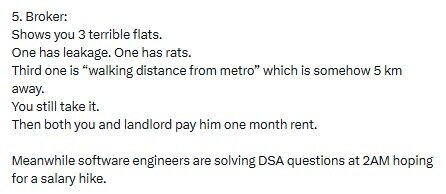
And then there is the broker. The experience, according to the post, is almost universal: one flat has leakage, another has rats, while the third is supposedly "walking distance from the metro" — only for that distance to somehow turn out to be 5 km.
You eventually take it anyway, and then comes the commission: roughly one month's rent, with Sakshi joking that both the tenant and landlord may end up paying. In this version of the Bengaluru housing story, the broker gets paid for navigating a market that most tenants would rather avoid altogether.
MEANWHILE, SOFTWARE ENGINEERS ARE SOLVING DSA
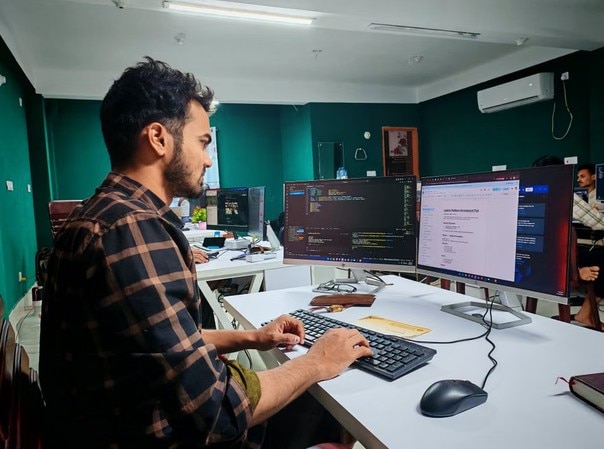
And that's where the punchline lands. While PG owners collect rent, landlords raise prices, tanker operators sell water and brokers collect commissions, software engineers are still awake at 2 am solving DSA questions and hoping the effort eventually translates into a better job or a salary hike.
One X user joked that software engineers "really chose the hardest path" and should have spent their DSA preparation time buying a water tanker instead.
Another summed up Bengaluru's real "product-market fit" as "chai, property and 'distance from metro' math" rather than AI or software.
The reactions underline why the post struck such a nerve. It isn't really suggesting that a PG owner will necessarily out-earn a software engineer. Instead, it pokes fun at the enormous effort people put into building careers while some everyday businesses can benefit from something much simpler: demand.
WHEN ASSETS BEAT SKILLS
The figures are estimates, not a formal analysis of income, and actual earnings can vary after rent, maintenance, taxes and other costs. But beneath the humour is a simple Bengaluru reality: the most valuable businesses are often those serving persistent demand --- housing, water, food and convenient locations.
The PG owner has tenants, the landlord has property, the tanker owner has water, while the software engineer has a laptop, DSA questions and another appraisal cycle. The list may be a joke, but it suggests that in a fast-growing city, owning the right asset can sometimes be as valuable as having the right skill.
(Disclaimer: This story is based on a social media post. The details, including figures, background, and outcomes, have not been independently verified by India Today. The article is intended for informational purposes only, and readers are advised to exercise their own discretion before drawing conclusions or making decisions based on the content.)
- Ends