

The management diet: Why companies want fewer managers, not less leadership
Microsoft's latest layoffs have put managers under the spotlight, but AI is not replacing them altogether. Instead, companies are cutting unnecessary management layers while redefining what leadership looks like. Experts explain why this shift is happening, what it means for careers, and the skills professionals will need to stay relevant.
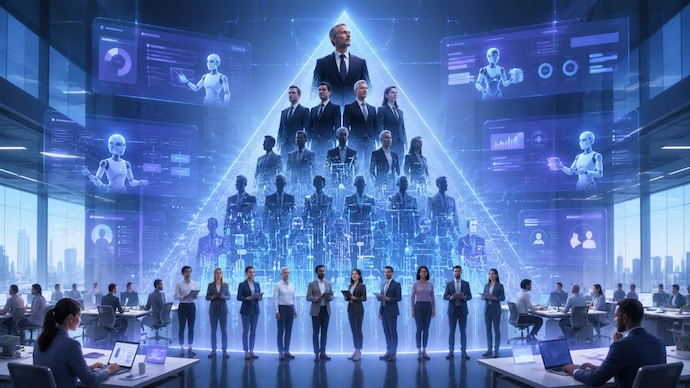
Microsoft's latest layoffs have put managers under the spotlight, but AI is not replacing them altogether. Instead, companies are cutting unnecessary management layers while redefining what leadership looks like.

New Delhi,UPDATED: Jul 10, 2026 16:34 IST
The traditional corporate ladder is getting a makeover.
For decades, career growth followed a familiar path. Employees joined as executives, became team leads, moved into middle management and climbed steadily towards senior leadership.
Today, that journey is becoming less predictable.
Microsoft's latest round of job cuts has once again put managers in the spotlight. Reports suggest the company is reducing management layers as it doubles down on artificial intelligence, echoing a trend already visible at companies such as Amazon, Meta and Shopify.
Across the technology industry, businesses are embracing flatter organisations with fewer layers between frontline employees and top leadership.
The shift has earned a nickname: the management diet.
But despite the headlines, experts say companies are not trying to get rid of managers altogether. They are rethinking what managers should actually do.
THIS IS ABOUT MORE THAN AI
"It reflects a wider shift in the way organisations are restructuring themselves to become more responsive, flexible and results-driven," says Gaurav Sharma, CHRO at True Balance.
According to him, organisations are asking whether every management layer is creating enough value by solving complex problems, mentoring employees and contributing to business growth.
Artificial intelligence is certainly playing a role. Managers are increasingly using AI to automate routine work, from administrative tasks and project coordination to assigning responsibilities. But Sharma believes the bigger shift is organisational redesign rather than technology alone.
Abhijeet Ghosh, CHRO at HireYou, agrees that companies are becoming more deliberate about reducing organisational complexity.
"In the last two years, companies are choosing a different strategy to make themselves faster and pursue agility," he says.
"AI acts as an administrative buffer which allows organisations to deliberately eliminate management layers without hampering operational oversight, quality control and team coordination,” he adds.
AI IS TAKING OVER ROUTINE MANAGEMENT TASKS
Much of what occupied middle managers for years is now being assisted by AI.
Performance dashboards update automatically. Meeting summaries are generated within seconds. Project progress can be tracked in real time, while AI tools help with workforce planning, scheduling, onboarding support and routine reporting.
"AI is increasingly automating data-intensive, repetitive and routine tasks that middle managers traditionally handled," says Sharma.
Ghosh points to performance tracking, resource allocation, scheduling and compliance monitoring as some of the responsibilities that are becoming increasingly automated.
That does not mean managers are becoming redundant.
"AI cannot be a substitute for judgement, empathy and contextual understanding," Sharma says. Those qualities remain essential for resolving conflicts, coaching employees, building team culture and leading organisations through periods of change.
THE MANAGER'S JOB IS EVOLVING
If AI is taking over repetitive coordination, what happens to managers?
"The role of managers is evolving, instead of vanishing," Sharma says.
Instead of supervising everyday workflows, future managers will spend more time developing talent, solving strategic problems, driving innovation and helping teams work across functions.
The distinction is becoming increasingly important.
Managers whose jobs revolve around approvals, monitoring routine workflows and collecting updates may find parts of their work automated. Those who combine business understanding with leadership, adaptability and strategic thinking are likely to become even more valuable.
WHAT THIS MEANS FOR YOUR CAREER
The biggest change may not be fewer jobs. It could be fewer traditional promotions.
For young professionals, becoming a manager is no longer the only definition of career success.
"Career growth is not defined solely by transitioning into people management," Sharma says. Instead, professionals should focus on building expertise, staying adaptable and solving complex business problems.

Ghosh believes employees should rethink the idea of climbing the corporate ladder.
"Instead of chasing a manager title, success will mean leading bigger projects, mastering specialised skills that AI can't replace and taking different roles to understand how the whole business works," he says.
The employees likely to stand out are those who continuously learn, understand AI tools, collaborate across teams and take ownership of business outcomes rather than simply managing people.
WILL INDIA FOLLOW THE SAME PATH?
Experts believe Indian companies will move in the same direction, although not at Silicon Valley's pace.
Sharma expects flatter organisational structures to become more common, especially among digital-first companies, while businesses with large, distributed workforces are likely to transition more gradually.
Ghosh predicts Indian firms will adopt a hybrid approach, balancing global pressure for leaner structures with the country's long-standing preference for traditional corporate hierarchies.
The destination, however, appears similar.
Companies still need leaders. What they need fewer of are managers whose primary role is to supervise routine work.
As AI takes over coordination and administration, the managers who thrive will be those who coach people, make difficult decisions, build trust and help teams navigate constant change. In the workplace taking shape today, leadership is becoming less about hierarchy and more about impact.
- Ends