
Ladies & Ladies: Yash, the toxic objectification of women and myth of female gaze
Three years after promising a female gaze, Toxic's 'Ladies & Ladies' teaser introduces women only through Yash's desire - mistaking objectification for empowerment.

A teaser introducing the women in Yash's Toxic was unveiled on July 1.

Chennai,UPDATED: Jul 1, 2026 17:34 IST
Three years. That is how long it took for Toxic to finally show the women who were promised to be at the centre of its "female gaze" narrative. And when the nearly two-minute teaser arrived on July 1, it did not answer the biggest question around the film – it only made it louder: Where are the women?
Ironically, the first thing the teaser establishes is that this isn't really about the women at all. It's about Yash.
Not because he dominates the screentime, although he certainly does. But because most of the nearly two-minute promo exists only to show how women desire him. They undress for him. They fight with him but end up on their knees in front of him. They even define themselves through him. Even in a teaser titled Ladies & Ladies, the women never become subjects of their own story. They remain satellites revolving around one man. For a film that has spent three years selling itself as a gangster drama seen through a woman's perspective, that is a staggering contradiction.
This becomes even more problematic as you go deeper into how it all began.
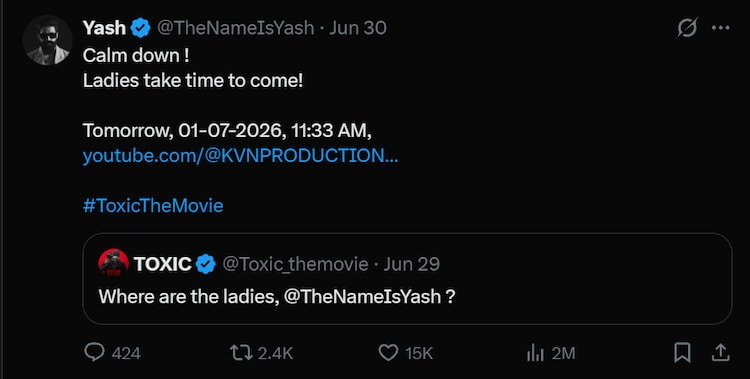
On June 30, teasing the release of the women's video, Yash captioned his post: "Ladies take time to come!" Harmless banter? Maybe. But it also sets the tone.
It is 2026, and one of Indian cinema's biggest stars thought a potshot at women – for taking time – was the right note to hit while introducing them to the audience. The irony that the makers themselves took three years to give these women even a teaser apparently slipped their minds.
That caption isn't just a throwaway social media line. It subtly reveals the attitude the teaser goes on to reinforce.
And then there is everything that this teaser shows.
The July 1 video opens with a bold disclaimer about keeping "everyone" away. You understand why within seconds. The camera tells you exactly whose perspective this film privileges. It doesn't introduce the women. It introduces their bodies.
The camera pans to women undressing. Then to Yash making out with one. Then another. Then more of the same, repackaged with a woman's voice-over that wants very much to sound like commentary. It also makes you question: Is this the female gaze the film promised?
We learn almost nothing about these women. We don't know what they want or who they are. We only know how they look around Yash.
The voice-over tries hard. "Love makes monsters of women," it says – a line that, on its own, carries genuine weight. On paper, it is an intriguing idea. The suggestion that love can consume, corrupt and destroy women is fertile emotional territory. But the visuals tell a different story. The camera shows almost no interest in who these women are. It is interested in how they look – their backs, feet, bodies and their desire for Raya. Their identities remain a mystery.
That isn't the female gaze. It is the same old male gaze dressed up with a female narration.
Then comes the line that collapses whatever the teaser was attempting to build: "We are fighting for his scraps of his devotion." Read that again. The women of this film, in the teaser designed to centre them, are defined by their competition for a man's attention. Not their own desires or contradictions, but his devotion.
The women don't exist independent of Raya. They exist because Raya exists. Remove him from the equation and the teaser leaves them with almost nothing.
Perhaps the biggest misunderstanding here is what "female gaze" actually means. For years, filmmakers have increasingly used the phrase as shorthand for stories centred on women. But simply placing women on screen does not create a female gaze. Neither does giving them a voice-over while the camera continues to consume their bodies.
The female gaze asks what women see. This teaser is interested only in how women look. There is an enormous difference between the two.
The closing line, "Don't forget the predictability of men and their cocks", is the final nail in the coffin. The visuals of Yash's character fighting the women positions itself as a provocation aimed at male behaviour. While the dialogue mocks men for reducing women to objects of desire, the visuals are busy doing precisely that.
It is simply sexist, yes, but it is sexist while insisting it is doing the opposite. A film that openly objectified its women without the "female gaze" framing would at least be honest. What Toxic is offering instead is the same product in different packaging: women as objects of desire and obsession, now with voice-over that sounds like critique.
The deceivers who were deceived
There is one more irony worth mentioning. The teaser positions its women as dangerous – mysterious, manipulative, capable of destruction in the few frames that it manages to show without objectifying them. The framing wants you to see them as the deceivers in this world, women who seduce and scheme and consume.
But look at what the teaser actually shows: women consumed by one man's orbit and fighting over scraps of his attention. These are not deceivers. These are women who were deceived – by the writers (Yash and Geetu Mohandas) who promised them a film with their perspective and delivered the same old story on a more expensive budget.
The teaser calls them deceivers. But the only deception on screen is the one being done to them.
The question the teaser leaves behind
Throughout those one minute and 44 seconds, the women of Toxic exist entirely within Yash's world – reacting to him, desiring him and competing for him. The camera follows his gaze, not theirs. The story, as presented, belongs to him. The women are not driving this film. They are just there to help him take it forward.
For a project that announced itself as a gangster drama seen through a woman's perspective, the teaser raises an uncomfortable but unavoidable question: is Toxic actually examining male power or is it just making male power look more glamorous by giving it a female voice-over?
Three years later, that question deserves a straight answer. And this teaser is not one.
- Ends