
Karavali review: Prajwal-Raj B Shetty's film offers thrills but feels incomplete
Karavali movie review: With beautiful visuals and intriguing ideas, Gurudatta Ganiga's coastal drama, starring Prajwal Devaraj with Raj B Shetty in an extended cameo, offers moments of genuine thrill but ultimately feels incomplete due to its lack of clarity and depth.
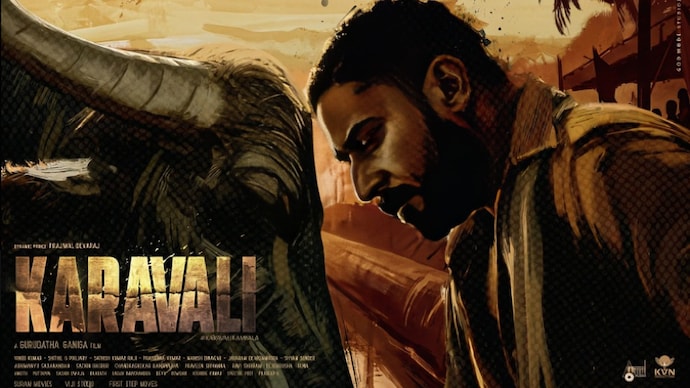

Imagine The Lion King, but with Rafiki the mandrill at its centre, not the heroic Mufasa or the prodigal heir Simba. What if the beloved supporting character is driving the story across timelines? That's the closest comparison to Gurudatha Ganiga's Karavali, a coastal mystery starring Prajwal Devaraj and Mithra, with Raj B Shetty in an impactful extended cameo.
Ambitious in its storytelling and rich in atmosphere, Karavali constantly hints at something profound. With an intriguing plot, stunning visuals and a glimpse into Karnataka's coastal heritage through Kambala, the film has all the ingredients of a compelling drama. Yet, it ultimately feels incomplete, unable to fully realise its abundant potential, another Kannada film in 2026 that promises far more than it delivers.
What does Karavali get right, and where does it lose its way? Let's find out.
Dhananjaya (Prajwal Devaraj)—the film's Simba—is a cattle breeder who shares an almost mystical bond with animals, especially buffaloes. Raised by his grandparents, Dhana's world is turned upside down when his beloved cow, Bhoomi, named after his late mother, is stolen. His search leads him to Karnataka's coastal belt, Karavali, where he stumbles upon Kambala, the traditional buffalo race deeply rooted in the region's culture.
Just before one of the races, Dhana manages to calm Mahabala's (Mithra) restless buffaloes, leading them to a historic victory—their first in three decades. The win brings Dhana closer to Mahabala, the film's Rafiki-like figure, but also puts them on a collision course with Doddavru (Ramesh Indira), the powerful village landlord who has dominated Kambala for over 30 years.
As the narrative unfolds, Mahabala's rivalry with Doddavru is revealed to stretch back generations and be deeply tied to the legendary Kambala racer Mahaveera (Raj B Shetty), the film's equivalent of Mufasa. Through intertwining timelines, Karavali explores legacy, friendship, destiny and a prodigal son's return to his roots. The premise is compelling, but uneven execution and a lack of narrative clarity prevent these ambitious ideas from coming together.
Gurudatha Ganiga deserves credit for conceiving a genuinely compelling story, using Kambala—a traditional sport that gained nationwide recognition after Rishab Shetty's 2022 blockbuster Kantara—as the backdrop for a tale of ego, pride, legacy and the politics surrounding heritage. On paper, Karavali has all the makings of an engrossing generational drama.
The screenplay, however, is the film's biggest stumbling block. For a project that reportedly spent nearly three years in production, Karavali feels surprisingly incomplete. Its brisk runtime of just over two hours leaves little room for emotional beats to land, rushing through pivotal moments without giving them the pay-off they deserve. As a result, none of the three central characters—Dhananjaya, Mahabala or Doddavru—receives the depth their arcs demand.
Doddavru is introduced as a layered antagonist driven by pride, entitlement and an obsession with preserving his dominance, but the screenplay offers little insight into what truly motivates his actions. The same problem extends to Mahabala and Dhananjaya. Several crucial emotional and narrative developments are expected to be accepted rather than experienced, leaving noticeable gaps in the storytelling. These missing links leave the film feeling underdeveloped and expose a screenplay that never fully finds its direction.
Mahaveera's legend is one of Karavali's most intriguing ideas. Long before the character appears on-screen, the film surrounds him with an air of mystique. Who is this legendary Kambala racer who continues to command reverence three decades after his death? Every mention of his name adds to the anticipation, making his eventual introduction one of the film's most awaited moments.
Unfortunately, that anticipation isn't rewarded. After all the meticulous build-up, Mahaveera is reduced to little more than a hardworking racer, with the film barely showcasing the feats that earned him his legendary status. Instead of witnessing why he became folklore, the audience is simply asked to believe it. The disconnect between the myth the film creates and the reality it presents significantly dilutes the emotional impact of the story.
A useful comparison would be Baahubali. When Mahendra Baahubali is on-screen, he remains the emotional anchor of the narrative. Once Kattappa begins recounting the legend of Amarendra Baahubali, the film seamlessly shifts its focus to the father before naturally returning to Mahendra in the present, allowing him to carry the story towards its climax. Karavali never achieves that balance.
Dhananjaya, Mahabala and Mahaveera all seem to compete for the role of the story's emotional anchor, leaving the narrative without a clear centre. Whether the film's well-publicised challenges/controversy contributed to this is impossible to say, but the lack of a singular creative vision is difficult to ignore.
Technically, Karavali is one of the more impressive Kannada films of the year. Gurudatha Ganiga experiments with several inventive ideas—smart transitions, multiple-perspective storytelling, and voice-overs that seamlessly bridge scenes. Many of these flourishes are genuinely refreshing. However, the film tries so hard to make every scene stylistically unique that the novelty eventually wears off. Creativity is most effective when it knows where to stop.
Abhimanyu Sadanandan's cinematography is the film's biggest strength. His stunning frames lend both the coastal landscape and the characters a striking sense of scale and gravitas. Sachin Basrur's background score also does much of the heavy lifting, keeping the narrative engaging even when the screenplay stumbles. Pratheek Shetty's editing, however, is inconsistent, with abrupt cuts and uneven pacing preventing the film from flowing as smoothly as it should.
The film's tight runtime leaves little room to develop its characters, limiting the actors in the process. While the story revolves around Prajwal Devaraj, Mithra, Raj B Shetty and Ramesh Indira, Sampada and Sushmitha Bhat are reduced to brief appearances and a token romantic song each.
Mithra is the standout performer. Known largely for his comic roles, he impresses in a layered, emotionally charged part and provides the film with much of its heart. Raj B Shetty lends Mahaveera his trademark gravitas, but the underwritten role doesn't allow him to fully embody the legend the film builds up. Ramesh Indira is effective as the antagonist, while Sampada and Sushmitha Bhat make the most of their limited screen time.
Prajwal Devaraj, however, is let down the most. Despite headlining the film, Dhananjaya rarely feels like its true protagonist. The mismatched dubbing further weakens his screen presence, and although the effort is evident, the screenplay never gives him the opportunity to deliver the kind of lead performance the film demands.
Karavali is a film that's easy to admire but difficult to love. It is packed with compelling ideas, rooted in a fascinating cultural backdrop and elevated by impressive technical craftsmanship. Yet, somewhere between its ambitious vision and uneven execution, it loses sight of the emotional core that could have made it truly memorable.
Gurudatha Ganiga shows flashes of a filmmaker with a distinct voice, but Karavali ultimately feels like a good film trapped inside an incomplete one. With a sharper screenplay and a clearer narrative focus, this could have been one of Kannada cinema's standout films of the year.