
Nasa's Nancy Grace Roman telescope flying to space today. All you need to know

Nasa's Nancy Grace Roman Space Telescope is set to launch aboard SpaceX's Falcon Heavy today. Here's when it will launch and what it will study in the vast vacuum of space.
 Last UpdatedAug 30, 2026 08:00 IST
  Published by
After years of development and testing, Nasa's Nancy Grace Roman Space Telescope is finally ready to leave Earth.
The powerful observatory is scheduled to launch today, August 30, aboard a SpaceX Falcon Heavy rocket, beginning a mission designed to give scientists a much wider view of the universe.
WHEN WILL NANCY GRACE TELESCOPE LAUNCH?
Roman will ride into space on a SpaceX Falcon Heavy, one of the world's most powerful operational rockets.
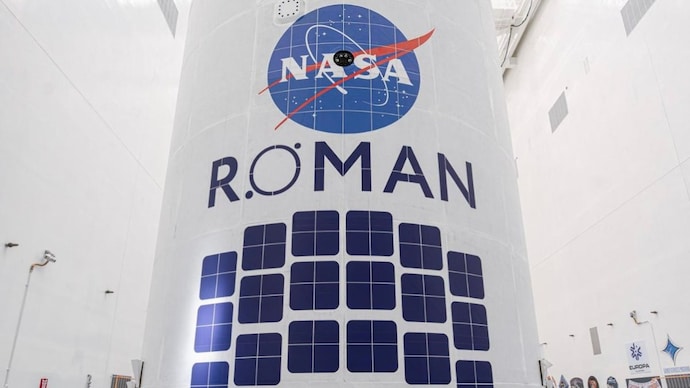
The telescope was recently moved into the SpaceX hangar at Kennedy Space Center inside its protective payload fairing, ahead of integration with the rocket.
The launch is also particularly notable because Roman is taking off about nine months earlier than its previous schedule.
Once separated from the rocket, it will begin a journey to the second Sun-Earth Lagrange point, or L2, about 16 lakh km from Earth.
There, it will have a broad, unobstructed view of the cosmos.
WHAT WILL NANCY GRACE ROMAN TELESCOPE DO?
Roman is not simply another telescope designed to take spectacular pictures. Its biggest advantage is its enormous field of view.
Its 2.4-metre primary mirror is similar in size to Hubble's, but its Wide Field Instrument can see an area of sky at least 100 times larger than Hubble's field of view in a single observation.
That means Roman can survey huge stretches of the universe much faster, creating a vast map of galaxies and cosmic structures.
Over its planned five-year primary mission, Roman will investigate dark energy and dark matter, study how galaxies evolve and search for thousands of planets beyond our solar system.
It will also use a Coronagraph Instrument, a technology demonstration designed to block the glare of stars and directly image some nearby giant planets.
In simple terms, if James Webb is built to zoom in and study cosmic objects in extraordinary detail, Roman is designed to zoom out and survey the bigger picture.
The two observatories are therefore expected to complement, rather than replace, each other.
The telescope is named after Nancy Grace Roman, Nasa's first chief astronomer, whose work helped lay the foundation for Hubble and earned her the nickname "Mother of Hubble".
Now, the telescope carrying her name is set to open another, much wider window on the universe.