
Watch LIVE: Lunar eclipse turns Moon orange as it lines up with Earth and Sun
A deep partial lunar eclipse is turning most of the Moon orange-red on August 28. With 96 per cent of the lunar surface in Earth's shadow, the event resembles an almost total blood moon.
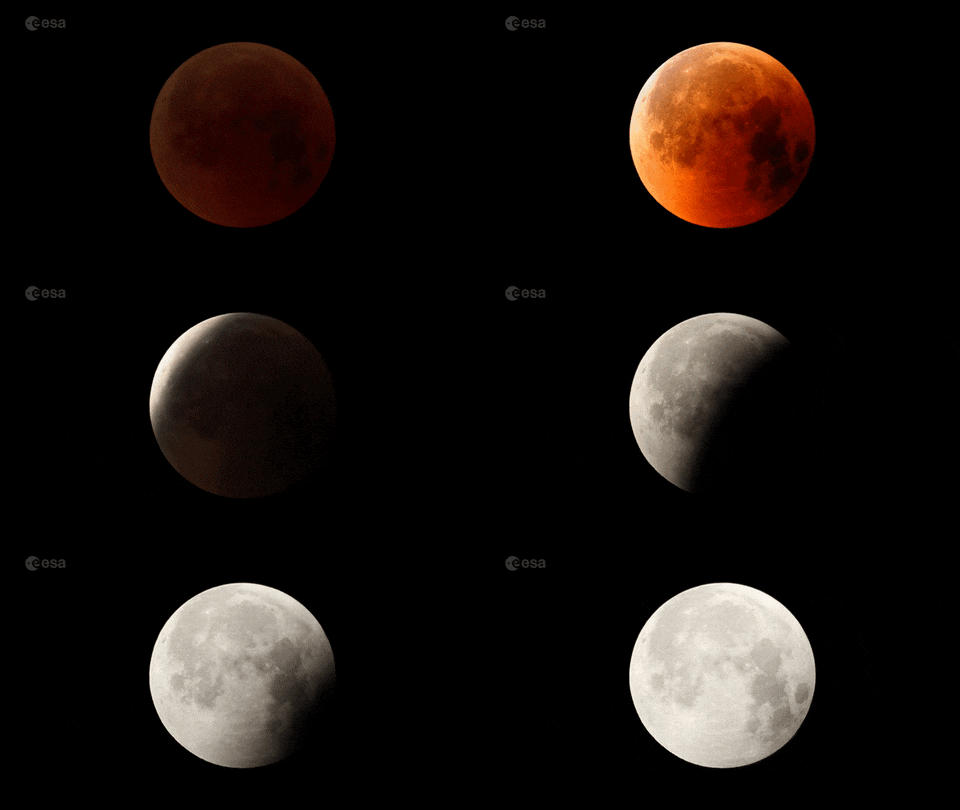

Skywatchers across large parts of the world are witnessing a dramatic celestial spectacle as a deep partial lunar eclipse turns much of the Moon a striking orange-red.
The eclipse, occurring on the night of August 28, is the result of the Moon passing deep into Earth's dark central shadow, known as the umbra.
At its peak, about 96 per cent of the lunar surface will be immersed in the shadow, making this one of the most dramatic partial lunar eclipses in recent years.
WATCH PARTIAL LUNAR ECLIPSE LIVE HERE
A lunar eclipse occurs when the Sun, Earth and Moon line up in space, with Earth positioned directly between the Sun and its natural satellite. During a full Moon, this alignment can cause Earth's shadow to fall across the lunar surface.
But the Moon will not simply disappear into darkness.
As sunlight passes through Earth's atmosphere, shorter blue wavelengths are scattered in different directions, while longer red and orange wavelengths are bent, or refracted, toward the Moon.
This filtered sunlight can give the eclipsed portion of the lunar surface a coppery, reddish or orange glow, the same basic atmospheric effect responsible for colourful sunsets on Earth.
The August event will be a partial lunar eclipse, meaning the Moon will not move completely inside Earth's umbra.
A small sliver will remain directly illuminated by sunlight even at maximum eclipse. Still, with around 96 per cent of the Moon entering the shadow, the spectacle is expected to resemble an almost-total “blood moon.”
The full sequence, including the Moon's gradual movement through Earth's outer and inner shadows, will stretch for more than five hours, while the main partial phase will last for over three hours.
The Americas will be best placed to witness the event, while parts of Europe and Africa will also see at least some phases of the eclipse.
However, India will not be in a favourable position to view this particular event because the Moon will be below the horizon during the key stages.
Unlike a solar eclipse, no special protective eyewear is needed. The Moon can be safely observed with the naked eye, although binoculars or a telescope can reveal the changing colours and sharp boundary of Earth's shadow.
For millions of skywatchers, the event will offer a rare reminder that an ordinary-looking full Moon can briefly become a glowing orange world when the Sun, Earth and Moon fall into almost perfect alignment.