
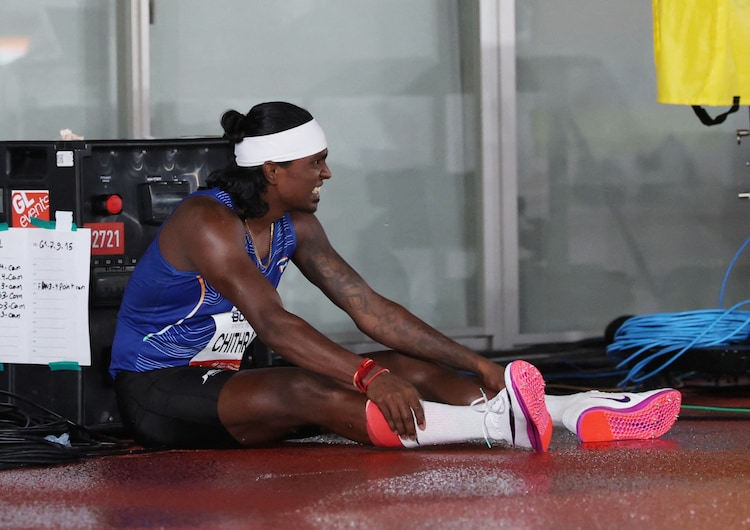
In a battle with destiny: At 33, fate defeats Karthik Unnikrishnan at Asian Games

At 33, Karthik Unnikrishnan finally made his Asian Games debut, only to see rain, injury, and another difficult day on the runway get in his way. Here's the story of how an athlete's life is shaped when destiny refuses to lose.
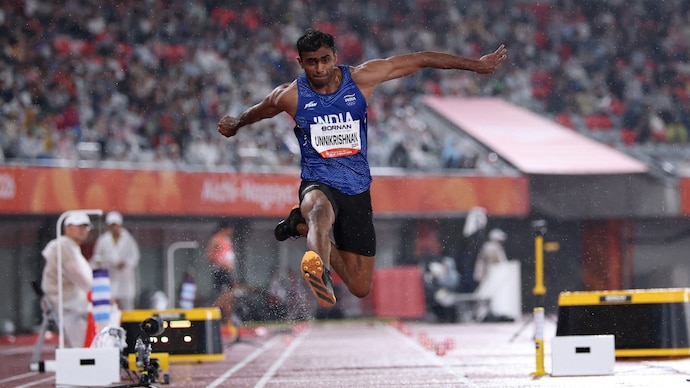
In his debut at the Asian Games, Karthik Unnikrishnan is beaten by destiny. (Reuters Photo)
New Delhi,Sep 27, 2026 13:06 IST Last UpdatedSep 27, 2026 13:06 IST
  Published by
Last UpdatedSep 27, 2026 13:06 IST Published bySaurabh Kumar
Sep 27, 2026 06:00 ISTThe rain had made the runway at the Nagoya City Mizuho Park Athletic Stadium difficult to negotiate. It was coming down steadily as Karthik Unnikrishnan prepared for the biggest competition of his life, at an age when most triple jumpers would be thinking about the end of their careers rather than the beginning of their international ones.
Karthik was 33 and making his Asian Games debut. He had waited years for this opportunity. He had also spent years wondering whether it would ever come.
There was more bad news waiting for him on the runway. Praveen Chithravel, India's 2022 Asian Games bronze medallist, pulled a muscle in the opening round and was ruled out without completing a jump. The responsibility of carrying India's challenge in the event was suddenly on Karthik, who had already arrived in Nagoya knowing that this could be the only major continental Games of his career.
It was hardly the debut he had imagined. But then, very little about Karthik's career has gone according to plan.
HUMBLE BEGINNINGS IN KERALA
Karthik was born in 1993 and has been part of India's triple jump scene since 2015. He is not a late starter in athletics; what slowed him down was everything around the sport. His parents ran a tea shop in Ooty, while Karthik grew up at his maternal grandparents' home in Kerala. He was not particularly good at studies, and when his family saw a six-foot boy who needed direction, sport became the obvious option.
At Parali High School in Palakkad, he was initially put into the hurdles, where he struggled. For a child living away from his parents and finding success in neither studies nor sport, failure quickly hardened into self-doubt. He cried. He felt lonely. When he was eventually moved to the triple jump, success came only in small bursts before stalling again at the state level.
So he made the dream smaller. He stopped measuring himself against national standards and focused on the only thing he thought was within reach: he just wanted to wear the Kerala state jersey.
THE ACCIDENTAL BREAKTHROUGH
Karthik's trajectory shifted when he was called up as an injury replacement for a national meet and unexpectedly finished second. That medal caught the eye of coach P.G. Manoj, who gave him practical advice: secure a job first, then figure out the rest.
That security came through the sports quota in the Indian Air Force. It was a massive moment for a family that initially, and hilariously, thought getting an Air Force job meant he would be flying planes.
Instead, the Air Force gave Karthik something he had never known: an environment where a domestic medal was just the starting point. Surrounded by jumpers looking far beyond state lines, his internal target steadily moved from 15 metres to 16, and then to 17. The Asian Games and the Olympics were no longer distant abstractions.
CARRYING THE BAGGAGE
The problem with allowing yourself to dream bigger is that failure stops being a vague feeling and starts taking very specific shapes.
Over the next few years, circumstance kept pulling the rug out. COVID-19 lockdowns trapped him in Patiala, far from his support system. Post-COVID recovery and the absence of his coach cost him at the Tokyo Olympic trials. An ankle injury at the Commonwealth Games trials sidelined him just after he had joined the elite club of Indians to breach the 17-metre barrier. By 2023, a severe tendon injury disrupted his muscle coordination so completely that he and his physio, Garima, now his wife, had to strip his technique down and teach him how to jump all over again.
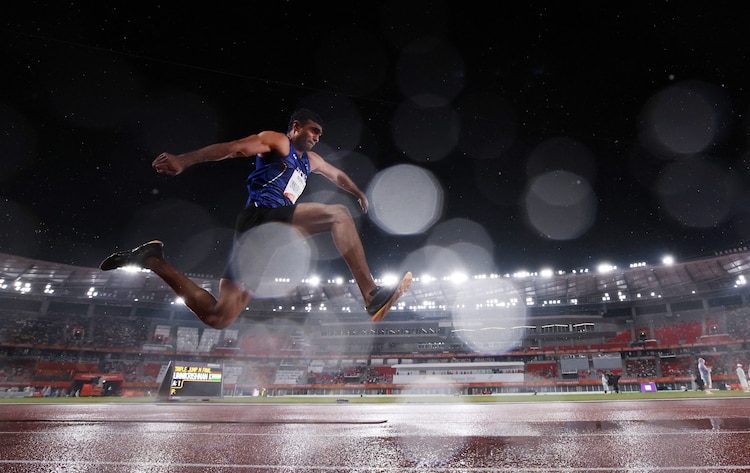
In isolation, each setback had a logical explanation: a bad infection, a torn tendon, bad timing. But stacked together, they became a psychological weight. Each major trial was no longer just a fresh runway; it came loaded with the memory of the last missed flight.
By the time he rebuilt his body to a point where he believed he had a 16.80-metre jump in him, he was 33, carrying a decade of near-misses to Nagoya.
WHEN DESTINY REFUSES TO LOSE
The rain was still falling when Karthik stepped onto the runway for his six attempts. He crossed the 16-metre mark only once, finishing sixth overall.
For most of his life, Karthik has been locked in a personal, quiet war with destiny, an unseen opponent that kept shifting the goalposts every time he got close. We like to think of destiny as an abstract, grand force, but in reality, it is ordinary and relentless. It shows up in an unseasonable downpour, a torn tendon at the worst possible week, an illness that drains your legs right before a trial. It affects every everyday person, but for an athlete like Karthik, those subtle shifts of fate are played out under stadium lights.
Destiny may have claimed the final round in Nagoya, ending what will likely be his last appearance on a stage like this. But Karthik will simply take it in stride, flash that familiar smile, and walk it off. In the end, his story isn't just about an athlete in the rain; it is about the everyday battles the rest of us fight against bad timing, missed chances, and shifted goalposts.
We don't always get to choose how fate plays its hand, but we do get to choose how we walk away from the board, unburdened by the destination, and content with the fact that we had the courage to show up.
- Ends
