
After WhatsApp gets notice, Sridhar Vembu says Arattai will disable usernames
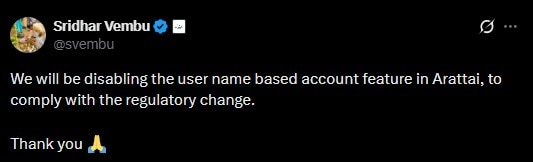
As WhatsApp and other messaging platforms, including Telegram and Signal, receive a notice from the central government over usernames, Zoho co-founder Sridhar Vembu has announced that homegrown app Arattai is set to disable usernames.
As WhatsApp faces a directive to pause username rollout, Sridhar Vembu says that Arattai will disable the feature entirely. (Representational image made with AI)

New Delhi,UPDATED: Jul 3, 2026 08:41 IST
This week has been all about messaging platforms, in particular WhatsApp. Shortly after newly-appointed WhatsApp CEO Kunal Shah announced that the Meta-owned platform was bringing usernames to the app, the Government of India ordered Meta to pause the feature until consultations on its privacy and security implications were completed. While Meta has not announced plans to cancel usernames on WhatsApp, Zoho co-founder Sridhar Vembu has stated that homegrown messaging app Arattai is set to stop having usernames.
On X, Vembu announced that Zoho was going to stop the username feature on Arattai which allows users to connect to others on the app, without sharing their phone number. The Zoho chief wrote on X, “We will be disabling the username based account feature in Arattai, to comply with the regulatory change.”
Arattai was launched in 2021, but went viral late last year as a potential homegrown alternative to WhatsApp.
While Sridhar Vembu says that disabling usernames on Arattai is a move to comply with changes in regulation, keep in mind that Indian authorities have not banned usernames on such platforms. Rather, the Ministry of Electronics and Information Technology (MeitY) has asked for explanations from Meta, Telegram, and Signal over risks linked to fraud with usernames.
Why are usernames under the radar?
Platforms like Telegram and Signal come with usernames that allow you to connect with someone on the app without sharing your phone number. Think of it as similar to how you may talk to someone on Instagram or X. The only difference here is that these are not social media apps, but messaging platforms.
When WhatsApp announced plans to bring a similar username feature, it sparked debate over whether this may make it easier for scammers. Some argue that scammers may be able to set up similar-sounding usernames to government entities or celebrities, and then potentially pull off frauds on WhatsApp – one of the most widely used apps in the country.
Though WhatsApp has clarified that it has built-in safeguards, including the reservation of usernames that may be linked to celebrities or organisations, thus avoiding impersonation. You also get an option for a username key, which when turned on, will make it necessary for anyone to know this unique four-digit code to text you on the app, even if they know your username.
On top of that, WhatsApp says that it will not have a search directory for usernames, which can help avoid spam. Some experts say that usernames may also help in curbing certain cybercrimes.
However, Indian officials remain concerned over the potential impact this may have on cybercrime. On Wednesday, Meta’s Chief Compliance Officer was given three days for an explanation about the usernames feature and why regulatory action should not be taken for launching a feature that may increase cybercrime. At the time of writing, Meta has not shared an explanation with Indian officials. Signal and Telegram, two messaging apps that already have usernames, have reportedly been asked for explanations too.
- Ends