Google to use Jeff Bezos' Blue Origin to send AI data centres to space

Blue Origin, the aerospace firm founded by Jeff Bezos, will launch Google's AI computing satellites into space in early 2029. This deal comes as Google expands its Project Suncatcher programme for data centres in space.
 Last UpdatedNov 20, 2026 10:02 IST
 Published by
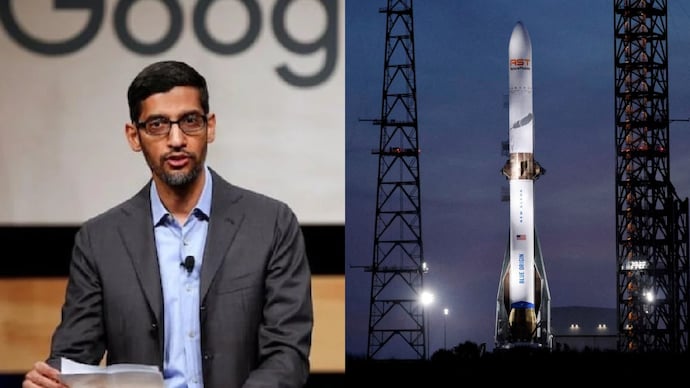
Google is joining forces with Jeff Bezos’ Blue Origin to set up data centres in space. On Thursday, the two companies announced that Google will be sending its AI computing satellites to space using Blue Origin rockets in early 2029.
As part of the deal, Blue Origin’s New Glenn rocket will carry several satellites equipped with Google’s Tensor Processing Units (TPUs) into sun-synchronous orbit. It is part of Project Suncatcher, Google’s long-term experiment to determine whether an interconnected network of solar-powered satellites can run AI systems in space.
Each satellite will have computing capacity roughly equal to a “rack of servers in a conventional data centre,” while its orbit will provide near-continuous access to sunlight. The companies did not disclose the agreement’s financial terms.
The launch, scheduled for the first quarter of 2029, would be the first “dedicated” one for Project Suncatcher. Last month, the company launched the first Project Suncatcher prototype aboard a SpaceX Falcon 9 rocket on a rideshare mission, where the Google satellite was one of 130 different payloads.
Why is Google building data centres in space?
Moving AI computing into orbit could reduce pressure on electricity grids, land and cooling systems on Earth as demand for computing capacity increases. Google’s long-term plan is to connect multiple satellites so they can work together on machine-learning tasks. “Project Suncatcher is a long-term moonshot to scale AI infrastructure in space by tapping into the abundant solar power in orbit,” said Travis Beals, senior director of Project Suncatcher at Google.
Google has already made some progress in Project Suncatcher. After the prototype was launched in October, Google sent a prompt from Earth to its Gemma 4 model running on the satellite and received an AI-generated haiku in response. The test showed that a TPU-equipped satellite could run an AI model in orbit and transmit its output to Earth.
The prototype is also testing whether the chips can withstand launch forces, radiation and extreme temperatures. Cooling remains a major challenge because heat from powerful chips must be released through pipes and panels without the airflow available on Earth. Radiation can damage electronics and corrupt data by changing binary values, a phenomenon known as a bit flip.
Google is not alone in exploring orbital data centres. Indian startups Pixxel and Sarvam AI are also working together on building space data centres. Meanwhile, SpaceX CEO Elon Musk has been one of the most vocal supporters of orbital data centres, claiming that the Earth will not have enough resources to meet demand for AI. “Global electricity demand for AI simply cannot be met with terrestrial solutions, even in the near term, without imposing hardship on communities and the environment,” he wrote on X earlier this year.
Instead, Elon Musk believes that AI data centres in space would allow for more compute power, without pushing the limits of energy production on Earth. He added, “In the long term, space-based AI is obviously the only way to scale.”
Though some, such as SoftBank CEO Masayoshi Son, have opposed orbital data centres. In June this year, the SoftBank chief said that the benefit of lower electricity costs of putting data centres in space would be outweighed by the total cost of running AI infrastructure when compared with hardware such as chips. A SpaceX Falcon 9 launch costs about $74 million, while expanding from one satellite to a large interconnected network would likely require years and substantial funding.