RBI MPC minutes reveal differences: More rate hikes or a pause?
The RBI raised the repo rate by 25 basis points to 5.50% earlier this month. It was the first-rate hike in nearly four years.

The repo rate is the interest rate at which the Reserve Bank of India lends money to commercial banks. It is a key tool used to control inflation and manage economic growth. Changes in the repo rate influence loan EMIs, deposit rates and overall borrowing costs. This topic page tracks repo rate decisions, policy signals, expert analysis and their impact on banks, markets and consumers.
Indian equity markets opened the week on a sharp negative note, with the Nifty breaching the crucial 23,000 mark and tumbling over 225 points amid fears of a potential Reserve Bank of India repo rate hike, rising crude prices, and sustained foreign institutional investor selling. The rupee weakened to 95.88 per US dollar, while MCX gold and silver also logged notable declines. Amid broad market weakness, banking and financial shares suffered significant cuts, while India VIX rallied over 11 percent, underscoring elevated market volatility. Separately, attention remained focused on Tata Sons as uncertainty continues regarding the schedule of its annual general meeting alongside decisions regarding the reappointment of N. Chandrasekaran and a potential listing. Additionally, scrutiny over the US H-1B visa program under the Trump administration presents emerging challenges for the domestic information technology sector.
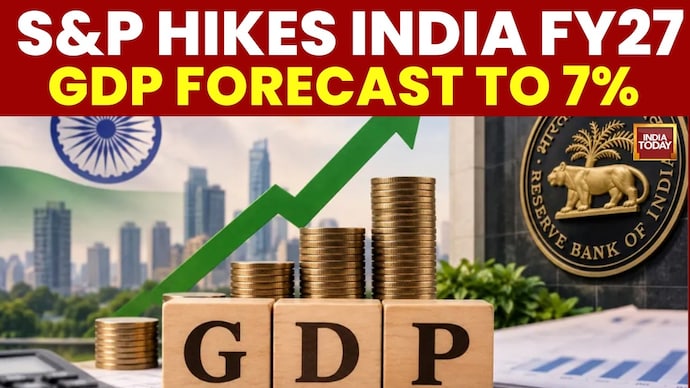
S&P Global Ratings has raised India's GDP growth forecast for financial year 2026-27 by 40 basis points to 7.0 per cent, revising its previous projection of 6.6 per cent upward. The rating agency cited robust industrial activity, healthy domestic consumption, strong goods exports, and accelerating government investment during the first quarter as primary drivers for the revision. Economists at S&P Global also project the Reserve Bank of India's rate-setting panel to hike the repo rate by 25 basis points to 5.50 per cent. The revised projection exceeds the Reserve Bank of India's estimate of 6.7 per cent and matches forecasts from agencies like Moody's. Analysts noted that India continues to maintain economic resilience despite external headwinds, including geopolitical conflicts in West Asia, the Russia-Ukraine war, global trade tariffs, and elevated crude oil prices.
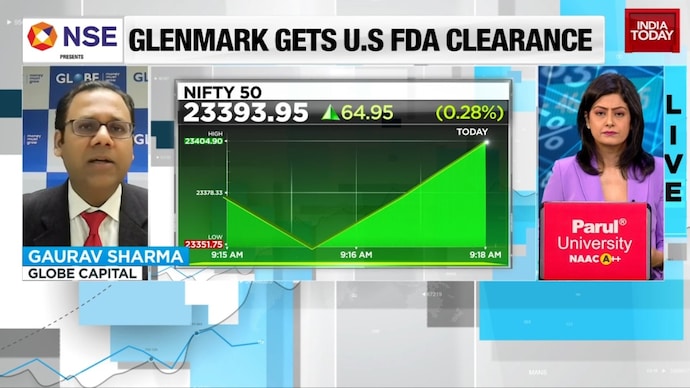
Indian equity markets opened on a steady note above 23,400 levels, supported by gains in financial and banking stocks alongside broad-based sector participation. S&P raised India's FY27 GDP growth forecast by 40 basis points to 7 per cent, citing robust industrial activity, strong exports, and government spending, while projecting a repo rate hike by the Reserve Bank of India. Meanwhile, the Supreme Court raised serious concerns over the significant gap between the price to retailer (PTR) and the maximum retail price (MRP) of essential and life-saving medicines, questioning why more drugs are not covered under the drug price control order. Pharma companies, represented in court, cited research and development alongside marketing expenses for the variance in pricing. Additionally, global geopolitical developments remained in focus as Donald Trump highlighted sweeping tariff authorities and expressed support for the India-Middle East-Europe Economic Corridor.
In an exclusive interview with India Today, Reserve Bank of India (RBI) Governor Sanjay Malhotra described the Indian economy as being in a 'Goldilocks period' characterised by high GDP growth of 8 per cent and low inflation.
On this Special Report, Business Today anchor Sakshi Batra discusses the market closing action as the Sensex falls over 200 points. Market expert Sudeep Bandyopadhyay, Group Chairman of Inditrade Capital, advises investors to 'stay away' from Indigo shares following the airline's flight disruptions and parliamentary summons. He instead recommends buying Vedanta to capitalise on the surge in silver prices, which hit a record ₹2.06 lakh per kg. The programme also features advice from a financial planner on fixed deposits and debt funds.
On this Special Report, the focus is on the Indian Rupee breaching the 90 mark against the US Dollar for the first time. The currency touched a low of 90.29 amid persistent dollar demand, prompting a debate on the economic implications. One expert argues that a depreciating rupee is not necessarily negative, suggesting it could aid export competitiveness and counter high tariffs, stating, 'we should not conflate a strong currency for a strong economy.' In contrast, another view highlights concerns over the 'fastest decline in the value of the rupee ever,' attributing the slide to a collapse in Foreign Direct Investment (FDI) and the absence of a trade deal. The programme explores whether this depreciation is a calibrated adjustment or a sign of underlying economic stress.
The Reserve Bank of India (RBI) has reduced the repo rate by 50 basis points to 5.5%, marking the third consecutive rate cut. This decision comes amid a sharp drop in retail inflation to 3.16% in April and strong economic growth of 7.4% in the January-March quarter. The move is expected to make loans cheaper, benefiting borrowers, especially home buyers. The RBI has also changed its stance from accommodative to neutral, indicating a data-driven approach moving forward.
Tahawwur Rana, accused in the 2008 Mumbai terror attacks, is being extradited from the U.S. and will arrive in India early tomorrow. He will be taken into custody by the NIA for initial interrogation and investigation, escorted by a special team of intelligence officials.
The Reserve Bank of India has cut the repo rate by 25 basis points to 6%, potentially leading to lower EMIs for home loans. The RBI has also lowered the GDP forecast for FY26 to 6.5% from the earlier 6.7%. The Monetary Policy Committee unanimously decided to change the stance from neutral to accommodative, hinting at possible further easing. The RBI Governor expressed concerns over global trade uncertainties and their potential impact on inflation and growth.
This marks the first rate cut since 2020 and the first policy decision under Governor Malhotra’s leadership.
The Reserve Bank of India (RBI) kept the Repo Rate unchanged at 6.5 per cent for the fourth consecutive policy, but red flagged volatility in food and fuel prices.
The Reserve Bank of India on Thursday left its key interest rate unchanged for a second straight policy meeting but signalled that it wants to see inflation moderate more while preserving the growth momentum.
The governor of the Reserve Bank of India (RBI) on Thursday said that the Monetary Policy Committee has unanimously decided to keep the benchmark repo rate unchanged at 6.5 per cent.
The Reserve Bank of India on Thursday hit the pause button and decided to keep key benchmark policy rate at 6.5 per cent even as inflation is trending above its tolerance level.
The Reserve Bank of India (RBI) today raised the repo rate by 25 basis points to 6.5 per cent on Wednesday from 6.25 per cent. The rate hike will directly impact borrowings and will make home loans costlier.
A 14-year-old girl was tortured and sexually assaulted for months by a couple in Gurugram.
The Reserve Bank of India (RBI) Governor Shaktikanta Das announced on Wednesday that the Monetary Policy Committee (MPC) has decided to hike the key interest rate by 25 basis points, taking the repo rate to 6.5 per cent.